
Prints just the plan, like a recipe card.
Last updated: November 23, 2026.
Maybe you used to exercise regularly, and then life happened: a busy job, an injury that healed, kids, a move. Now it has been months or years, and the hardest part is not the workout itself. It is knowing where to restart without overdoing it on day one and quitting again by day four.
This guide gives you a gentle two-week restart: short walks and one simple strength session, sized for the fitness you have now rather than the fitness you remember. It suits anyone returning after a break of months or longer. All you need is a sturdy chair, a wall, and comfortable shoes. The approach is deliberately modest, because the goal of the first two weeks is not intensity. It is momentum.
This guide sits in our Exercise and Workouts collection, where you will find the 4-week and 8-week beginner plans that make a natural next step. If eating habits slipped during the break too, our 7-day beginner reset meal plan is a kind companion, and there are more in the Diet Plans library.
Key takeaways
- Start at about half of what you think you can do. Finishing comfortably is what rebuilds the habit.
- The first two weeks are 10 to 20-minute walks and one or two gentle strength sessions.
- Some muscle stiffness in the first days is normal. Sharp pain is not, and it is a reason to stop.
- Judge this restart by consistency, not by how the workouts compare with your old ones.
Who this workout is for, and who should check with a doctor first
This restart is for adults who have been away from regular exercise for months or years and want a safe, structured way back. It is also suitable if you never quite got started and want a beginning that assumes nothing.
Check with your doctor before starting if your break involved an injury, surgery, pregnancy, or a new diagnosis, or if you have a heart condition, joint problems, or a history of chest pain. If your break was caused by illness or injury, your doctor or physical therapist may want to set your starting level, and their guidance comes first.
If you have a history of disordered eating, talk with a doctor or a registered dietitian before following any diet plan. For eating disorder support in the US, visit the National Alliance for Eating Disorders at allianceforeatingdisorders.com.
What you need
- A sturdy chair and a clear wall space
- Comfortable, supportive shoes that still fit well
- A safe, flat walking route, or space to walk in place at home
- A calendar to schedule sessions like appointments
- Patience with yourself, which matters more than any equipment
Warm-up (5 minutes)
Returning exercisers often skip the warm-up because they used to. Do not. Your joints and muscles need it more now, not less.
- Easy walking (2 minutes). Walk in place or around the room, starting very gently.
- Shoulder rolls and arm circles (1 minute). Slow rolls in both directions, then small arm circles.
- Side steps (1 minute). Step out and back in an easy rhythm.
- Easy knee lifts (1 minute). Lift one knee at a time to a comfortable height, holding the chair if you like.
The workout: your two-week restart
Week 1 has three walks of 10 to 15 minutes and one strength session. Week 2 has three walks of 15 to 20 minutes and two strength sessions. Keep every walk at a pace where you can talk in full sentences. The strength session below takes about 10 minutes and uses the easiest options first.
| Day | Week 1 | Week 2 |
|---|---|---|
| Monday | Walk 10 to 15 minutes | Walk 15 to 20 minutes |
| Tuesday | Rest or gentle stretching | Strength session |
| Wednesday | Walk 10 to 15 minutes | Walk 15 to 20 minutes |
| Thursday | Strength session | Rest or gentle stretching |
| Friday | Walk 10 to 15 minutes | Walk 15 to 20 minutes |
| Saturday | Rest, or an easy stroll | Strength session |
| Sunday | Rest | Rest |
Sit-to-stand from a chair
- Sit near the front of a sturdy chair, feet flat and hip width apart.
- Use your hands on your thighs or the chair arms to help you stand tall.
- Sit back down slowly. Aim for 6 to 8 reps in week 1.
Easier: Choose a higher chair or add a firm cushion to raise the seat.
Harder: Use your hands less, and cross your arms over your chest when that feels steady.
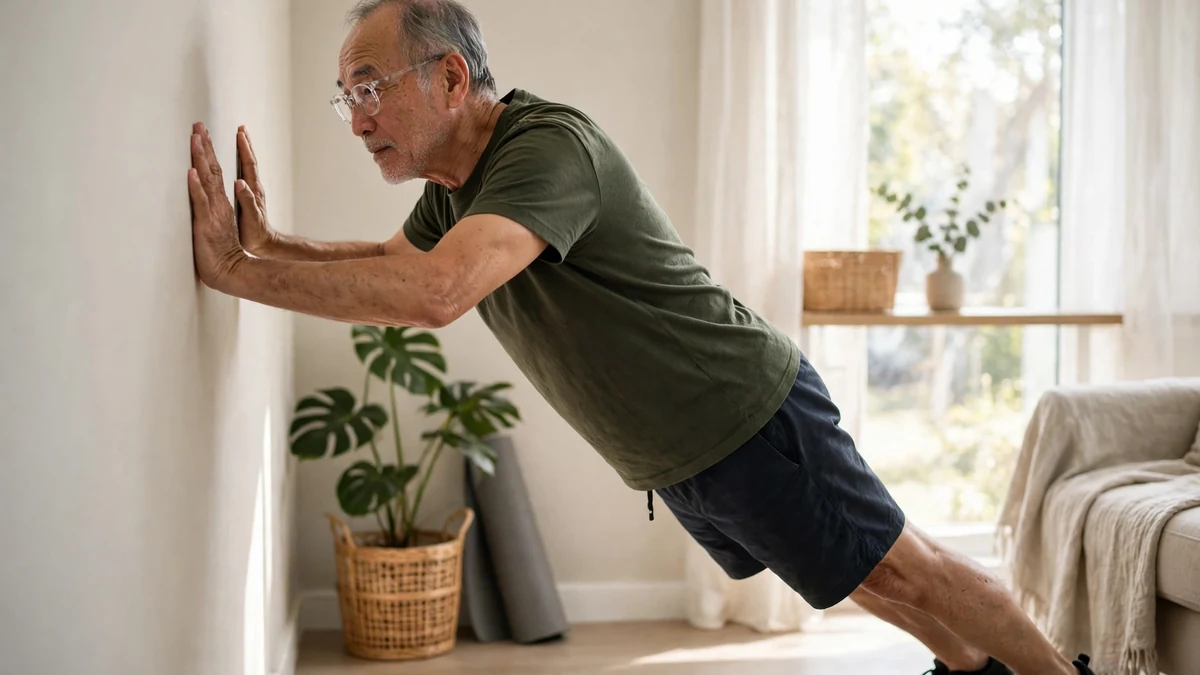
Wall push-ups
- Stand close to a wall and place your palms flat at shoulder height.
- Bend your elbows to bring your chest toward the wall, keeping your body straight.
- Press back gently. Aim for 6 to 8 reps.
Easier: Stand even closer to the wall so you lean very little.
Harder: Step your feet back a few inches.
March in place
- Stand tall beside the chair, holding it if you want support.
- March slowly for 1 minute, lifting your knees only a few inches.
- Breathe steadily and keep your chest lifted.
Easier: March seated in the chair, lifting one foot at a time.
Harder: Lift your knees a little higher and swing your arms.
Glute bridge or seated glute squeeze
- On the floor: lie on your back with knees bent, press through your heels, and lift your hips partway. Lower slowly. Aim for 8 reps.
- Seated alternative: sit tall, press both feet into the floor, squeeze your glutes for five seconds, and release. Repeat 8 times.
Easier: Use the seated version, or lift your hips only a small amount.
Harder: Lift to a full straight line from shoulders to knees and hold for two seconds.
Standing calf raises
- Stand behind the chair with both hands resting on the back.
- Rise onto the balls of your feet a small amount, pause, and lower. Aim for 8 reps.
Easier: Keep the lift very small, or do the exercise seated.
Harder: Slow the movement down and pause longer at the top.
Cool-down and stretching (5 minutes)
- Slow walking (1 minute). Let your pace and breathing ease down.
- Calf stretch (30 seconds each side). Step one foot back with the heel down and lean gently toward a wall.
- Standing quad stretch (30 seconds each side). Hold the chair and bring one heel toward your glute.
- Chest opener (30 seconds). Clasp your hands behind your back and open your chest.
- Slow breathing (1 minute). Breathe in for four counts and out for four counts. Finishing a session feeling like you could do a little more is exactly right at this stage.
How to progress after the restart
After two weeks of comfortable sessions, you have a base to build on. Sensible next steps, one at a time:
- Weeks 3 to 4: Add 5 minutes to each walk and use the standard versions of the strength exercises, with a second round of the circuit when you feel ready.
- Weeks 5 onward: Move into a structured plan, such as a 4-week beginner plan, which keeps the same rhythm and builds toward longer walks and two weekly strength days.
- Ongoing: Work gradually toward the general pattern in the Physical Activity Guidelines for Americans: at least 150 minutes of moderate-intensity aerobic activity each week, plus muscle-strengthening activities on 2 or more days a week. There is no deadline for getting there.
Safety notes
Stop and rest if you feel pain, dizziness, nausea, or chest pain, and seek medical help right away for chest pain or trouble breathing. Talk with your doctor before starting if your break involved a health condition, injury, or surgery, or if you have been inactive for a long time. Mild muscle stiffness a day or two after a new session is common when restarting; it should ease as the week goes on. Sharp joint pain is different: never exercise through it. Good form over speed, always, and keep the first sessions easier than you think necessary. Your confidence is a muscle too, and early wins rebuild it.
Common mistakes
- Starting where you left off. Your old routine was built for a fitter version of you; this one is built for today.
- Doing one huge session to “make up for lost time,” then being too sore to continue.
- Comparing yourself with your past performance, or with anyone else.
- Skipping the warm-up and cool-down because the session is short.
- Waiting to feel motivated before scheduling sessions. Put them on the calendar; motivation usually follows action.
- Quitting after a missed day. A restart with a gap in it is still a restart.
Pair it with a diet plan
If your eating habits also drifted during the break, change one thing at a time rather than everything at once. Our 7-day beginner reset meal plan keeps meals simple while you rebuild your routine. For an estimate of your daily calorie needs, try the free Calorie Calculator.
Frequently asked questions
How much fitness do I lose during a long break?
Some fitness fades with inactivity, and how much depends on the length of the break and what you were doing before. The encouraging part is that returning exercisers usually regain ground steadily once they start again, especially with a plan sized for their current level.
Is it normal to be sore after the first sessions?
Mild muscle stiffness or tenderness a day or two after new exercise is common when restarting, particularly in the legs. Gentle walking and stretching usually help it ease. Pain that is sharp, in a joint, or getting worse instead of better is a reason to rest and, if it continues, to check with your doctor.
How do I know if I am starting too hard?
If you cannot talk in full sentences while walking, if a session leaves you exhausted for the rest of the day, or if you dread the next session because the last one was miserable, ease off. The right starting level feels almost too easy, and that is deliberate.
What if I have to take another break, for illness or travel?
Resume a step below where you stopped. After a week or two away, repeat your last comfortable week. After a longer break, restart this two-week plan. Coming back is a skill you get better at each time.
When can I go back to my old workouts?
When the restart sessions and a few weeks of gradual building feel comfortable, you can start mixing in familiar workouts at reduced length or intensity. Let your current fitness lead, and keep the warm-ups, cool-downs, and rest days that this plan taught you.
Sources and further reading
- Physical Activity Guidelines for Americans, US Department of Health and Human Services: health.gov
- Physical activity basics for adults, Centers for Disease Control and Prevention: cdc.gov
- Exercise and physical activity guidance, MedlinePlus: medlineplus.gov
This article is for general educational purposes only and is not medical, nutrition, or fitness advice. Talk with your doctor or a registered dietitian before changing your diet or starting an exercise program.