Last updated: November 23, 2026.
It is mid-afternoon, lunch feels like a long time ago, and dinner is still hours away. You are hungry, a little tired, and the easiest food nearby is whatever happens to be in the break room or the pantry. If that moment sounds familiar, a planned snack can help.
The simplest way to build a snack that keeps you full is to pair two or three building blocks instead of relying on one food alone. Combine a source of protein or fiber with produce, whole grains, or a healthy fat, add something to drink, and keep the portion in a range that fills the gap without replacing your next meal.
A snack does not need to be fancy, packaged in a special way, or perfectly timed. It just needs to work for your day, your hunger, and the foods you actually enjoy eating.
This guide sits in our Nutrition Basics library, where we explain everyday eating skills in plain language. If you want to see snacks worked into a full day of meals, look at our 7-day 1,500-calorie meal plan for women, and browse the full collection in the Diet Plans hub.
Key takeaways
- A filling snack usually pairs protein or fiber with another food group, rather than relying on a single item.
- Produce plus protein is a reliable starting point, such as fruit with yogurt or vegetables with hummus.
- Planning ahead, even loosely, makes a satisfying snack easier to reach for than whatever is closest.
- Portion awareness matters, but a snack is meant to satisfy you, not to be as small as possible.
- Pay attention to thirst, timing, and your own hunger signals when you decide whether to snack at all.
Why one food alone often falls short
Many common snack foods are mostly one thing. A handful of crackers is mostly refined grain. A piece of candy is mostly sugar. A small bag of chips is mostly fat and salt. Any of these can taste good, and none of them needs to be off limits, but on their own they may not keep you full for long.
Protein and fiber tend to digest more slowly than foods made mostly of refined starch or sugar, so snacks that include them often hold you over better until the next meal. Pairing foods also adds variety in flavor and texture, which can make a modest snack feel more satisfying.
A simple pairing formula
Try thinking in pairs. Start with a protein food or a fiber-rich food, then add a second item for flavor, crunch, or freshness. Greek yogurt with berries, an apple with peanut butter, cheese with whole grain crackers, or carrots with hummus all follow the same basic pattern.
You do not need to hit every food group at every snack. One thoughtful pairing is enough, and the best choice is the one you will enjoy and can repeat on a busy day.
The building blocks of a filling snack
The table below groups common snack foods by what they mainly contribute. Use it to mix and match two or three items rather than to grade foods. Every food listed can fit into a balanced eating pattern.
| Building block | What it adds | Everyday examples |
|---|---|---|
| Protein | Helps a snack feel substantial | Greek yogurt, cottage cheese, hard-boiled egg, edamame, milk |
| Fiber-rich foods | Adds bulk and slows digestion | Whole fruit, vegetables, popcorn, whole grain crackers, beans |
| Healthy fats | Adds flavor and staying power in small amounts | Peanut butter, nuts, seeds, avocado, hummus |
| Fresh produce | Adds crunch, color, and hydration | Apple slices, berries, cucumber, bell pepper strips, cherry tomatoes |
Snacks built from the blocks
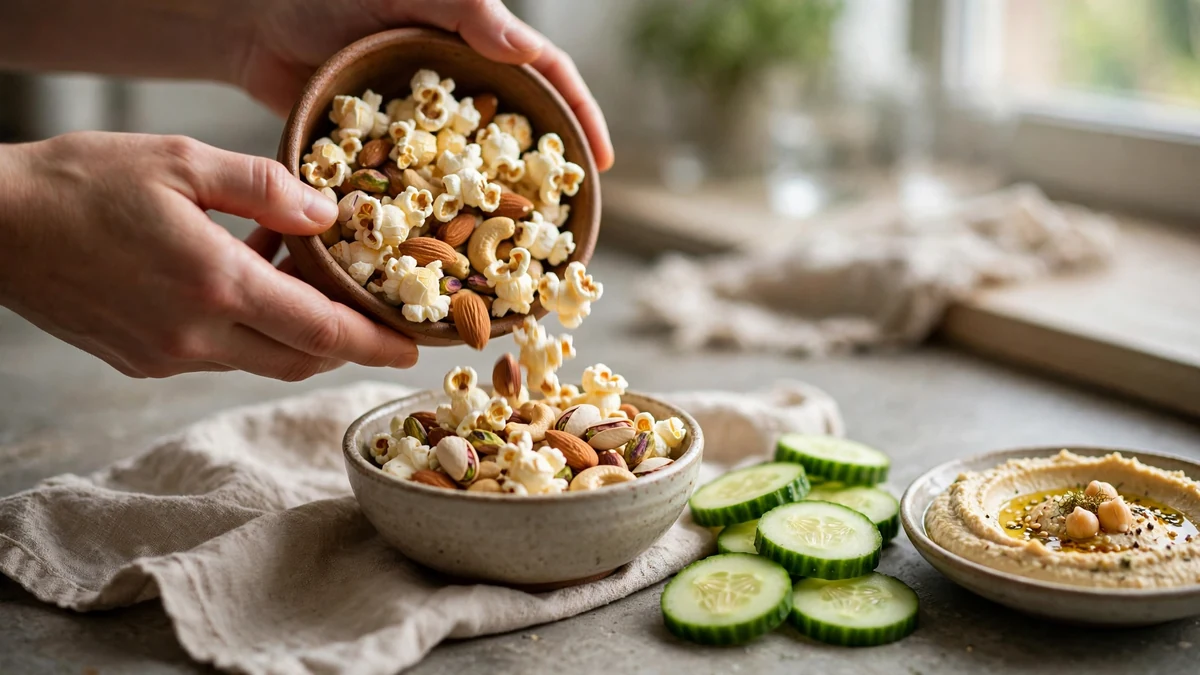
Here are a few combinations built from the table. A small bowl of cottage cheese with peach slices pairs protein with fruit. Popcorn with a small handful of nuts pairs a fiber-rich grain with healthy fat. Whole grain crackers with hummus and cucumber slices cover three blocks at once.
If you follow a higher protein eating pattern, our 7-day high-protein meal plan for beginners shows how protein foods can be spread across meals and snacks through the day.
Watch the easy-to-overpour foods
Nuts, seeds, nut butters, cheese, and granola are nutritious and satisfying, and they are also easy to eat in larger amounts than you intended, especially straight from a large container. Serving yourself a small bowl or a single portion on a plate is a simple way to enjoy them and still notice when you have had enough.
Planning snacks that fit your real day
The best snack plan is a light one. You do not need a different snack for every day of the week. Keeping two or three reliable options stocked at home, at work, or in a bag covers most situations.
Stock the basics
Choose a short list you like: one or two fruits, a vegetable you enjoy raw, a protein you can grab without cooking, and a shelf-stable option such as nuts or popcorn. When those basics are on hand, building a snack takes a minute instead of a decision.
Perishable snacks travel well in a small insulated bag with an ice pack. Shelf-stable options are useful for a desk drawer, a car console, or a gym bag, as long as they are stored safely and checked for freshness.
Time it around your meals
There is no single correct snack schedule. Many people find a snack useful in a long gap between meals, before a workout, or during a long commute. Others feel better eating three meals without snacks. Both patterns can work.
If you want a rough sense of how snacks fit into your overall day, our Calorie Calculator can help you estimate your daily needs so you can judge what size of snack makes sense alongside your meals.
Pause before you snack
Sometimes the urge to eat is really thirst, tiredness, boredom, or habit, such as always eating while watching television. A short pause helps you sort that out. Have a glass of water, wait a few minutes, and ask whether you are hungry enough that a balanced snack sounds good.
If the answer is yes, eat the snack and enjoy it. Sitting down, putting food on a plate, and eating without a screen when you can makes it easier to notice flavor and fullness.
Common questions or misconceptions
Snacking always leads to weight gain. Snacking itself is neither helpful nor harmful on its own. What matters is the overall pattern: what you eat across the whole day, how hungry you are, and whether snacks fill a real gap or add eating on top of meals out of habit.
A snack has to be a special snack product. Bars and packaged snack foods can be convenient, and some are fine choices. Ordinary foods such as fruit, yogurt, cheese, eggs, and leftovers work just as well and often cost less.
You should never snack after dinner. There is no universal cutoff time that applies to everyone. If you are genuinely hungry in the evening, a modest, balanced snack is a reasonable response. If evening eating is mostly habit, changing the routine may help more than changing the clock.
Low-calorie is always better. A very small snack that leaves you hungry can backfire if it leads to arriving at dinner ravenous. A snack that actually satisfies you, even if it is not the lowest calorie option, often serves you better.
Who should talk with a professional first
Talk with your doctor or a registered dietitian before changing your eating pattern if you have a medical condition affected by diet, take medication that interacts with food or meal timing, are pregnant, or are planning snacks for a child with specific health needs. A professional can help you adapt general ideas to your situation.
If you have a history of disordered eating, talk with a doctor or a registered dietitian before following any diet plan. For eating disorder support in the US, visit the National Alliance for Eating Disorders at allianceforeatingdisorders.com.
Frequently asked questions
How big should a snack be?
Big enough to take the edge off your hunger and carry you to the next meal, and small enough that you are still hungry for that meal. For many adults that is a modest portion, such as a piece of fruit with a small handful of nuts or a single serving of yogurt with berries, but your needs depend on your meals, activity, and body size.
What is a good snack before a workout?
Many people do well with something light and easy to digest, such as a banana, a slice of toast, or a small yogurt, eaten with enough time before exercise that they feel comfortable. If your workout is short and you ate a meal recently, you may not need a snack at all.
Are protein bars a good everyday snack?
They can be a practical backup when fresh food is not available, and quality varies a lot between products. Check the label for protein, fiber, and added sugar, and treat bars as one option among many rather than the default. Whole foods give you the same building blocks with more variety.
What can I snack on if I want something crunchy?
Raw vegetables with hummus or a yogurt-based dip, popcorn, apple slices, roasted chickpeas, and whole grain crackers all give you crunch. Pairing a crunchy food with a protein or a dip usually makes it more filling than eating it alone.
Should I snack if I am not hungry?
Usually not. Snacking works best as a response to hunger or as a planned bridge during a long gap between meals. If you notice you are eating out of boredom or stress most days, that pattern is worth a gentle look, and a doctor, dietitian, or counselor can help if it feels hard to change.
Sources and further reading
- MyPlate (myplate.gov) for food group basics and everyday meal building ideas.
- Dietary Guidelines for Americans (dietaryguidelines.gov) for national guidance on balanced eating patterns.
- Academy of Nutrition and Dietetics (eatright.org) for practical nutrition information from registered dietitians.
- USDA FoodData Central (fdc.nal.usda.gov) for nutrient details on specific foods.
This article is for general educational purposes only and is not medical, nutrition, or fitness advice. Talk with your doctor or a registered dietitian before changing your diet or starting an exercise program.