Last updated: November 23, 2026.
Search for home workout equipment and you will be offered everything from a simple mat to a machine the size of a wardrobe. It is easy to overspend, and just as easy to buy the impressive thing while skipping the useful one.
The honest answer is that most beginners need very little. A small set of versatile basics covers walking, bodyweight strength, and gentle cardio at home, and you can add pieces later only when a real gap appears. This guide explains the main types of home equipment, what each is actually for, and how to build a setup in a sensible order.
Where this guide fits
This article is part of our Tools and Calculators collection. It pairs with Choosing a Gym Membership if you are weighing home training against joining somewhere, and our Resistance Band Workout for Beginners shows what the cheapest item on this list can do. The rest of the library is in Diet Plans.
Key takeaways
- Start with the floor: a mat, supportive shoes, and your own bodyweight cover a surprising amount of training.
- Resistance bands and one pair of dumbbells are the most versatile strength tools per dollar and per square foot.
- Buy for the workouts you will actually do this month, not for an imagined future routine.
- Cardio machines are the biggest and most expensive category. Walking outdoors or in place is a free alternative that works.
- Stability and safety matter more than features: sturdy, simple equipment used often beats complex equipment used rarely.
The foundation: space, floor, and footwear
Your training space
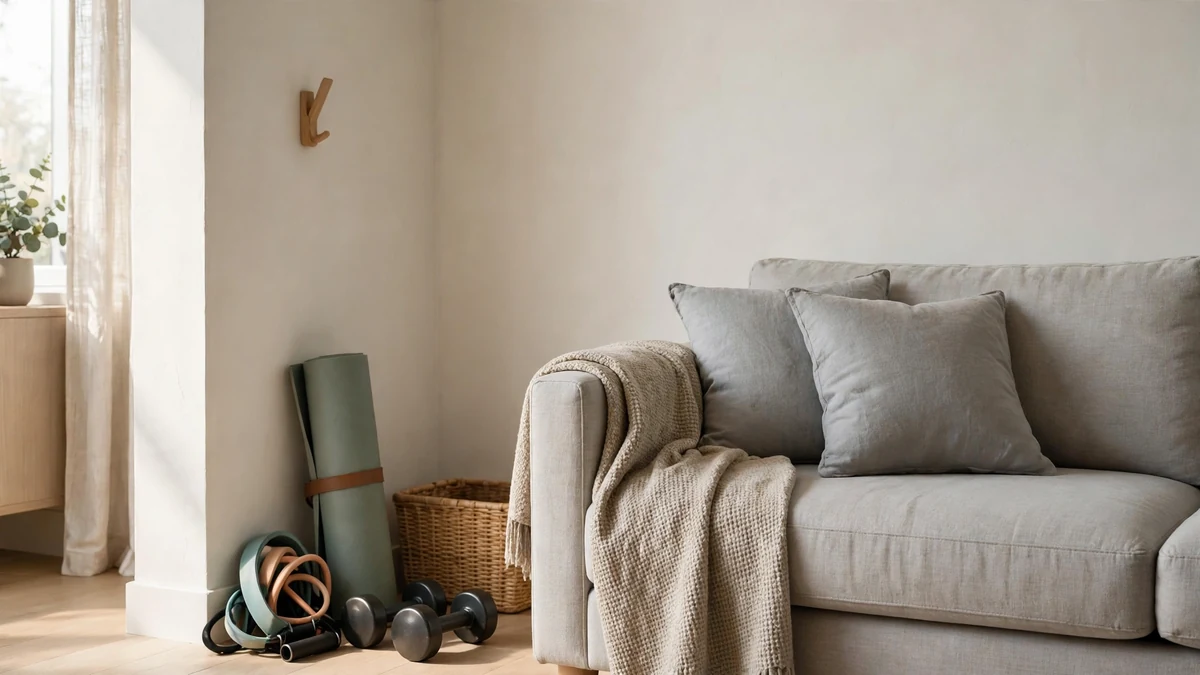
You need roughly the footprint of a yoga mat, with a little margin on each side, and a floor that will not slip. A rug or an exercise mat protects both the floor and your knees, elbows, and back during floor work. If space is tight, choose equipment that stores in a closet or under a bed; gear that must be dragged out from behind furniture quietly discourages workouts.
Shoes and clothing
Supportive shoes with a firm sole are the right default for standing strength work and indoor walking. For gentle floor routines, bare feet on a mat are fine for many people. Comfortable clothes you can move in are the only other requirement. None of this needs to be specialized or new.
Strength basics, compared by type
Resistance bands
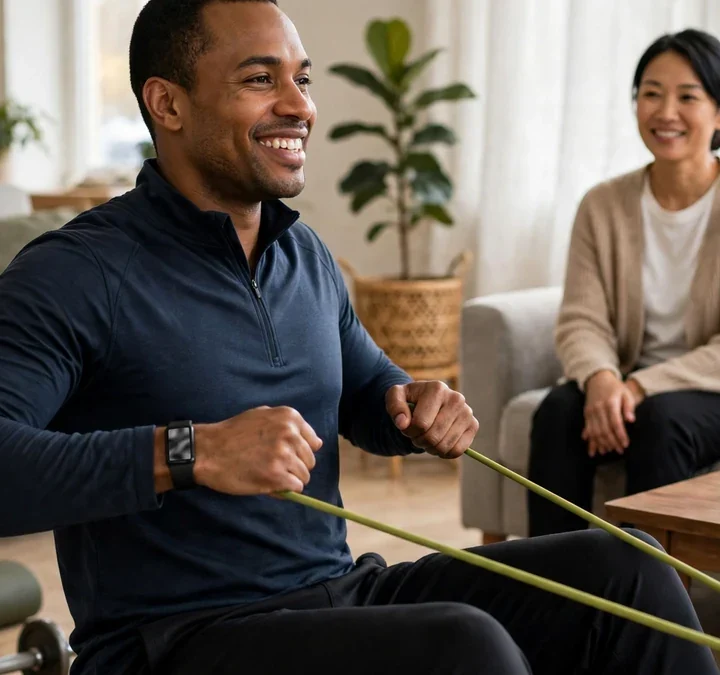
Bands come as flat therapy bands, loop bands, and long bands with handles. They provide resistance that grows as you stretch them, store in a drawer, and travel anywhere. They suit beginners especially well because changing difficulty is as simple as stepping closer to the anchor or holding the band differently. Check bands for tears before each use and anchor them only to doors or furniture that cannot move.
Dumbbells
A single pair of light dumbbells covers presses, rows, squats, hinges, and carries. Fixed-weight pairs are simple and durable; adjustable dumbbells replace several pairs in one footprint but cost more and take a moment to change between exercises. Many beginners start around 2 to 5 pounds and add a heavier pair later, only if the first pair genuinely becomes too light.
Your own bodyweight
Push-ups against a wall or counter, chair squats, glute bridges, and planks need no equipment at all and scale from very gentle to genuinely challenging. A sturdy chair or couch edge extends the list further. For the first month of strength training, bodyweight plus bands is a complete toolkit for most people.
Nice to have later
A kettlebell, a step platform, or a suspension trainer can add variety once you have a routine you enjoy. Treat these as later additions driven by a specific workout you want to do, not as starter purchases. If a piece would not be used in your next four workouts, it is not a starter purchase.
| Equipment type | Best for | Storage |
|---|---|---|
| Resistance bands | Full-body strength, travel | A drawer |
| One pair of dumbbells | Classic strength moves | A corner or closet |
| Mat and sturdy chair | Floor work, support, balance | Rolled or folded away |
| Cardio machine | Indoor walking or cycling | A dedicated space |
Cardio at home: options and alternatives
Walking, the free default
Walking needs no purchase at all. Outdoor routes, indoor walking routines, and marching in place during television time all count. For many beginners, walking plus two strength sessions a week is the entire program, and it works. Consider a machine only if weather, safety, or schedule genuinely blocks walking most days.
Treadmills and walking pads
Treadmills offer controlled indoor walking at any hour, and smaller walking pads fit apartments and under-desk use. Check that the belt length suits your stride, that the machine feels stable at your walking speed, and that you have a realistic place for it to live. A machine folded against a wall it never leaves is a common and avoidable outcome.
Stationary bikes and other machines
Stationary bikes are kind to knees and quiet enough for apartments, and they pair well with reading or television. Rowers and ellipticals train more of the body but take more space and coordination. Try any large machine somewhere first, at a gym or a friend’s home, because comfort over twenty minutes decides whether you will use it for twenty weeks.
A sensible buying order
If you are starting from nothing, this sequence works for most people. First, the mat and shoes you train in. Second, a set of resistance bands in a few tensions. Third, one pair of dumbbells once bands alone start to feel easy on the bigger movements. Fourth, and only if your routine proves it is missing something, one larger piece chosen for a specific workout you already know you enjoy. Each step is earned by use, not by optimism, and the total footprint stays small enough for almost any home.
Who should talk with a professional first
If you have joint problems, balance concerns, a heart condition, or you have been inactive for a long time, talk with your doctor before starting a home routine, and consider one session with a physical therapist or qualified trainer to check your form on the basics.
If you have a history of disordered eating, talk with a doctor or a registered dietitian before following any diet plan. For eating disorder support in the US, visit the National Alliance for Eating Disorders at allianceforeatingdisorders.com.
Frequently asked questions
What should I buy first if my budget is small?
A mat and a set of resistance bands. Together they cover floor work, stretching, and a full-body strength routine, and they store almost anywhere. Add one pair of dumbbells next if you find yourself wanting more load for squats, rows, and presses.
Are adjustable dumbbells worth it?
They can be, if you will train at home for a long time and space is tight, because one adjustable set replaces many pairs. If you are unsure you will stick with strength training, a single fixed pair is the lower-risk start, and you can upgrade later.
Do I need a cardio machine to lose weight?
No. Weight loss is driven mainly by your overall eating pattern and total activity. Walking, dancing in your kitchen, and active chores all count as activity. A machine is a convenience for people whose circumstances block those options, not a requirement.
Is used equipment a good idea?
Often, yes, especially simple items like dumbbells and benches that have little to go wrong. Inspect anything used for cracks, rust, frayed bands, or wobbling parts, and be more cautious with complex machines whose repair history you cannot know.
How do I keep equipment from becoming clutter?
Buy in the order you will use things, store each item where the workout happens, and give new purchases a trial period in your routine. If a piece has not been touched in a month, that is information: sell it, give it away, and put the space back to work.
Sources and further reading
- Physical Activity Guidelines for Americans, US Department of Health and Human Services: health.gov
- American Heart Association, strength and resistance training basics: heart.org
- MedlinePlus, exercise and physical fitness: medlineplus.gov
This article is for general educational purposes only and is not medical, nutrition, or fitness advice. Talk with your doctor or a registered dietitian before changing your diet or starting an exercise program.