Last updated: November 23, 2026.
You serve yourself a bowl of pasta, a piece of chicken, or a handful of nuts, and you wonder whether that amount is about right. Without a scale or a measuring cup in front of you, it is hard to tell, and guessing can leave you either still hungry or uncomfortably full.
The practical answer is to use your own hand as a rough guide. Your palm, fist, cupped hand, and thumb are always with you, and they scale roughly with your body size, so they can help you estimate portions of common foods at home, at a restaurant, or at someone else’s table.
These comparisons are general guides, not precise measurements. They are meant to build awareness and confidence, not to turn every meal into a calculation.
This guide is part of our Nutrition Basics library, where we cover everyday skills for balanced eating. To see portions in the context of a full day, look at our 7-day 1,500-calorie meal plan for women, and explore more in the Diet Plans hub.
Key takeaways
- Your hand is a portable, rough portion guide: palm for protein, fist for vegetables and grains, thumb for fats.
- Hand comparisons are estimates, not precise measurements, and they work best as a starting point you adjust over time.
- A portion is what you serve yourself, while a serving is the amount listed on a package label, and the two often differ.
- Plate setup, serving style, and eating slowly all influence how much feels like enough.
- If a food matters for a medical reason, a scale, measuring tools, or a dietitian will give you more accuracy than visual guides.
Portion versus serving: a useful distinction
A serving size is a standard amount set on a food package label or in dietary guidance. A portion is the amount you actually put on your plate, which may be smaller or larger than one serving. Neither word tells you what you personally should eat at a given meal.
Knowing the difference helps when you read a label. If a package lists nutrition for one serving and your bowl holds about two servings, the label numbers apply twice. That is simple awareness, not a rule that your portion must match the label.
Why visual guides help
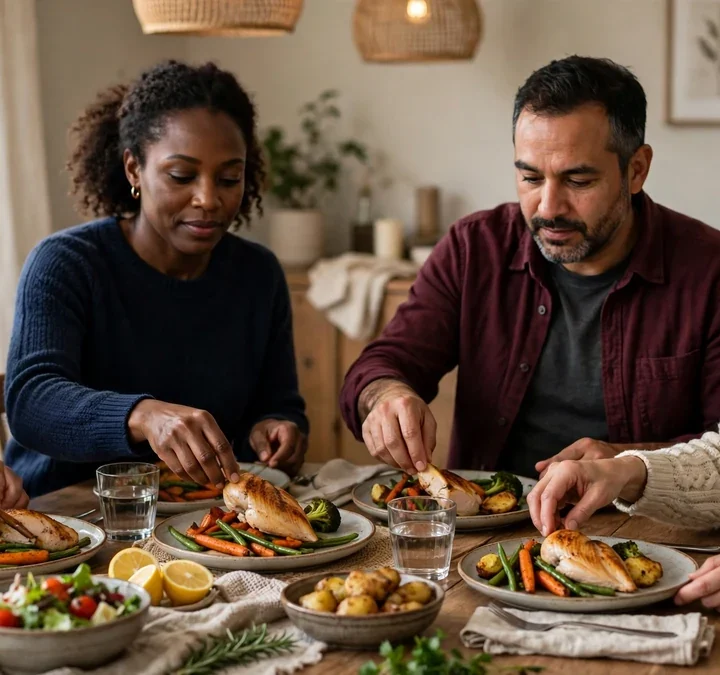
Most meals are not eaten next to a kitchen scale. Visual guides give you a quick reference in real settings: a cafeteria line, a family dinner, a restaurant plate, or a picnic. Over time, using them builds a steadier sense of amounts, so estimating gets easier and less stressful.
The hand guide to everyday portions
The table below lists the comparisons people use most often. Treat each one as an approximation. Hands differ, foods are shaped differently, and that is fine. The goal is a reasonable ballpark, not an exact weight.
| Visual guide | Roughly matches | Commonly used for |
|---|---|---|
| Palm (no fingers) | About 3 to 4 ounces cooked | Chicken, fish, meat, tofu portions |
| Deck of cards | About 3 ounces | A piece of meat or fish when a hand is hard to compare |
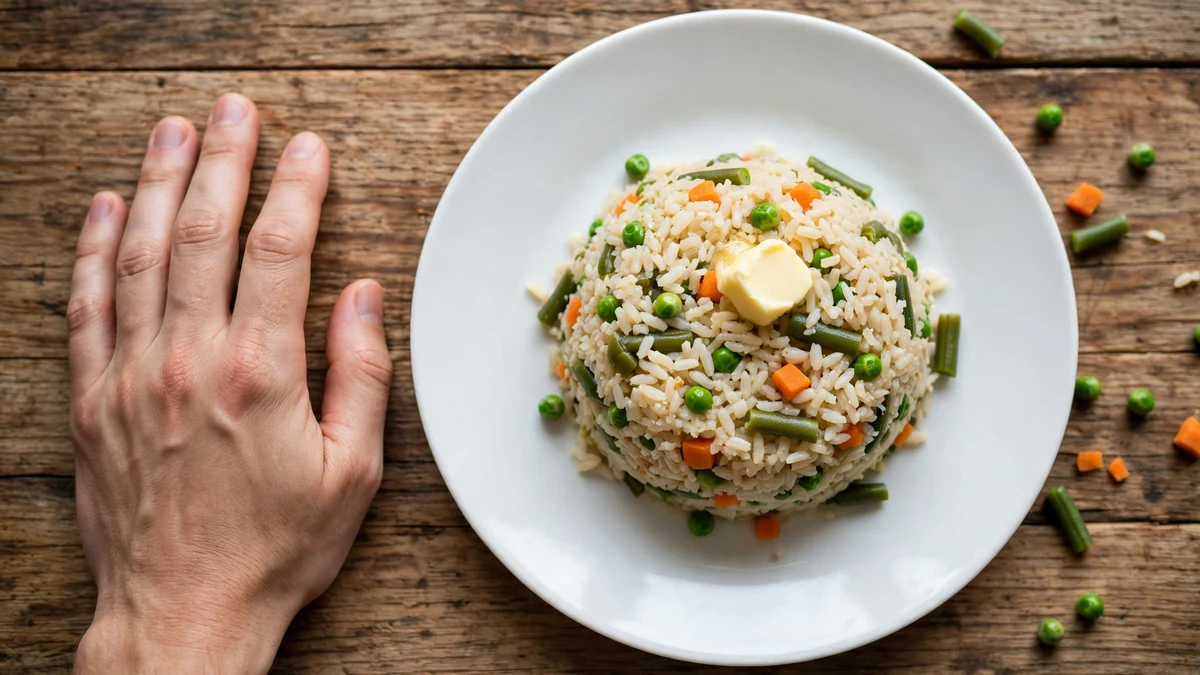
| Fist | About 1 cup | Cooked rice or pasta, cereal, vegetables, fruit |
| Cupped hand | About half a cup | Grains, beans, chopped fruit, snack foods |
| Thumb (tip to base) | About 1 tablespoon | Peanut butter, butter, oils, mayonnaise |
| Thumb tip | About 1 teaspoon | Small amounts of butter, oil, or sugar |
Protein foods
For cooked chicken, fish, meat, or tofu, a piece about the size and thickness of your palm is a common reference point. Many adults eat one palm-sized portion at a meal, and some, especially larger or more active people, eat more. Let your hunger, your overall day, and any guidance from your care team shape the final amount.
Grains, vegetables, and fruit
A fist is a handy stand-in for about a cup, which works for cooked rice, pasta, cereal, and many vegetables and fruits. A cupped hand, roughly half a cup, is useful for beans, chopped fruit, and foods that are easy to keep adding, such as granola or trail mix.
For leafy greens, portions can comfortably be larger, since a big handful of salad takes up space without adding much else. For dried fruit and nuts, which pack a lot into a small volume, the cupped hand or smaller is a more useful guide.
Fats and spreads
Fats add flavor and help a meal satisfy, and they are also the foods where a little visually goes a long way. A thumb-sized amount is a rough guide for a tablespoon of peanut butter, butter, or oil. Using your thumb helps you notice amounts that are otherwise easy to pour or spread without thinking.
Putting the guide to work on a real plate
A simple way to build a plate is to start with vegetables for a large share of the space, add a palm-sized protein, add a fist-sized portion of grains or starchy vegetables, and finish with a thumb or two of fat in cooking or dressing. This is a flexible pattern, not a formula, and many healthy meals look quite different.
If you want to connect portions to your overall daily needs, our Calorie Calculator offers a starting estimate. Pairing that estimate with a plan such as our 7-day high-protein meal plan for beginners can show how portions are distributed across a day in practice.
At restaurants and shared meals
Restaurant portions are often larger than what most people would serve at home. You can use the hand guide to decide how much to eat now and how much to save for later, ask for dressing or sauce on the side, or share a large dish. None of this has to be rigid. Enjoying a meal out matters too.
At buffets and family-style meals, serving yourself once, sitting down, and eating slowly before deciding on more gives your fullness signals time to catch up.
When to measure for real
Visual guides are not the right tool for every job. If you are learning a new eating pattern, checking the actual amount of a food you eat often, such as cereal, pasta, or nut butter, with a cup or scale for a few days can teach your eye a lot. After that short check, most people go back to estimating.
Movement matters alongside portions, and a gentle routine such as our indoor walking workout for beginners is one way many people add activity without special equipment. Browse more options in the Exercise and Workouts category.
Common questions or misconceptions
Hand guides are exact. They are not. They are rough guides that vary with hand size, food shape, and cooking method. Their value is consistency and convenience, not precision.
Everyone should eat the same portions. Needs differ with body size, age, activity, health, and hunger on a given day. A guide that helps you notice amounts should still leave room for eating more on a hungry, active day and less when you are not very hungry.
Bigger portions of vegetables are a problem. For most people, generous portions of non-starchy vegetables are a helpful part of a meal, adding volume and fiber. What is added to them, such as large amounts of dressing or butter, is usually the part worth a second look.
Children should use adult portions. Children have smaller hands, which is part of why the hand guide is appealing for families, but children also have their own growth needs. For specific questions about a child’s eating, a pediatrician or dietitian is the right source.
Who should talk with a professional first
If you manage a condition such as diabetes, kidney disease, or a heart condition, or if you take medication affected by meal size or timing, ask your doctor or a registered dietitian how portions should look for you. Visual guides are general education and do not replace personal guidance.
If you have a history of disordered eating, talk with a doctor or a registered dietitian before following any diet plan. For eating disorder support in the US, visit the National Alliance for Eating Disorders at allianceforeatingdisorders.com.
Frequently asked questions
How accurate is the palm method for meat and fish?
It is a reasonable estimate for many cuts, roughly matching a few ounces of cooked protein, but thickness and shape make a real difference. If you need accuracy for a medical or training reason, weighing food for a short period will give you a firmer sense of your usual portions.
What portion guide works for cheese?
A common comparison is two thumbs, or a matchbox-sized piece, for a portion of hard cheese. Pre-sliced or grated cheese can also be checked against the package label, which lists the weight or volume for one serving.
How do I judge portions of mixed dishes like casseroles or stew?
Use the fist guide for the total amount, roughly a cup at a time, and think about what is in the dish. A stew full of vegetables and beans is different from a creamy casserole, even at the same volume, so consider ingredients as well as size, and serve more after you have finished the first portion if you are still hungry.
Should I use smaller plates?
Many people find that a smaller plate makes a moderate portion look and feel more satisfying, while a very large plate can make the same amount look small. It is a simple environmental cue worth trying, though it is optional and does not replace paying attention to hunger and fullness.
What if I am still hungry after a guide-sized portion?
Eat more. The guides are starting points, not limits. Add vegetables, protein, or another portion of what you are eating, and notice over several meals whether your usual pattern leaves you satisfied. Persistent hunger is useful information to discuss with a dietitian.
Sources and further reading
- MyPlate (myplate.gov) for food groups and plate-based portion guidance.
- National Heart, Lung, and Blood Institute (nhlbi.nih.gov) for heart-healthy eating and portion resources.
- MedlinePlus (medlineplus.gov) for plain-language nutrition and health information.
- USDA FoodData Central (fdc.nal.usda.gov) for nutrient details and standard serving information for specific foods.
This article is for general educational purposes only and is not medical, nutrition, or fitness advice. Talk with your doctor or a registered dietitian before changing your diet or starting an exercise program.