Prints just the plan, like a recipe card.
Last updated: November 23, 2026.
A resistance band costs little, fits in a drawer, and works in the smallest apartment. If space or budget rules out dumbbells, a band may be the most practical way to start strength training at home.
This resistance band workout trains your legs, back, chest, shoulders, and arms with six band moves, each with a no-anchor option where possible. It suits healthy beginners and takes about 25 minutes. You need one or two long resistance bands with handles or a loop band set, plus a sturdy door if you want to use the anchor variations.
This workout sits in our Exercise and Workouts collection, next to bodyweight routines that need no gear at all. It pairs well with the 7-Day Meal Plan for Apartment Cooks With No Oven from our Diet Plans library, another small-space friendly plan.
Key takeaways
- Bands get harder as they stretch, so slow reps and a pause at full stretch make light bands effective.
- Stepping further from the anchor, or using a thicker band, increases resistance.
- Check your band for nicks or tears before every session; a snapped band is the main band injury.
- Two or three sessions a week covers all the major muscle groups.
Who this workout is for, and who should check with a doctor first
This workout is for adults who are new to strength training and want low-cost, low-space equipment. It is also a good travel option, since a band fits in a suitcase and every move here can be done in a hotel room or small living room.
Check with your doctor first if you have been inactive for a long time, have a heart condition, have joint problems, are pregnant, have had recent surgery or an injury, or have a history of chest pain. If you have a latex allergy, choose latex-free bands. Eye injuries from snapping bands are rare but real, so the inspection step in this routine matters.
If you have a history of disordered eating, talk with a doctor or a registered dietitian before following any diet plan. For eating disorder support in the US, visit the National Alliance for Eating Disorders at allianceforeatingdisorders.com.
What you need
- One long resistance band with handles (light or medium) or a set of loop bands.
- A sturdy door that closes firmly, if you use anchor variations, and a door anchor if your band came with one.
- A mat or carpet and a sturdy chair for balance.
- Comfortable clothing and shoes, and water.
- A minute to inspect the band for cuts, nicks, or worn spots before you start.
Warm-up (5 minutes)
- March in place for 1 minute.
- Do 10 arm circles each direction and 10 shoulder rolls.
- Do 8 bodyweight squats to a comfortable depth, holding a chair if needed.
- Hold the band lightly and do 8 easy chest presses at half effort.
- Do 8 gentle band pull-aparts with almost no tension to warm up your shoulders and back.
The workout: resistance band session
Do the six moves in order, resting 45 to 90 seconds between sets. Aim for 2 to 3 sets of each. Keep constant tension on the band: never let it go fully slack mid-set, and never let it snap back uncontrolled.
| Exercise | Reps | Sets |
|---|---|---|
| Band squat | 10 to 15 | 2 to 3 |
| Band row (standing or anchored) | 10 to 15 | 2 to 3 |
| Band chest press | 10 to 15 | 2 to 3 |
| Band deadlift | 10 to 12 | 2 to 3 |
| Band overhead press | 8 to 12 | 2 to 3 |
| Band pull-apart | 10 to 15 | 2 |
Band squat
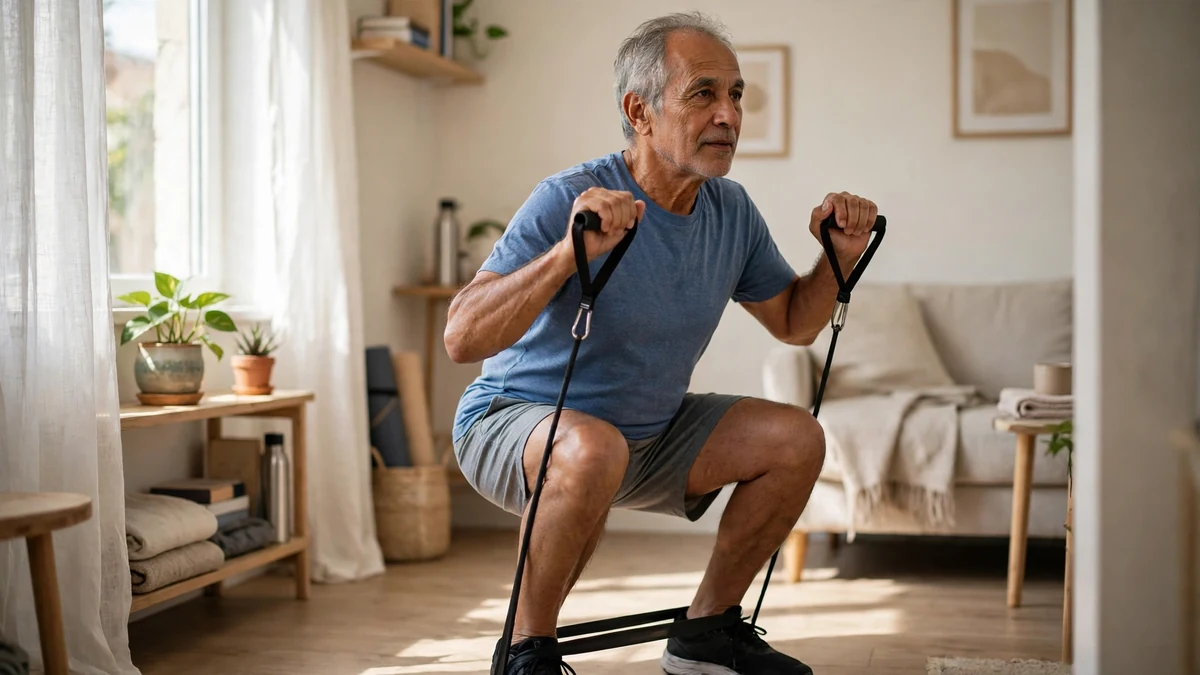
Stand on the middle of the band with feet hip width apart, holding the handles or ends at shoulder height with some tension already in the band. Sit your hips back and down into a squat, keeping your chest lifted, then stand up against the band’s pull. The band should stay taut at the bottom of the squat.
Easier: Squat to a chair behind you, or use a lighter band.
Harder: Stand with your feet wider on the band to shorten it, or pause for two seconds at the bottom.
Band row
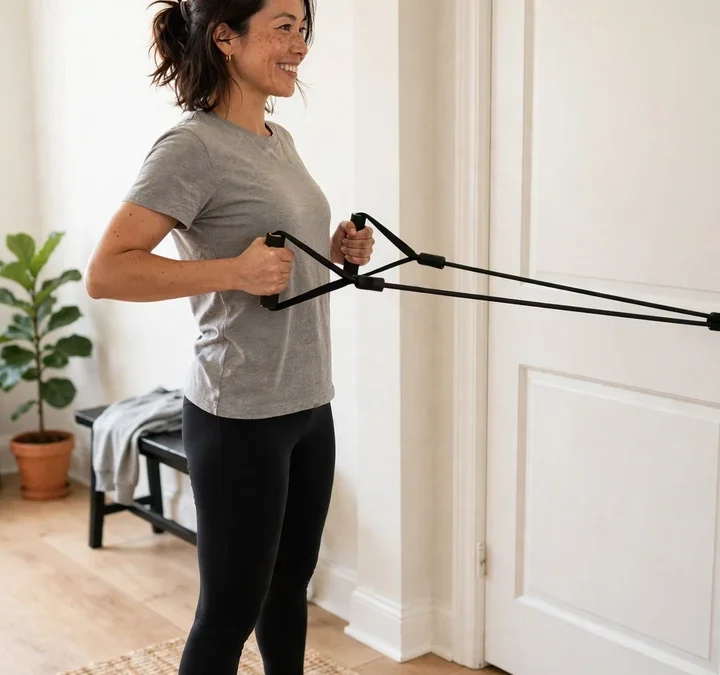
Anchor the band at chest height in a closed door, or loop it around a sturdy post. Face the anchor, hold the handles, and step back until the band is taut with your arms straight. Pull your elbows back past your ribs, squeezing your shoulder blades, then return slowly. No anchor? Sit on the floor with legs extended, loop the band around your feet, and row from there.
Easier: Step closer to the anchor to reduce tension.
Harder: Step further back, or hold the squeezed position for two seconds per rep.
Band chest press
Anchor the band at chest height behind you, or wrap it around your back under your shoulder blades. Face away from the anchor, hold the handles at chest height, and stagger your feet for balance. Press your hands forward until your arms are straight, then return slowly until your hands are beside your chest.
Easier: Step closer to the anchor or use a lighter band.
Harder: Step further forward for more tension, keeping your body straight and your stomach tight.
Band deadlift
Stand on the middle of the band with feet hip width apart, holding the handles with the band fairly short. Soften your knees, push your hips back, and lower your hands toward your shins with a flat back, as if setting down heavy bags. Push your hips forward to stand tall, squeezing your glutes against the band’s resistance.
Easier: Use a lighter band and a smaller hip hinge range.
Harder: Stand with more band under your feet to shorten it, or pause at the top for two seconds.
Band overhead press
Stand on the middle of the band, feet hip width apart, holding the handles at shoulder height. Tighten your stomach and press the handles overhead until your arms are straight. Lower slowly. If standing on the band is too much tension, kneel on the band instead to shorten your lever.
Easier: Kneel on the band, or press one arm at a time.
Harder: Use both feet on the band with a wider stance for more tension.
Band pull-apart
Hold the band in front of your chest with both hands, arms straight, hands about shoulder width apart, with light tension. Keeping your arms straight and shoulders down, pull your hands apart until the band lightly touches your chest. Return slowly. This trains the upper back and the backs of the shoulders.
Easier: Start with your hands wider apart on the band for less tension.
Harder: Start with your hands closer together, or add a two-second hold at full stretch.
Cool-down and stretching
- Walk slowly for 1 minute, shaking out your arms.
- Doorway chest stretch, 30 seconds per side.
- Cross-body shoulder stretch, 30 seconds per side.
- Standing quad stretch holding a chair, 30 seconds per side.
- Seated hamstring stretch, 30 seconds per side.
- Finish with 5 slow breaths.
How to progress
Weeks 1 and 2: 2 sets per move, twice a week, with a light band. Weeks 3 and 4: build to the top of the rep ranges and add a third set. After that, progress by stepping further from the anchor, shortening the band under your feet, or moving up to a thicker band. Bands progress in bigger jumps than dumbbells, so combine methods: a slightly thicker band plus a shorter stance change can overshoot, so change one thing at a time. Retire any band that develops nicks or tears.
Safety notes
Stop and rest if you feel pain, dizziness, nausea, or chest pain, and seek medical help right away for chest pain. Talk with your doctor before starting if you have been inactive or have a health condition. Choose good form over speed and heavier bands. Never exercise through sharp joint pain. Inspect the band before every session, never stretch a band toward your face, and make sure door anchors are on a fully latched door. Keep your grip secure; a handle slipping out of a sweaty hand is a common mishap.
Common mistakes
- Letting the band snap back instead of controlling the return.
- Using a band with visible nicks or cracks.
- Standing so close to the anchor that the band goes slack at the start of each rep.
- Shrugging the shoulders during rows and pull-aparts.
- Arching the back during the overhead press instead of tightening the stomach.
- Anchoring to a door that opens toward you and is not latched.
Pair it with a diet plan
Small-space training pairs well with simple home cooking. The 7-Day Meal Plan for Apartment Cooks With No Oven keeps meals easy in a small kitchen. The Calorie Calculator can help you line up your portions with your new routine.
Frequently asked questions
Are resistance bands as good as weights?
For beginners, bands provide plenty of resistance to build strength, and muscles respond to effort rather than to the type of equipment. Bands feel different because resistance rises as they stretch, which is why slow reps and a pause at full stretch work so well.
What strength band should I buy first?
A light to medium long band with handles is the most versatile first choice. Many beginners end up with two bands, a light one for presses and pull-aparts and a medium one for squats, rows, and deadlifts, since legs are usually stronger than shoulders.
How do I know if the band is about to break?
Look for small cuts, nicks, pale worn patches, or thinning spots, especially near the handles and the middle where it goes under your feet. Any of those means the band should be retired. Storing bands away from sunlight and heat helps them last longer.
Can I do this workout without a door anchor?
Yes. The seated row around your feet covers the back, and wrapping the band around your back covers the chest press. The squat, deadlift, overhead press, and pull-apart never needed an anchor in the first place.
Why do my reps feel easy at the start and hard at the end of each rep?
That is how bands work: the further they stretch, the more resistance they give. It means the strongest part of each movement gets the most load. Moving slowly and pausing briefly at full stretch makes the most of this effect.
Sources and further reading
- Physical Activity Guidelines for Americans, US Department of Health and Human Services: health.gov
- CDC, physical activity basics for adults: cdc.gov
- MedlinePlus, exercise and physical fitness background: medlineplus.gov
This article is for general educational purposes only and is not medical, nutrition, or fitness advice. Talk with your doctor or a registered dietitian before changing your diet or starting an exercise program.