Prints just the plan, like a recipe card.
Last updated: November 23, 2026.
After 50, strength stops being about how you look and starts being about what you can do: carrying the groceries in one trip, getting up from a low chair without thinking about it, keeping up with grandkids at the park. If the word “strength training” brings to mind heavy barbells and crowded gyms, this workout will be a relief. It is built for real living rooms and real joints.
This strength workout for adults over 50 uses a sturdy chair, a wall, and your own body weight, with an optional light pair of dumbbells. The session takes about 30 minutes, covers your legs, hips, back, chest, arms, and core, and gives you an easier and a harder option for every exercise. No jumping, no floor-to-standing gymnastics, and no equipment to buy before you can start.
This workout sits in our Exercise and Workouts collection, alongside walking plans and chair routines. It pairs well with our 7-Day Meal Plan for Women Over 50, and you can explore the rest of the library in Diet Plans.
Key takeaways
- Strength training twice a week helps you keep the muscle that everyday tasks depend on.
- Chair support and wall exercises make balance a non-issue while you build strength.
- Slow, controlled reps with good form beat fast, sloppy ones at any age.
- Start with body weight; add light dumbbells only when the moves feel easy.
- Mild next-day soreness is normal at first; sharp pain is a signal to stop.
Who this workout is for, and who should check with a doctor first
This workout is for adults over 50 who are new to strength training or returning after a long layoff, and who want a safe, structured way to get stronger at home. It assumes you can walk around your home comfortably and get down to the floor and back up with some effort; if floor work is not for you yet, our chair workout is a better first step.
Check with your doctor before starting if you have been inactive for a long time, have a heart condition, have joint problems or osteoporosis, are pregnant, have had recent surgery or an injury, or have a history of chest pain. If you take medication that affects your heart rate or blood pressure, ask how that changes exercise guidance for you. This workout is general information, not personal medical advice.
If you have a history of disordered eating, talk with a doctor or a registered dietitian before following any diet plan. For eating disorder support in the US, visit the National Alliance for Eating Disorders at allianceforeatingdisorders.com.
What you need
- A sturdy chair without wheels, against a wall
- A clear wall space for push-ups
- A mat or carpeted area for the floor exercises
- Supportive shoes and a water bottle
- Optional: a light pair of dumbbells, about 2 to 5 pounds
Warm-up (5 minutes)
Warm up every time. Cold muscles and stiff joints are more likely to complain.
- Marching in place (2 minutes). Start slow, lifting your feet a few inches, and gradually lift your knees a little higher.
- Shoulder rolls and arm swings (1 minute). Roll your shoulders in slow circles, then swing your arms gently forward and back.
- Supported sit-to-stands, easy pace (1 minute). Stand up and sit down 5 or 6 times slowly, using your hands as much as you like.
- Ankle circles and toe taps (1 minute). Circle each ankle both ways, then tap your toes and heels in front of you.

The strength workout for adults over 50
Move through the circuit in order, resting 30 to 60 seconds between exercises. Do 2 rounds. You should be able to speak in short sentences throughout; if you cannot catch your breath, rest longer.
1. Sit-to-stand from a chair
Reps: 8 to 12.
- Sit near the front of the chair with feet flat, hip width apart.
- Lean forward slightly from the hips and press through your whole foot to stand.
- Stand tall and squeeze your buttocks gently at the top.
- Sit back down slowly by pushing your hips back toward the chair.
Easier: Raise the seat with a firm cushion and push off your thighs or the chair arms.
Harder: Cross your arms over your chest, or hold a light dumbbell at your chest with both hands.
2. Countertop or wall push-ups
Reps: 8 to 12.
- Place your hands on a wall or a sturdy countertop, shoulder width apart, and step your feet back so your body leans in a straight line.
- Bend your elbows to lower your chest toward the surface with control.
- Stop a few inches away, then press back to the start.
- Keep your body straight like a plank; do not let your hips sag.
Easier: Use the wall and stand closer to it, so you are more upright.
Harder: Use a lower surface, like a countertop instead of the wall, or slow each rep to a count of three down and three up.
3. Standing rows with dumbbells or bottles
Reps: 10.
- Stand with feet hip width apart, a light dumbbell or water bottle in each hand.
- Hinge forward slightly from your hips with a flat back, knees soft, arms hanging down.
- Pull the weights up toward your ribs, squeezing your shoulder blades together.
- Lower the weights slowly.
Easier: Do the rows without weights, focusing on the shoulder blade squeeze, or sit tall in a chair and row from there.
Harder: Pause for a count of two at the top, or use slightly heavier dumbbells once 10 reps feel easy.
4. Glute bridges
Reps: 10 to 12.
- Lie on your back on a mat, knees bent, feet flat and hip width apart.
- Press through your heels and lift your hips until your body forms a gentle line from shoulders to knees.
- Hold for a breath at the top, squeezing your buttocks.
- Lower slowly back to the floor.
Easier: Lift your hips only a few inches and keep the hold brief.
Harder: Hold the top for a count of three, or lift one foot slightly off the floor at the top, alternating sides.
5. Dead bug
Reps: 6 per side.
- Lie on your back with arms pointing at the ceiling and knees bent at 90 degrees over your hips.
- Press your lower back gently into the floor and keep it there.
- Slowly extend your right arm overhead and your left leg out straight, just above the floor.
- Return to the start and repeat on the other side, breathing steadily.
Easier: Keep your feet on the floor and slide one heel out and back at a time, or move only the arms.
Harder: Lower the arm and leg closer to the floor and pause for a breath before returning.
Cool-down and stretching
Take about 5 minutes to cool down after the second round.
- Easy walking around the room (2 minutes). Let your pace and breathing gradually settle.
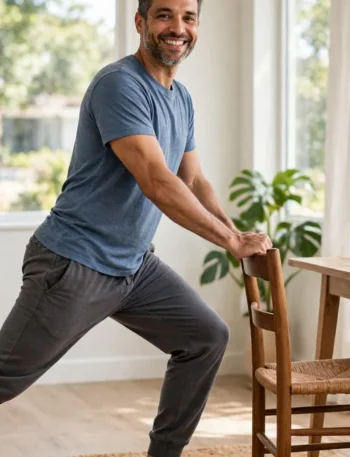
- Standing quad stretch (30 seconds per side). Holding the chair, bend one knee and bring your heel toward your buttock as far as comfortable.
- Seated hamstring stretch (30 seconds per side). Sit on the chair edge, straighten one leg with the heel down, and hinge forward gently with a flat back.
- Chest opener (30 seconds). Clasp your hands behind your back and lift your chest, drawing your shoulders back.
- Slow breathing (1 minute). Breathe in for a count of four and out for a count of six, seated or standing.
How to progress
Progress is measured in months, not days. Add difficulty only when the current level feels manageable twice in a row.
- Weeks 1 to 2: One to two rounds, body weight only, easier options wherever needed, 2 days per week.
- Weeks 3 to 4: Two full rounds with standard form, and try one harder option per session.
- Week 5 and beyond: Add light dumbbells to the rows and sit-to-stands, or add a third weekly session. Keep at least one rest day between strength days.
The Physical Activity Guidelines for Americans recommend that adults get at least 150 minutes of moderate-intensity aerobic activity each week, plus muscle-strengthening activities on 2 or more days a week. Pair these sessions with regular walking and you are covering both parts of that guidance.
Safety notes
Stop and rest if you feel pain, dizziness, nausea, or chest pain during any exercise, and seek medical help right away for chest pain. Never exercise through sharp joint pain; choose the easier option or skip that move. Talk with your doctor before starting if you have been inactive for a long time or have any health condition. Get up from the floor slowly, using the chair for help, and sit for a moment if you feel lightheaded. Good form matters more than reps, so move slowly and keep support within reach for standing exercises.
Common mistakes
- Holding your breath and straining during effort instead of exhaling on the hard part.
- Choosing weights that are too heavy and letting form fall apart.
- Rushing reps; slow reps build more strength and are easier on joints.
- Training the same muscles hard two days in a row without a rest day.
- Skipping the warm-up and cool-down to save time.
Pair it with a diet plan
Strength training works best when meals include enough protein and plenty of produce. Our 7-Day Meal Plan for Women Over 50 is designed for exactly this stage of life, and there is a matching plan for men over 50 in the same collection. For a general estimate of your daily calorie needs, try the Calorie Calculator.
Frequently asked questions
Is strength training safe after 50?
For most healthy adults, yes, when it is done with good form, sensible resistance, and medical clearance where needed. The exercises here use support and controlled movements on purpose. If you have osteoporosis, arthritis, or a heart condition, ask your doctor which variations suit you before starting.
How heavy should my dumbbells be?
A light pair of dumbbells, about 2 to 5 pounds, is a common starting point for the rows and loaded sit-to-stands. The right weight lets you finish the set with good form while the last two reps feel like real work. Many people start with no weight at all and add it after a few weeks.
How many times a week should I do this workout?
Twice a week on non-consecutive days is a solid target, which matches the muscle-strengthening part of the Physical Activity Guidelines for Americans. Add walking on most other days for the aerobic part, starting with whatever duration feels comfortable.
What if I cannot get down on the floor for bridges and dead bugs?
Skip the floor exercises for now and add an extra round of sit-to-stands and wall push-ups instead. Our chair workout builds similar strength entirely from a chair. As you get stronger, floor work may become possible; a physical therapist can help you practice getting down and up safely.
Sources and further reading
- Physical Activity Guidelines for Americans, US Department of Health and Human Services: health.gov
- CDC pages on physical activity for older adults: cdc.gov
- MedlinePlus information on exercise and aging: medlineplus.gov
- American Heart Association guidance on strength and resistance training: heart.org
This article is for general educational purposes only and is not medical, nutrition, or fitness advice. Talk with your doctor or a registered dietitian before changing your diet or starting an exercise program.