Prints just the plan, like a recipe card.
Last updated: November 23, 2026.
Swimming is often recommended to people whose knees, hips, or back complain about other exercise, because the water supports your weight. But walking into a pool as a beginner can feel awkward: lanes, caps, goggles, and swimmers who seem to glide without ever breathing. Where do you even start?
Start with the basics in this guide: getting comfortable in the water, walking in the shallow end, kicking with a board, and swimming short, easy lengths with plenty of rest. Your first sessions are about 20 to 30 minutes in the water, and most of that time you will be resting or walking. That is not a failed workout. That is exactly how swimming fitness begins.
This workout sits in our Exercise and Workouts collection, with walking, cycling, and home routines. It pairs well with our 7-Day Joint-Friendly Eating Plan, since both were chosen with sensitive joints in mind, and the full library is in Diet Plans.
Key takeaways
- Water walking and kickboard lengths are real swimming workouts for beginners.
- Swim short lengths with long rests. Build the number of lengths before you chase speed.
- Only swim where a lifeguard is on duty, and never swim alone.
- If you never learned to swim, lessons come first. That is the smart starting point, not a detour.
Who this workout is for, and who should check with a doctor first
This guide is for adults who can swim at least a little, even just one length with stops, and want to build a pool routine. It is a good fit for people looking for exercise that is gentle on joints. If you cannot swim yet, sign up for adult lessons at your local pool first; most pools offer them, and a few lessons change everything about safety and confidence.
Check with your doctor before starting if you have been inactive for a long time, if you have a heart condition, asthma or other breathing conditions, joint problems, ear problems, or a history of chest pain, or if you are pregnant or recovering from a recent surgery or injury. Open wounds, ear infections, and certain skin conditions are reasons to stay out of the pool until your doctor says otherwise.
If you have a history of disordered eating, talk with a doctor or a registered dietitian before following any diet plan. For eating disorder support in the US, visit the National Alliance for Eating Disorders at allianceforeatingdisorders.com.
What you need
- A pool with a lifeguard on duty, and a shallow area where you can stand comfortably.
- A swimsuit you can move in, plus goggles if you like them. A swim cap is optional.
- A kickboard, which most pools lend out at the deck.
- A towel and a bottle of water at the pool edge. You sweat in the pool more than you realize.
- A locker or bag for your belongings, and flip-flops for the deck and locker room.
Warm-up (5 minutes)
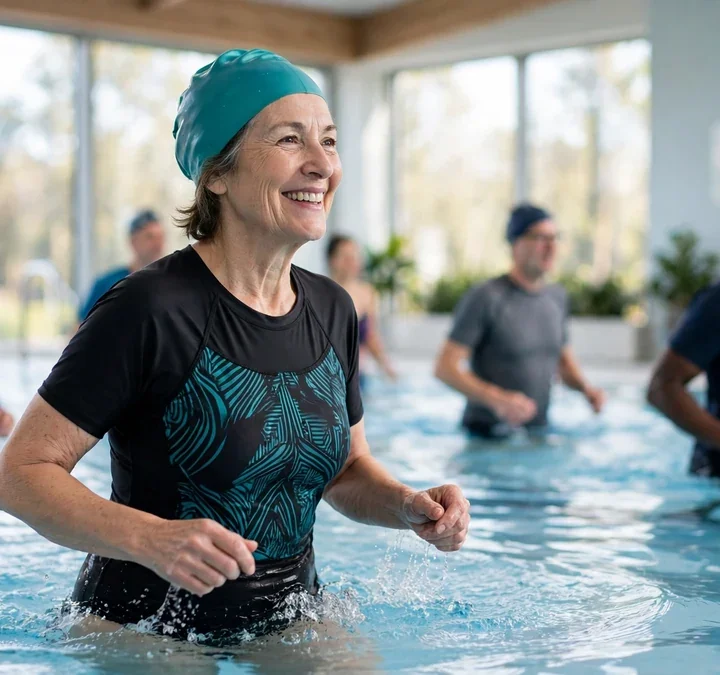
Your warm-up is water walking in the shallow end, which wakes up your whole body with almost no joint stress.
- Walk forward across the shallow end at an easy pace for 1 minute, swinging your arms through the water.
- Walk backward for 1 minute, taking care to check the space behind you.
- Walk sideways for 1 minute, leading with one leg, then return leading with the other.
- Do 1 minute of gentle marching in place in the water, lifting your knees to a comfortable height.
- Finish with 1 minute of easy forward walking, a little brisker, and a few slow arm circles through the water.
The workout: beginner pool session
Work through the four parts below, resting at the wall whenever you need to. A length means one trip across the pool; if your pool is long, treat half-lengths as your unit. Rest is part of the workout, so take it without apology.
| Part | Amount | Rest |
|---|---|---|
| Kickboard lengths | 2 to 4 lengths | 30 to 60 seconds at the wall |
| Easy freestyle or backstroke lengths | 2 to 4 lengths | 30 to 60 seconds at the wall |
| Water walking intervals | 4 x 1 minute brisk | 1 minute easy between |
| Mixed easy lengths, any style | 2 to 4 lengths | As needed |
Kickboard lengths
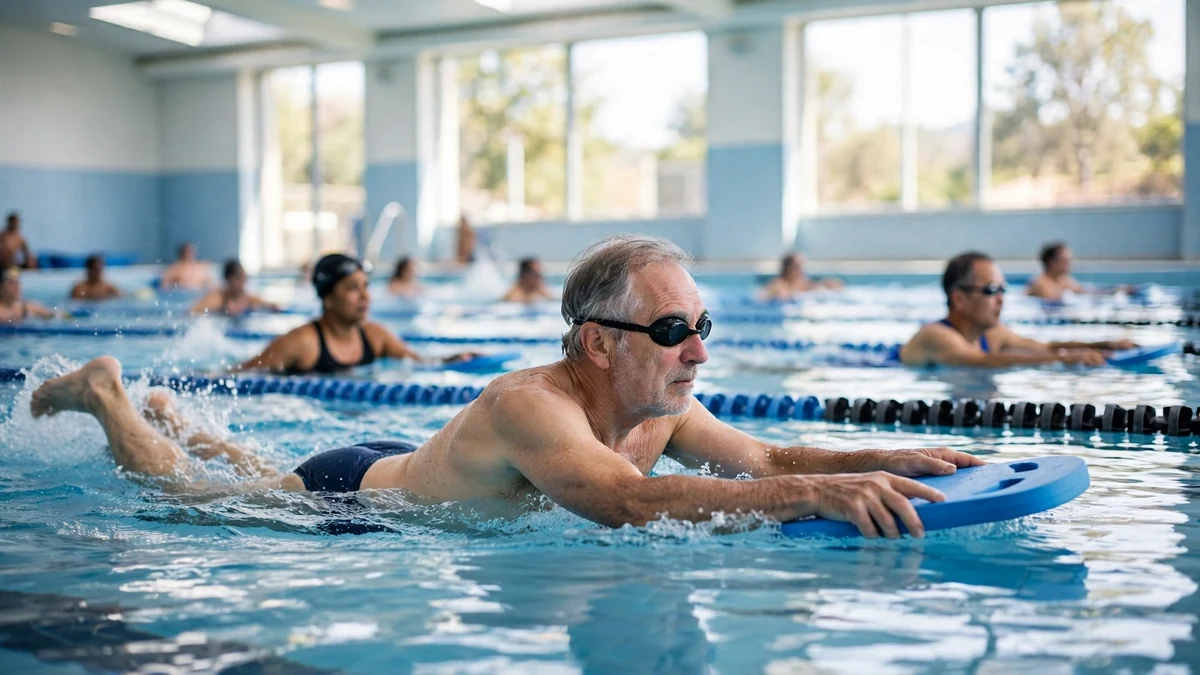
Hold the kickboard out in front of you with both hands, arms extended, and kick gently from the hips with loose ankles. Keep the kicks small and steady rather than splashy. Breathe comfortably, lifting your head as needed. Swim to the far end, rest, and come back.
Easier: Walk while holding the board, kicking only for a few yards at a time.
Harder: Add one more length before resting, keeping the same gentle kick.
Easy freestyle or backstroke lengths
Swim one length at an easy pace in whichever style feels most comfortable. For freestyle, turn your head to the side to breathe rather than lifting it straight up. For backstroke, keep your head back and your hips near the surface. There is no prize for speed; smooth and relaxed wins.
Easier: Swim half the length, stand and rest, then finish it.
Harder: Swim the length, rest 20 seconds, and swim back without a longer break.
Water walking intervals
In the shallow end, walk as briskly as you can for 1 minute, pushing your arms through the water to add effort. Then walk easily for 1 minute. Repeat 4 times. The water gives resistance in every direction, which makes this simple move surprisingly effective.
Easier: Slow the brisk minutes to a moderate pace.
Harder: Lift your knees higher during the brisk minutes, or add a fifth interval.
Mixed easy lengths
Finish with 2 to 4 easy lengths in any mix of styles: a kickboard length, a backstroke length, whatever feels good. The pace should ease down as you go, so you end the session relaxed rather than exhausted.
Easier: Replace lengths with more water walking.
Harder: String two lengths together with only a short wall rest.
Cool-down and stretching
- Walk easily in the shallow end for 2 minutes, letting your breathing settle.
- At the wall, calf stretch: one foot back on the pool floor, heel down, lean in gently. Hold 20 seconds per side.
- Shoulder stretch across your chest, 20 seconds per side, standing in the shallow end.
- Chest stretch: place a forearm on the pool wall and turn gently away. Hold 20 seconds per side.
- On deck, a standing quad stretch holding the wall, 20 to 30 seconds per side, then slow breaths to finish.
How to progress
Weeks 1 and 2: two pool sessions a week, using the low end of every range, with long rests. Weeks 3 and 4: add 1 or 2 lengths to each part, or trim rests to 30 seconds. After a month, many beginners swim 20 to 30 lengths total across a session with rests, and that is a genuinely solid workout. Swimming counts toward the Physical Activity Guidelines for Americans recommendation of at least 150 minutes of moderate-intensity aerobic activity each week, and water walking counts too.
Safety notes
Stop and rest if you feel pain, dizziness, nausea, or chest pain, and get out of the water and seek medical help right away for chest pain. Talk with your doctor before starting if you have been inactive or have any health condition. Only swim where a lifeguard is on duty, never swim alone, and stay in water where you can stand until your swimming is strong. Good form matters more than speed, and tired swimmers should hold the wall or stand up rather than push on. Never exercise through sharp joint pain. Skip diving, and follow your pool’s posted rules.
Common mistakes
- Trying to swim nonstop like experienced lap swimmers. Rests are how beginners build up.
- Holding your breath for whole lengths. Breathe out into the water and in when your head turns.
- Kicking from the knees with big splashes instead of small kicks from the hips.
- Choosing the fast lane and feeling pressured. Use the slow or recreational area without embarrassment.
- Skipping water breaks because you are already wet. Drink anyway.
Pair it with a diet plan
Gentle training pairs well with gentle eating structure. The 7-Day Joint-Friendly Eating Plan lays out a full week built around fish, produce, and whole grains. To check your own calorie estimate, try the Calorie Calculator.
Frequently asked questions
I can only swim one length before resting. Is that normal?
Completely normal. Swimming uses muscles and breathing patterns that take time to learn, and even fit walkers are often surprised by their first lengths. Rest at every wall without apology; the lengths add up over the weeks.
Does water walking really count as exercise?
Yes. Water resists every step, so brisk water walking raises your breathing and works your legs and core with very little joint stress. It is a legitimate main exercise for many beginners, not just a warm-up.
What if I am nervous in deep water?
Stay in the shallow end where you can stand, and build confidence there. Many pools have lanes along the wall. If fear of the water is the main barrier, adult swim lessons are the best investment you can make.
How many times a week should I swim?
Two sessions a week is a great start. Add a third when the sessions feel comfortable, and mix in walking or strength work on other days if you enjoy variety.
Do I need goggles and a cap?
Neither is required. Goggles help many beginners relax because they can see and keep water out of their eyes, and a cap keeps hair out of the way. Try the session first with just a swimsuit and see what you miss.
Sources and further reading
- Physical Activity Guidelines for Americans, US Department of Health and Human Services: health.gov
- CDC, physical activity basics for adults: cdc.gov
- MedlinePlus, exercise and physical fitness: medlineplus.gov
This article is for general educational purposes only and is not medical, nutrition, or fitness advice. Talk with your doctor or a registered dietitian before changing your diet or starting an exercise program.