Prints just the plan, like a recipe card.
Last updated: November 23, 2026.
If jumping workouts leave your knees, ankles, or back complaining for days, you are not alone, and you do not have to choose between hard exercise and no exercise. Low-impact simply means at least one foot stays on the floor, so you get your heart rate up without the pounding.
This 20-minute low-impact workout strings together smooth, joint-friendly moves for your whole body: marching, step touches, sit-to-stands, wall push-ups, and standing leg work. It suits beginners, older adults, and anyone whose joints prefer a gentler session. There is no jumping and no floor work, and the only equipment is a sturdy chair and a wall.
This workout sits in our Exercise and Workouts collection, next to chair workouts, walking plans, and mobility routines. It pairs well with our 7-day low-impact lifestyle meal plan, and you can browse more eating plans in the Diet Plans library.
Key takeaways
- Every move is low impact: one foot stays on the floor at all times, with no jumping.
- The session runs about 20 minutes, including a warm-up and a cool-down.
- You stay standing the whole time, with a chair nearby for balance.
- Easier and harder options let you match the workout to your joints on any given day.
Who this workout is for, and who should check with a doctor first
This workout is for adults who want cardio and light strength work without impact: beginners, people with sensitive knees or hips, and anyone returning to exercise after time off. Because you stay upright and hold support when you need it, it is also a friendly option if getting down to the floor is difficult.
Check with your doctor before starting if you have been inactive for a long time, if you have a heart condition, significant joint problems, balance concerns, or a history of chest pain, or if you are pregnant or recovering from surgery or a recent injury.
If you have a history of disordered eating, talk with a doctor or a registered dietitian before following any diet plan. For eating disorder support in the US, visit the National Alliance for Eating Disorders at allianceforeatingdisorders.com.
What you need
- A sturdy chair that does not slide, ideally braced against a wall
- A clear wall space
- Supportive shoes and comfortable clothes
- A small floor area, roughly the size of a yoga mat plus a step in each direction
- Water nearby
Warm-up (4 minutes)
- Gentle march in place (1 minute). Start slowly and let your arms swing. Build the pace a little as you go.
- Step touches (1 minute). Step one foot out to the side, tap the floor, and return. Alternate sides in a steady rhythm.
- Shoulder rolls and chest openers (1 minute). Roll your shoulders, then open your arms wide and bring them back, like a slow hug in reverse.
- Mini knee lifts (1 minute). Lift one knee a few inches at a time, holding the chair if you like, and gradually lift a little higher.

The 20-minute low-impact workout
The main circuit lasts about 12 minutes. Do each exercise for about 50 seconds, rest for about 10 seconds while you move to the next one, and complete two full rounds. Keep your movements smooth and controlled, and breathe steadily. You should be able to speak in short sentences throughout.
| Exercise | Time or reps | Rounds |
|---|---|---|
| March in place with arm swings | 50 seconds | 2 |
| Step touch with a reach | 50 seconds | 2 |
| Sit-to-stand from a chair | 50 seconds (about 8 reps) | 2 |
| Wall push-ups | 50 seconds (about 10 reps) | 2 |
| Standing side leg lifts | 50 seconds (25 seconds each side) | 2 |
| Heel-to-toe rockers and calf raises | 50 seconds | 2 |
March in place with arm swings
- Stand tall with your feet hip width apart and your shoulders relaxed.
- March on the spot, lifting each knee to a comfortable height.
- Swing the opposite arm forward as each knee lifts, the way you naturally walk.
Easier: Lift your knees only slightly and let your arms rest or hold the chair.
Harder: Lift your knees toward hip height and make the arm swings bigger.
Step touch with a reach
- Step your right foot out to the side and tap your left foot in beside it.
- As you step, reach both arms out to the sides at shoulder height.
- Step back to the middle and repeat to the left, keeping a gentle rhythm.
Easier: Take smaller steps and keep your arms low.
Harder: Bend your knees a little deeper as you step, like a soft, small squat with each touch.
Sit-to-stand from a chair
- Sit near the front edge of the chair with feet flat, hip width apart.
- Lean slightly forward from the hips and press through your heels to stand.
- Sit down slowly and repeat without fully resting on the chair between reps.
Easier: Use your hands to help push up, and choose a taller chair.
Harder: Cross your arms over your chest and take three seconds to sit down.
Wall push-ups
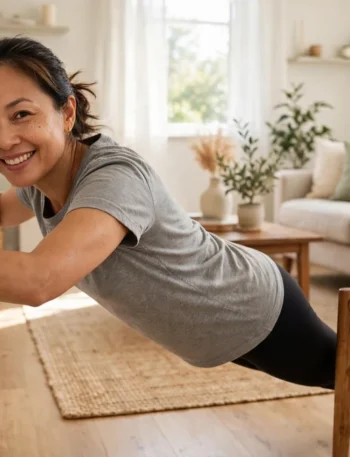
- Place your palms on the wall at shoulder height, about an arm’s length away.
- Bend your elbows to bring your chest toward the wall, keeping your body straight.
- Press back to the starting position.
Easier: Stand closer to the wall so you lean less.
Harder: Step your feet back a little more, or progress to a sturdy countertop.
Standing side leg lifts
- Stand behind the chair and hold the back for balance, feet together.
- Lift your right leg out to the side, keeping it straight and your toes pointing forward.
- Lower slowly and repeat, then switch sides halfway through the interval.
Easier: Lift the leg only a few inches off the floor.
Harder: Pause for two seconds at the top of each lift.
Heel-to-toe rockers and calf raises
- Stand with fingertips on the chair back for balance.
- Rise onto the balls of your feet, pause, and lower.
- Then gently rock back so your toes lift slightly off the floor, and return. Alternate the two movements.
Easier: Do plain calf raises only, with a small range of motion.
Harder: Slow the calf raises down and hold the top for three seconds.
Cool-down and stretching (4 minutes)
- Slow step touches (1 minute). Let the pace drop gradually until your breathing feels calm.
- Standing calf stretch (30 seconds each side). Step one foot back, heel down, and lean gently toward the wall.
- Standing quad stretch (30 seconds each side). Hold the chair, bend one knee, and bring your heel toward your glute.
- Chest and shoulder stretch (30 seconds). Clasp your hands behind your back and gently open your chest.
- Side stretch (30 seconds). Reach one arm overhead and lean gently to the opposite side, then switch.
How to progress
Aim for this workout on 3 or 4 days a week to start. When two rounds feel comfortable, progress like this:
- Weeks 1 to 2: Two rounds as written, choosing easier options whenever you need them.
- Weeks 3 to 4: Use the harder option on one or two exercises, and make the marching intervals brisker.
- Weeks 5 onward: Add a third round, which brings the main circuit to about 18 minutes, or add a fourth workout day.
Sessions like this one count toward the general weekly targets for adults. The Physical Activity Guidelines for Americans recommend that adults get at least 150 minutes of moderate-intensity aerobic activity each week, plus muscle-strengthening activities on 2 or more days a week. Building up gradually is the safe way to get there.
Safety notes
Stop and rest if you feel pain, dizziness, nausea, or chest pain, and seek medical help right away for chest pain or trouble breathing. Talk with your doctor before starting if you have been inactive or have a health condition, especially one affecting your heart, lungs, or joints. Good form comes before speed, so slow down rather than letting the moves get sloppy. Never exercise through sharp joint pain; use the easier option, reduce the range of motion, or skip that exercise. Keep the chair within reach during standing moves if your balance feels unsteady.
Common mistakes
- Turning step touches into small hops. Low impact means a foot stays down; keep it smooth.
- Leaning your whole body sideways during leg lifts. Keep your torso upright and let the leg do the work.
- Rushing the sit-to-stand. The slow sit-down is where much of the benefit is.
- Forgetting to breathe. Steady breathing keeps the effort comfortable.
- Skipping the cool-down because you feel fine. Your muscles and joints still benefit from it.
Pair it with a diet plan
A gentle approach to exercise often goes with a gentle approach to eating. Our 7-day low-impact lifestyle meal plan keeps meals simple and steady. To estimate your daily calorie needs, try the free Calorie Calculator.
Frequently asked questions
Can a low-impact workout still improve my fitness?
Yes. Impact and intensity are different things. A low-impact session done at a pace that quickens your breathing and makes you feel warm is real aerobic exercise, and the strength moves still challenge your muscles, all without jumping.
Is this workout safe for sore knees?
The moves are chosen to be knee friendly: no jumping, no deep knee bends, and a chair for support. Keep the sit-to-stand on a higher chair if that feels better, and stop if you feel sharp pain. For ongoing knee problems, ask your doctor or a physical therapist what is right for you.
How many days a week should I do it?
Three or four days a week is a sensible start. On other days, an easy walk or a stretching routine keeps you active while the same muscles recover.
What if I cannot do two full rounds yet?
Do one round and finish with the cool-down. That is a complete, worthwhile session. Add the second round for one or two exercises at a time as your stamina grows.
Do I have to stay standing the whole time?
No. If standing for 20 minutes is too much right now, sit in the chair for the marching intervals and pedal your feet gently, then stand for the moves where you feel steady. Building up gradually is the goal.
Sources and further reading
- Physical Activity Guidelines for Americans, US Department of Health and Human Services: health.gov
- Physical activity and arthritis information, Centers for Disease Control and Prevention: cdc.gov
- Exercise and physical activity guidance, MedlinePlus: medlineplus.gov
This article is for general educational purposes only and is not medical, nutrition, or fitness advice. Talk with your doctor or a registered dietitian before changing your diet or starting an exercise program.