Prints just the plan, like a recipe card.
Last updated: November 23, 2026.
The treadmill can look like the most intimidating machine in the gym, mostly because of the person sprinting on the one next to it. Ignore that person. A treadmill is also the most beginner-friendly tool in the building: no traffic, no weather, no uneven sidewalks, and a pace you control to the decimal.
This treadmill walking workout is a 25-minute session designed for first-timers. You will learn the basic controls, walk at speeds described by feel rather than by scary numbers, and try a gentle incline in the middle. If you have never stepped on a treadmill before, the setup section walks you through it before the workout even starts.
This workout sits in our Exercise and Workouts collection, with more walking and strength routines for beginners. On cold weeks when the treadmill is your main option, the 7-Day Winter Comfort Food Meal Plan from our Diet Plans library makes a cozy partner.
Key takeaways
- Learn the safety clip, the stop button, and the handrails before you press start.
- Speeds are given as gentle ranges. Your talk test overrules any number on the screen.
- This session is 25 minutes with a small incline section in the middle, and flat walking is fine too.
- Stand in the middle of the belt, look ahead, and let your arms swing instead of gripping the rails.
- Let the belt slow to a stop before you step off, every time.
Who this workout is for, and who should check with a doctor first
This workout is for adults who are new to treadmills or new to exercise in general and want a controlled, weatherproof way to walk. It is a good choice if you like predictable conditions, want to walk early or late without worrying about dark streets, or prefer a surface that is kinder and more even than concrete.
Check with your doctor before starting if you have been inactive for a long time, have a heart condition or a history of chest pain, have joint or balance problems, are pregnant, or have had recent surgery or an injury. If your balance feels unsteady, a treadmill may not be your best first tool; ask your doctor or a physical therapist what they recommend.
If you have a history of disordered eating, talk with a doctor or a registered dietitian before following any diet plan. For eating disorder support in the US, visit the National Alliance for Eating Disorders at allianceforeatingdisorders.com.
What you need
- A treadmill, at a gym or at home, with a working safety clip
- Supportive walking shoes
- Comfortable clothes and a water bottle for the cup holder
- A small towel if your gym asks you to wipe down the machine
- Optional: headphones for music, kept low enough to hear around you
Before you start: treadmill basics
Stand on the side rails with your feet on either side of the belt. Attach the safety clip to your clothing; if you slip, it stops the belt. Press start at the slowest speed, then step onto the moving belt holding the handrail, and walk in the center of the belt, not at the very back. Look straight ahead, not down at your feet. Increase speed in small steps of 0.1 or 0.2 miles per hour. Know where the big stop button is before you need it.
Warm-up (5 minutes)
- Minutes 1 to 2: very slow. Set the speed around 1.5 to 2.0 miles per hour, flat. Hold the rail briefly until the belt feels natural, then let go and swing your arms.
- Minutes 3 to 4: easy. Nudge up to about 2.0 to 2.5 miles per hour. You should be able to chat easily.
- Minute 5: build. Move toward your comfortable walking speed, often around 2.5 to 3.0 miles per hour for many adults, guided by your breathing.
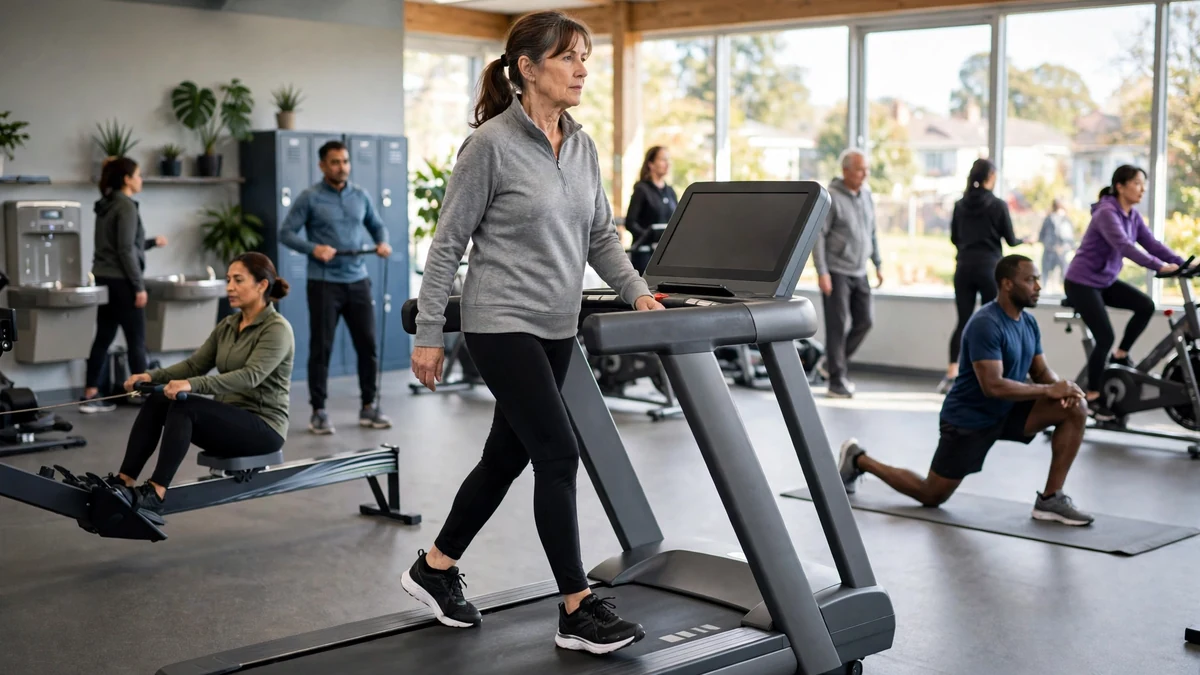
The treadmill walking workout
The middle 15 minutes alternate comfortable flat walking with two short, gentle incline sections. Incline is shown as a percentage on most machines. If your treadmill has no incline, simply walk a little brisker during those minutes instead.
| Segment | Time | Speed feel | Incline |
|---|---|---|---|
| Warm-up | 5 minutes | Slow to easy | 0 percent |
| Comfortable walk | 4 minutes | Short sentences | 0 percent |
| Gentle incline | 3 minutes | Slightly slower | 2 to 3 percent |
| Comfortable walk | 3 minutes | Short sentences | 0 percent |
| Gentle incline | 3 minutes | Slightly slower | 3 to 4 percent |
| Easy walk | 2 minutes | Conversational | 0 percent |
| Cool-down | 5 minutes | Slow | 0 percent |
Comfortable flat walking
Walk in the center of the belt at a pace where you can speak in short sentences. Keep your shoulders down, your hands loose, and your stride natural: not reaching far in front of you, which can jar your knees, and not shuffling at the back edge of the belt.
Easier: Slow down by 0.2 or 0.3 miles per hour. Harder: Add 0.1 or 0.2 miles per hour while keeping the same comfortable breathing.
Gentle incline sections
Raise the incline to 2 to 3 percent for the first section and 3 to 4 percent for the second. You will probably want to slow your speed slightly as the belt tilts; that trade is normal and smart. Lean very slightly forward from your ankles, keep your steps a touch shorter, and do not haul yourself up by the handrails, which changes the exercise and strains your wrists and shoulders.
Easier: Use 1 to 2 percent, or stay flat and walk brisker. Harder: Hold the second incline for 4 minutes instead of 3.
Easy finish
Drop the incline back to zero and walk 2 conversational minutes. Your breathing should settle and your legs should feel loose again before the cool-down begins.
Easier: Slow down more and breathe deeply. Harder: There is no harder version; finishing easy is the design.
Cool-down and stretching
Reduce speed gradually over the final 5 minutes until the belt is at its slowest, then press stop and wait until the belt fully halts before stepping off. Stretch beside the machine for 2 to 3 minutes, about 30 seconds per side.
- Calf stretch with hands on the treadmill rail or a wall, back heel down.
- Standing thigh stretch while holding the rail for balance.
- Hip flexor stretch in a short lunge, especially good after incline walking.
- Chest opener with hands clasped behind your back.
How to progress
Progress in small, boring steps, which is another way of saying progress that lasts. Weeks 1 to 2: repeat this session 3 or 4 times a week exactly as written. Weeks 3 to 4: extend the middle to 20 minutes by adding one more flat-and-incline cycle. Weeks 5 to 6: raise the second incline to 4 to 5 percent, or add a fourth weekly session. After that, many people alternate treadmill days with outdoor walks or add short intervals using the incline instead of speed. Change only one dial at a time: time, speed, or incline, never all three in the same week.
Safety notes
- Stop and rest right away if you feel pain, dizziness, nausea, or chest pain. On a treadmill, press stop first, step onto the side rails, and sit down if you feel faint. Seek medical help promptly for chest pain.
- Talk with your doctor before starting if you have been inactive for a long time or have any health condition.
- Always wear the safety clip. It exists for the one moment you hope never happens.
- Choose good form over speed: no leaning on the rails, no looking down for long stretches, no walking at the very back of the belt.
- Never jump off a moving belt, and never let children play on or near a running treadmill.
- Never exercise through sharp joint pain. Lower the incline first; hills are the usual culprit.
Common mistakes
- Gripping the handrails the entire session, which reduces the work and wrecks your posture.
- Setting the speed by copying the person next to you.
- Cranking the incline high in week one and wondering why your calves are furious.
- Stepping off before the belt has completely stopped.
- Staring down at the console, which tightens your neck and shoulders.
Pair it with a diet plan
Treadmill season pairs well with warm, satisfying meals. The 7-Day Winter Comfort Food Meal Plan offers a balanced week of comfort dishes that fit an indoor training stretch. To sanity-check your daily intake against your activity, try the Calorie Calculator for a general estimate.
Frequently asked questions
What speed should a beginner walk on a treadmill?
Most beginners are comfortable somewhere between 2.0 and 3.0 miles per hour, but height and fitness change that a lot. Use the talk test: short sentences at your working pace, easy chat during warm-up. The right speed is the one that matches that feel.
Is holding the handrails bad?
Briefly, for balance while the belt starts, is fine. Holding on for the whole session changes your posture and reduces the natural arm swing, so aim to walk hands-free once you feel steady.
Does incline walking bother knees?
A gentle incline is comfortable for many people, but knees vary. Start at 1 to 2 percent, and if you feel sharp pain, return to flat walking and mention it to your doctor.
How often should I do this workout?
Three or four times a week with a rest or easy day between sessions is a solid beginner rhythm.
Why does treadmill walking feel harder than outdoor walking?
Many people find the unchanging pace and warm indoor air make it feel tougher, even at the same speed. A slight incline of about 1 percent also feels closer to outdoor walking for some. Trust your effort, not the comparison.
Sources and further reading
- Physical Activity Guidelines for Americans, US Department of Health and Human Services: health.gov
- CDC, physical activity for adults: cdc.gov
- American Heart Association, recommendations for physical activity in adults: heart.org
- MedlinePlus, exercise and physical fitness: medlineplus.gov
This article is for general educational purposes only and is not medical, nutrition, or fitness advice. Talk with your doctor or a registered dietitian before changing your diet or starting an exercise program.