Prints just the plan, like a recipe card.
Last updated: November 23, 2026.
You finally bought a pair of dumbbells, maybe the only equipment that fits in your apartment, and now you are wondering how much of a workout one pair can actually give you. The answer is plenty. With a single pair of light dumbbells you can train your legs, back, chest, shoulders, and arms in about 30 minutes, right in your living room.
This routine is built for small spaces and quiet floors. There is no jumping and nothing gets dropped. A light pair of dumbbells, about 2 to 5 pounds, is a common starting point for beginners; if your pair is a little heavier, use the easier options and fewer reps while you learn the moves. Every exercise includes an easier and a harder version.
This workout sits in our Exercise and Workouts collection, next to bodyweight routines, band workouts, and walking plans. It pairs naturally with our 7-Day Meal Plan for Apartment Cooks With No Oven, another small-space favorite, and you can see everything in Diet Plans.
Key takeaways
- One pair of dumbbells is enough for a full-body strength session at home.
- Six basic moves cover legs, back, chest, shoulders, and arms.
- Slow tempo and pauses make light weights feel challenging without heavier gear.
- Do this workout 2 or 3 times a week with rest days in between.
Who this workout is for, and who should check with a doctor first
This workout is for beginners who have one pair of dumbbells and a small amount of floor space, roughly the size of a yoga mat. It suits apartment living because it is quiet and needs no bench or rack.
Check with your doctor before starting if you have been inactive for a long time, if you have a heart condition, joint problems, or a history of chest pain, or if you are pregnant or recovering from a recent surgery or injury. If your dumbbells feel too heavy for any move, do that move with no weight and tell your doctor or a physical therapist about any pain that keeps coming back.
If you have a history of disordered eating, talk with a doctor or a registered dietitian before following any diet plan. For eating disorder support in the US, visit the National Alliance for Eating Disorders at allianceforeatingdisorders.com.
What you need
- One pair of dumbbells (about 2 to 5 pounds is a common beginner starting point).
- A mat or rug, and about 6 feet of clear floor space.
- A sturdy chair or couch edge for support during one move.
- Supportive shoes or bare feet on the mat, plus a bottle of water.
Warm-up (5 minutes)
- March in place for 1 minute, swinging your arms.
- Do 8 bodyweight squats to a chair, sitting back lightly each time.
- Circle your arms in big slow loops, 8 forward and 8 backward.
- Practice 8 hip hinges with no weight, hands sliding down your thighs.
- Finish with 30 seconds of gentle side steps.
The workout: one pair, full body
Do the six exercises in order, resting 30 to 60 seconds between moves. One full round takes about 12 to 15 minutes. Start with 2 rounds. Because you only have one weight for everything, use tempo to adjust the challenge: slower reps and short pauses make any move harder without extra equipment.
| Exercise | Reps | Rounds |
|---|---|---|
| Goblet squat | 10 to 12 | 2 to 3 |
| Dumbbell Romanian deadlift | 10 to 12 | 2 to 3 |
| Floor press | 8 to 12 | 2 to 3 |
| Bent-over row | 10 to 12 | 2 to 3 |
| Supported reverse lunge | 6 to 8 per leg | 2 to 3 |
| Farmer march in place | 30 seconds | 2 to 3 |
Goblet squat
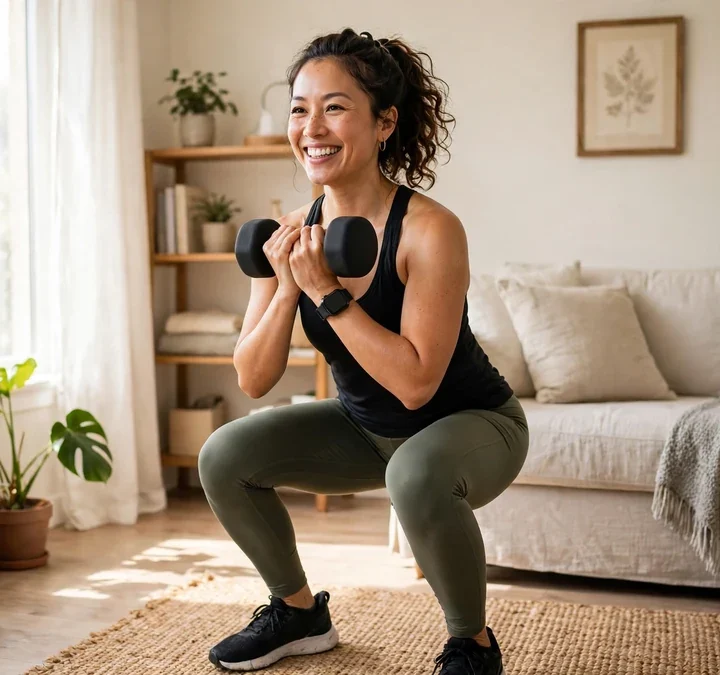
Hold one dumbbell vertically at your chest with both hands. Stand with feet about hip-width apart. Sit your hips back and down, keeping your chest lifted and your elbows pointing down. Press through your heels to stand. Do 10 to 12 reps.
Easier: Squat to a chair and tap the seat each rep.
Harder: Lower to a count of 3 and pause 1 second at the bottom.
Dumbbell Romanian deadlift
Hold a dumbbell in each hand in front of your thighs. With feet hip-width apart and knees slightly bent, push your hips back and slide the weights down the front of your legs, back flat. Stop when you feel a stretch in the back of your thighs, then squeeze your glutes to stand tall. Do 10 to 12 reps.
Easier: Hold one dumbbell with both hands, or practice the hinge without weights.
Harder: Slow the lowering to a count of 4, and stand without fully resting at the top.
Floor press
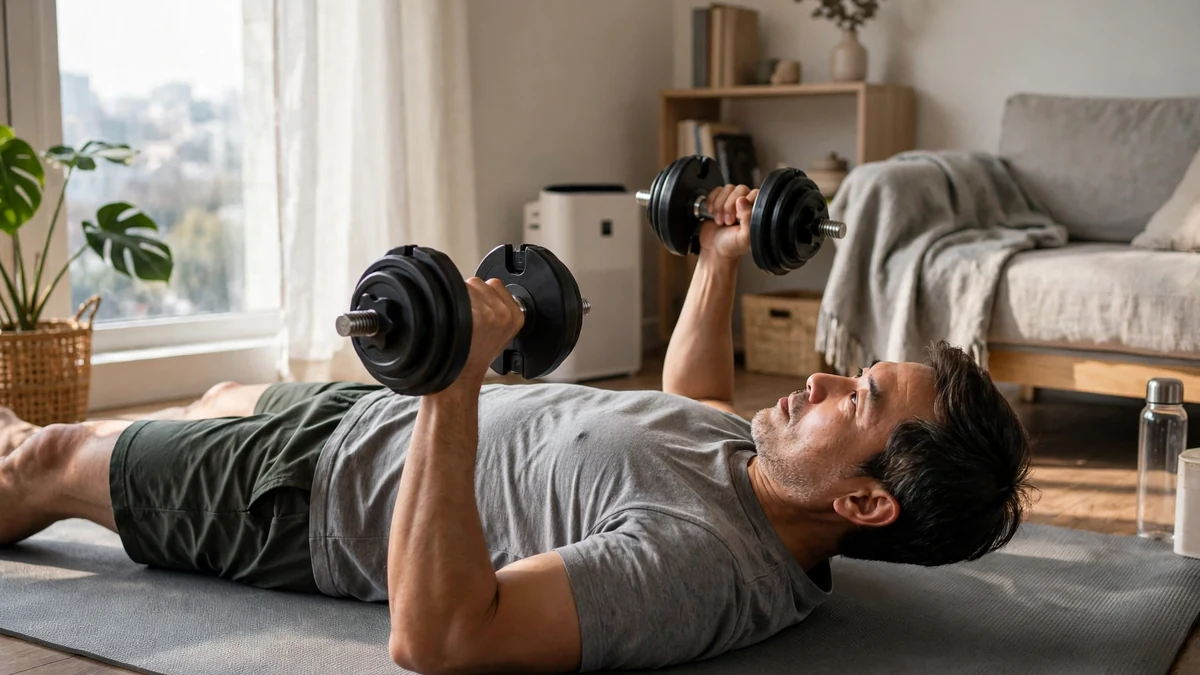
Lie on your back on the mat, knees bent, feet flat. Hold a dumbbell in each hand at chest level with your upper arms resting on the floor. Press up until your arms are straight, then lower until your upper arms touch the floor again. Do 8 to 12 reps.
Easier: Press a single dumbbell held with both hands.
Harder: Lower to a count of 3, or press one arm at a time.
Bent-over row
Stand with feet hip-width apart, a dumbbell in each hand. Hinge forward from the hips about 45 degrees, back flat, knees slightly bent. Let the weights hang, then pull them toward your lower ribs, squeezing your shoulder blades together. Lower slowly. Do 10 to 12 reps.
Easier: Stand more upright and row one arm at a time with the other hand on a chair.
Harder: Pause 2 seconds at the top of each rep.
Supported reverse lunge
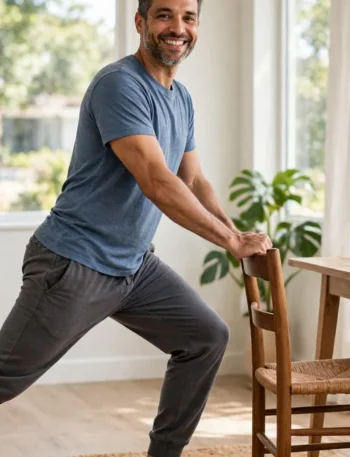
Stand beside a chair or couch, one hand resting on it for balance, holding one dumbbell in the other hand (or no weight). Step one leg back and lower until both knees are comfortably bent, keeping your chest tall. Push through the front heel to return. Do 6 to 8 reps per leg.
Easier: No dumbbell, both hands free to use the support, and a smaller step back.
Harder: Hold a dumbbell in each hand and remove the hand support once your balance feels steady.
Farmer march in place
Hold a dumbbell in each hand at your sides, stand tall, and march in place slowly for 30 seconds, lifting your knees to a comfortable height. Keep your shoulders down and your steps quiet. This builds grip strength and balance at the same time.
Easier: Hold one dumbbell and keep a hand near the chair.
Harder: March for 45 seconds, or slow each step down so control does the work.
Cool-down and stretching
- Set the dumbbells down and walk slowly for 1 minute.
- Chest stretch in a doorway, 20 to 30 seconds per side.
- Standing hamstring stretch: heel on the floor ahead of you, toes up, lean forward gently with a flat back. Hold 20 to 30 seconds per side.
- Shoulder stretch across the chest, 20 to 30 seconds per side.
- Standing quad stretch holding the chair, 20 to 30 seconds per side, then finish with slow breaths.
How to progress
Weeks 1 and 2: 2 rounds, focus on clean form. Weeks 3 and 4: add 2 reps to each exercise, or slow the tempo down. When 3 rounds feel manageable, that is your full session. If every move starts to feel easy for two sessions in a row, a slightly heavier pair of dumbbells is the natural next step, but there is no rush. The Physical Activity Guidelines for Americans recommend muscle-strengthening on 2 or more days a week, and 2 or 3 sessions of this routine covers that.
Safety notes
Stop and rest if you feel pain, dizziness, nausea, or chest pain, and seek medical help right away for chest pain. Talk with your doctor before starting if you have been inactive or have any health condition. Good form matters more than speed or weight, so rest longer whenever a move starts to look sloppy. Never exercise through sharp joint pain. Put the dumbbells down gently between rounds, and keep them out of walkways so nobody trips.
Common mistakes
- Using momentum: swinging weights up instead of lifting them with control.
- Rounding the back during rows and deadlifts instead of hinging at the hips.
- Holding your breath through hard reps.
- Skipping the support on lunges when balance is still shaky.
- Trying to make one pair of dumbbells fit every move at the same reps. Adjust reps and tempo instead.
Pair it with a diet plan
Small-space cooking meets small-space training in the 7-Day Meal Plan for Apartment Cooks With No Oven, which needs no oven and very little equipment. Check your own calorie estimate with the Calorie Calculator before you settle on a plan.
Frequently asked questions
Can one pair of dumbbells really train my whole body?
Yes. Squats, hinges, presses, rows, lunges, and carries cover all the major muscle groups. Tempo changes, pauses, and rep ranges let you adjust the difficulty for each move even though the weight stays the same.
What weight should my one pair be?
About 2 to 5 pounds is a common starting point for beginners. Legs will find that light and shoulders may find it plenty, which is normal. Use the easier and harder options to bridge the gap.
How many days a week should I do this?
Two or three non-consecutive days a week works well. Rest days let your muscles recover, and you can walk or stretch on the days between.
What if the lunges bother my knees?
Make the step back smaller, keep your front knee comfortable, and use the chair support. If you feel sharp pain, skip the lunge and add a second set of goblet squats instead, and talk with your doctor about your knees.
Do I need a bench or other equipment later?
No. This routine is designed to stay complete with one pair of dumbbells. If you outgrow it, a second heavier pair or a resistance band adds variety, but neither is required.
Sources and further reading
- Physical Activity Guidelines for Americans, US Department of Health and Human Services: health.gov
- American Heart Association, strength and resistance training basics: heart.org
- MedlinePlus, exercise and physical fitness: medlineplus.gov
This article is for general educational purposes only and is not medical, nutrition, or fitness advice. Talk with your doctor or a registered dietitian before changing your diet or starting an exercise program.