Prints just the plan, like a recipe card.
Last updated: November 23, 2026.
Maybe you want stronger arms and shoulders for carrying groceries, lifting a grandchild, or just feeling steadier day to day, but you do not own a single weight. The good news is that your own body weight is plenty to start with.
This upper body bodyweight workout trains your chest, shoulders, arms, and upper back with four moves you can do in a living room. It suits healthy beginners and takes about 20 minutes. You need a wall, a countertop or sturdy chair, and a table edge or sheet for rows. No weights required.
This workout sits in our Exercise and Workouts collection, next to full-body and lower body routines. It matches the 7-Day Meal Plan for Strength Training Beginners in our Diet Plans library if you want your meals planned around training days.
Key takeaways
- Push-ups, rows, dips, and a plank variation cover the chest, back, shoulders, and arms.
- The height of the surface sets the difficulty, so every fitness level can start.
- Two sessions a week, with rest days between, is a solid beginner schedule.
- Slow reps and full control matter more than high rep counts.
Who this workout is for, and who should check with a doctor first
This workout is for adults who are new to strength training and want to build upper body strength at home. It works well alongside a lower body day or a walking routine, and each move can be adjusted to your current level.
Check with your doctor first if you have been inactive for a long time, have a heart condition, have shoulder, wrist, elbow, or neck problems, are pregnant, have had recent surgery or an injury, or have a history of chest pain. Wrist and shoulder issues are especially relevant here, since push-ups and dips load both joints.
If you have a history of disordered eating, talk with a doctor or a registered dietitian before following any diet plan. For eating disorder support in the US, visit the National Alliance for Eating Disorders at allianceforeatingdisorders.com.
What you need
- A wall and a sturdy countertop, table, or chair at about hip height.
- A sturdy table edge or a sheet over a latched door for rows, or a resistance band if you have one.
- A mat or carpet for the plank variation.
- A chair for seated support if your balance needs it.
- Water and a small towel.
Warm-up (5 minutes)
- March in place for 1 minute with easy arm swings.
- Do 10 arm circles forward and 10 backward, starting small.
- Do 10 shoulder rolls each direction.
- Do 8 wall push-ups at an easy pace.
- Open and close your hands 15 times, then circle your wrists 8 times each way to warm up your grip and wrists.
The workout: upper body bodyweight session
Move through the four exercises in order, resting 60 seconds between sets. Complete 2 to 3 sets of each before moving on, or cycle through them as a circuit if you prefer. Keep one or two good reps in reserve rather than pushing to failure.
| Exercise | Reps or time | Sets |
|---|---|---|
| Incline or knee push-up | 6 to 12 reps | 2 to 3 |
| Table or sheet row | 6 to 12 reps | 2 to 3 |
| Chair dip (short range) | 5 to 10 reps | 2 to 3 |
| Forearm plank or wall plank | 15 to 40 seconds | 2 to 3 |
Incline or knee push-up
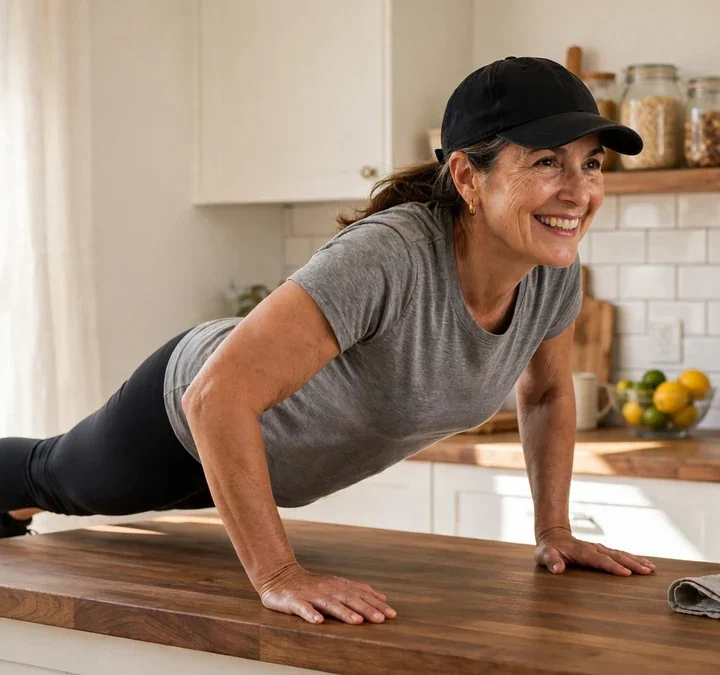
Place your hands on a countertop edge or on the floor with your knees down, hands slightly wider than your shoulders. Keep your body straight from head to knees or heels. Lower your chest toward the surface by bending your elbows to about 45 degrees from your body, then press back up.
Easier: Use a wall, standing with your feet close to it.
Harder: Lower the surface step by step, from countertop to chair seat to floor, and slow the lowering phase to three seconds.
Table or sheet row
Lie under a sturdy table and grip the edge, or use a sheet trapped over a latched door and lean back with straight arms. Keep your body in one straight line and pull your chest toward the table or door, squeezing your shoulder blades together. Lower slowly.
Easier: Bend your knees with feet flat, or stand more upright at the door.
Harder: Straighten your legs and move your feet forward so your body is closer to horizontal.
Chair dip, short range
Sit on the edge of a sturdy chair with your hands beside your hips, fingers forward. Walk your feet out a step and support your weight on your hands with your knees bent. Lower your body just a few inches by bending your elbows, keeping your shoulders down away from your ears, then press back up. Keep the range small; this should feel like arm work, not a shoulder stretch.
Easier: Keep your feet close under your knees and lower only 2 to 3 inches, or swap in wall push-ups if dips bother your shoulders.
Harder: Walk your feet further out and lower a little deeper, never past the point where your shoulders feel pinched.
Forearm plank
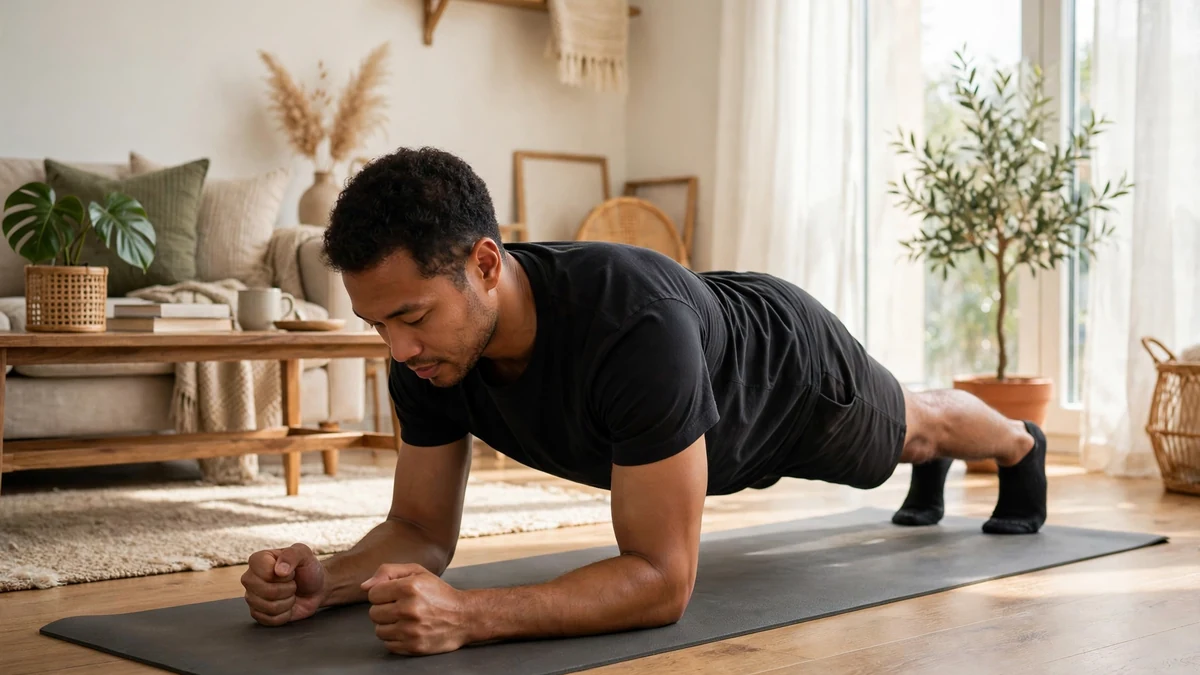
Rest on your forearms and knees or toes, elbows under your shoulders. Keep your body in a straight line, tighten your stomach gently, and breathe normally while you hold. Look down at the floor to keep your neck relaxed.
Easier: Do a wall plank, leaning on your forearms against a wall, or hold the floor plank from your knees for shorter times.
Harder: Extend the hold by 5 to 10 seconds, or lift one foot a few inches off the floor for a few seconds at a time.
Cool-down and stretching
- Shake out your arms and hands for 30 seconds.
- Cross one arm over your chest and hold for 30 seconds per side.
- Do a doorway chest stretch, 30 seconds per side.
- Clasp your hands behind your back, straighten your arms gently, and lift slightly for a chest and shoulder stretch, 20 to 30 seconds.
- Stretch the front of your forearms by gently pressing your fingers back with the other hand, 20 seconds per side.
- Finish with 5 slow breaths, rolling your shoulders down and back.
How to progress
Start with 2 sets of each move, twice a week. When you can finish the top of the rep range with good form, first add a third set. Next, make one move harder using its harder option, one move per week. After four to six weeks, most beginners can move push-ups to a lower surface and rows to a flatter body angle. Keep a simple note of your surface height, reps, and sets so you can see the progress adding up.
Safety notes
Stop and rest if you feel pain, dizziness, nausea, or chest pain, and seek medical help right away for chest pain. Talk with your doctor before starting if you have been inactive or have a health condition. Choose good form over speed and extra reps. Never exercise through sharp joint pain, especially in the shoulders during dips; swap the move instead. Check that chairs and tables are stable before you put weight on them.
Common mistakes
- Flaring the elbows wide during push-ups instead of keeping them at about 45 degrees.
- Shrugging the shoulders up toward the ears during dips and rows.
- Going deep on chair dips when a short range is safer for beginner shoulders.
- Letting the hips sag in the plank.
- Training the same muscles hard two days in a row.
- Skipping rows, which leaves the back untrained while the chest gets stronger.
Pair it with a diet plan
Upper body work pairs well with regular protein at meals. The 7-Day Meal Plan for Strength Training Beginners plans a full week of balanced eating. Not sure about portions? The Calorie Calculator offers a quick general estimate to start from.
Frequently asked questions
Can bodyweight moves really build upper body strength?
Yes, especially for beginners. Your muscles respond to effort, and incline push-ups, rows, and dips provide plenty of it when done slowly with good form. As you get stronger, lowering the surface or flattening your body angle keeps the same moves challenging.
Why do my wrists hurt during push-ups?
Stiff wrists are common. Try push-ups on a countertop edge, hold dumbbell-free grips such as push-up handles if you have them, or make fists so your wrists stay straighter. If wrist pain is sharp or does not settle, stop and talk with a doctor.
How long until I can do a full floor push-up?
It varies. Many beginners get there in four to eight weeks by lowering the surface gradually: wall, countertop, chair seat, knees on the floor, then toes. There is no deadline, and knee push-ups remain a useful exercise even after you progress.
Should I train upper body and lower body on the same day?
You can, but many beginners prefer splitting them so each session stays short and energy stays up. A simple pattern is upper body on Monday, lower body on Wednesday, and a full-body or walking day on Friday.
What if chair dips bother my shoulders?
Skip them. Replace dips with an extra set of push-ups at a comfortable height, which still trains the backs of your arms. Shoulder comfort is a valid reason to change any exercise.
Sources and further reading
- Physical Activity Guidelines for Americans, US Department of Health and Human Services: health.gov
- CDC, physical activity basics for adults: cdc.gov
- MedlinePlus, exercise and physical fitness background: medlineplus.gov
This article is for general educational purposes only and is not medical, nutrition, or fitness advice. Talk with your doctor or a registered dietitian before changing your diet or starting an exercise program.