Prints just the plan, like a recipe card.
Last updated: November 23, 2026.
Stairs feel harder than they used to, and getting up from the floor takes more effort than you would like. Stronger legs fix a lot of everyday moments like those, and you can start building them at home with no equipment at all.
This lower body bodyweight workout trains your thighs, glutes, hips, and calves with five beginner-friendly moves. It suits healthy adults who are new to strength training, and it takes about 20 minutes. You need a sturdy chair for balance and squats, a clear floor space, and comfortable shoes.
This workout sits in our Exercise and Workouts collection, where you can also find walking plans and stretching routines. It pairs well with the 7-Day Meal Plan for Strength Training Beginners from our Diet Plans library.
Key takeaways
- Squats, bridges, lunges, step-ups, and calf raises cover all the main leg and hip muscles.
- A chair gives you balance support and a target depth for squats.
- Every move starts with a supported, partial-range version.
- Two sessions a week is a good starting rhythm for beginners.
Who this workout is for, and who should check with a doctor first
This workout is for adults who want stronger, steadier legs for daily life and walking. It is a good fit if you can stand and walk without assistance and want to add structured strength work at a gentle pace.
Check with your doctor first if you have been inactive for a long time, have a heart condition, have knee, hip, ankle, or back problems, are pregnant, have had recent surgery or a joint replacement, or have a history of chest pain. Balance problems or a history of falls are also reasons to get medical guidance before starting.
If you have a history of disordered eating, talk with a doctor or a registered dietitian before following any diet plan. For eating disorder support in the US, visit the National Alliance for Eating Disorders at allianceforeatingdisorders.com.
What you need
- A sturdy chair without wheels, placed against a wall so it cannot slide.
- A low, stable step, bottom stair, or thick book for step-ups, only if it feels solid.
- A wall or countertop for balance during lunges and calf raises.
- Supportive shoes and clothing you can bend and step in.
- Water nearby.
Warm-up (5 minutes)
- March in place for 1 minute, swinging your arms.
- Do 10 gentle knee lifts, holding the chair if needed.
- Do 8 sit-to-stands from the chair at an easy pace.
- Circle each ankle 8 times in each direction, holding the chair for balance.
- Do 8 small hip hinges: hands on hips, push your hips back slightly with soft knees, then stand tall.
The workout: lower body bodyweight session
Do each exercise for the reps listed, resting 45 to 90 seconds between sets. Complete 2 sets of each move in your first weeks, building to 3 sets. Move slowly, about two seconds down and two seconds up, and keep breathing.
| Exercise | Reps | Sets |
|---|---|---|
| Chair squat (sit-to-stand) | 8 to 12 | 2 to 3 |
| Glute bridge | 10 to 15 | 2 to 3 |
| Supported reverse lunge | 5 to 8 per side | 2 to 3 |
| Low step-up | 6 to 10 per side | 2 |
| Standing calf raise | 10 to 15 | 2 to 3 |
Chair squat (sit-to-stand)
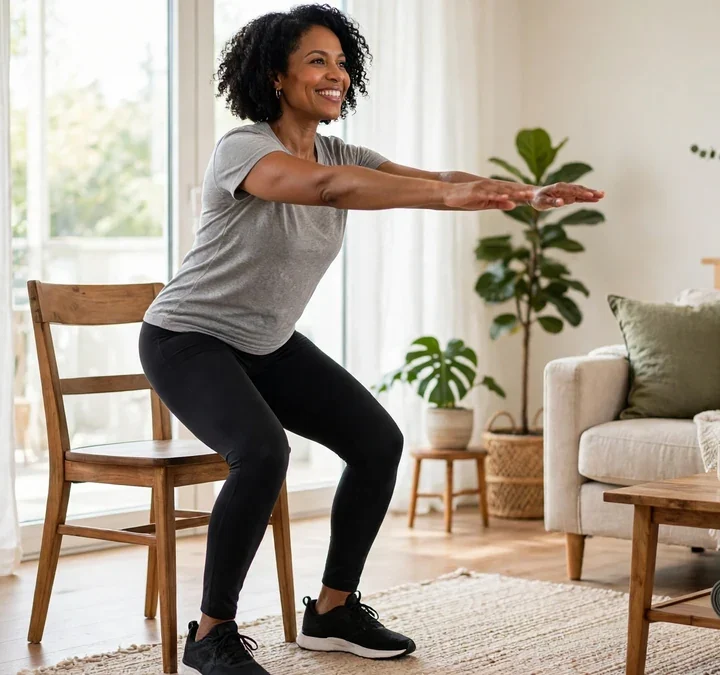
Sit on the front half of the chair with your feet flat, hip width apart. Lean your chest slightly forward, press through your whole foot, and stand up fully. Sit back down slowly, tapping the chair before standing again. Keep your knees pointing the same way as your toes.
Easier: Use your hands on the chair or your thighs to help you stand, and choose a higher seat.
Harder: Cross your arms over your chest, or hover just above the chair without fully sitting.
Glute bridge
Lie on your back, knees bent, feet flat and hip width apart, arms by your sides. Press through your heels and lift your hips until your shoulders, hips, and knees form a line. Squeeze your glutes for one second, then lower slowly without fully relaxing at the bottom.
Easier: Lift your hips partway and rest fully between reps.
Harder: Hold the top for 3 seconds, or lift one foot slightly at the top for a few reps per side.
Supported reverse lunge
Stand beside a countertop or chair back and hold it lightly. Step one foot back about two feet, bend both knees, and lower until your front thigh is partway toward parallel, keeping your torso tall. Push through your front foot to return to standing. Finish all reps on one side or alternate.
Easier: Take a shorter step and lower only a few inches.
Harder: Let go of the support for balance, or lower deeper with a longer step.
Low step-up
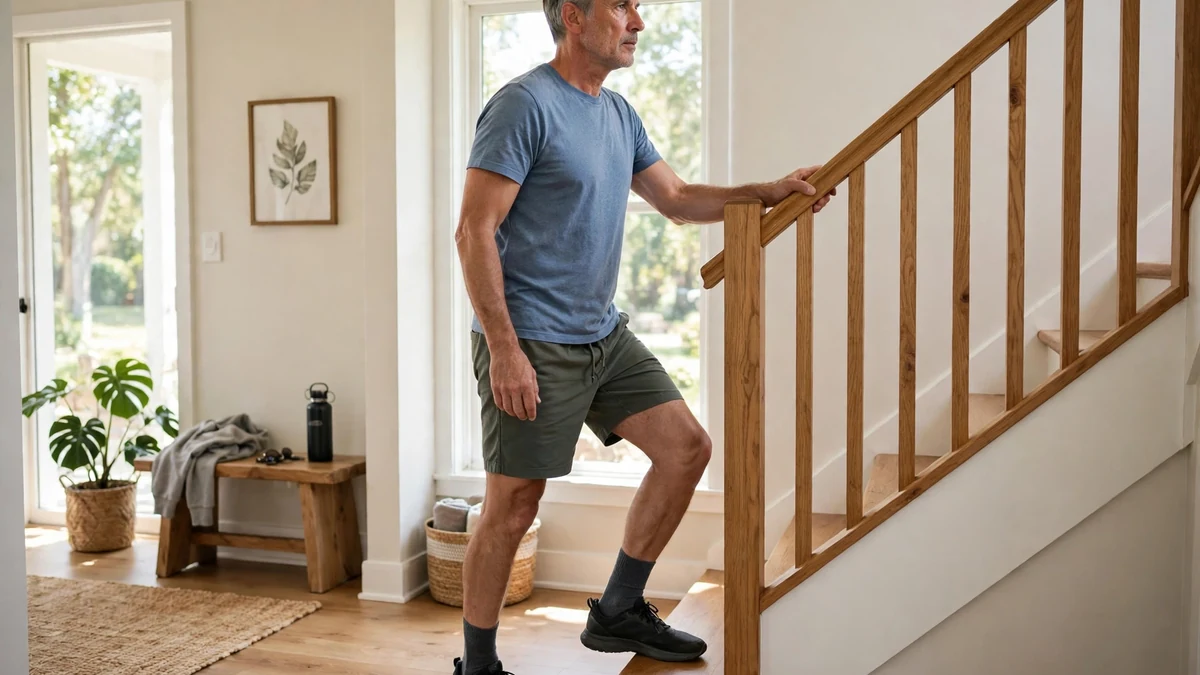
Face a low step or bottom stair and hold a rail or wall. Place your whole right foot on the step, press through it to stand up on the step, then step back down with control. Do all reps on one side, then switch. Your working leg should do the lifting, not a push from the floor foot.
Easier: Use the lowest step available and keep a hand on the rail the whole time.
Harder: Use a slightly higher step, or slow the step-down to a count of three.
Standing calf raise
Stand tall behind a chair, holding the back for balance, feet hip width apart. Press through the balls of your feet to lift your heels as high as comfortable. Pause at the top, then lower slowly until your heels touch the floor.
Easier: Lift your heels only partway and sit down to rest between sets as needed.
Harder: Do the raises on a step edge for a bigger range, or try single-leg raises holding the chair.
Cool-down and stretching
- Walk slowly around the room for 1 minute.
- Standing quad stretch holding the chair, 30 seconds per side.
- Calf stretch against a wall, 30 seconds per side.
- Figure-four stretch lying down or seated for your hips and glutes, 30 seconds per side.
- Seated hamstring stretch: extend one leg, heel on the floor, and hinge gently forward for 30 seconds per side.
- Finish with 5 slow breaths.
How to progress
Weeks 1 and 2: 2 sets of each move, twice a week, using support freely. Weeks 3 and 4: add a third set to the squats and bridges, and try one harder option. Weeks 5 and 6: reduce how much you rely on the chair during lunges, and slow the lowering phase of step-ups. After that, you can add a third weekly session or move on to a dumbbell leg workout. Progress one small step at a time, and repeat any week that still feels like plenty.
Safety notes
Stop and rest if you feel pain, dizziness, nausea, or chest pain, and seek medical help right away for chest pain. Talk with your doctor before starting if you have been inactive or have a health condition. Choose good form over speed or depth. Never exercise through sharp joint pain; if lunges bother your knees, shorten the step and reduce the depth, or swap in extra chair squats. Keep a support within reach for every standing move until your balance is reliable.
Common mistakes
- Letting the knees cave inward during squats and lunges.
- Bouncing out of the bottom of a squat instead of standing with control.
- Pushing off the floor foot during step-ups instead of using the leg on the step.
- Rushing calf raises without a pause at the top.
- Holding your breath on the hard part of each rep.
- Skipping balance support to prove a point, and wobbling through every set.
Pair it with a diet plan
Leg training and regular meals with protein go well together. The 7-Day Meal Plan for Strength Training Beginners lays out a full week of balanced eating. The Calorie Calculator can help you check that your intake roughly matches your activity level.
Frequently asked questions
Will this workout make my legs bulky?
No. Beginner bodyweight training builds strength and firmness gradually, and noticeable bulk requires far more training volume and food than this routine involves. What most people notice first is that stairs, hills, and getting up from low seats feel easier.
My knees ache during squats. What should I do?
Try a higher chair, a shallower depth, and check that your knees track over your toes rather than caving in. Mild muscle effort is fine, but joint pain is a signal to adjust. If knee pain keeps happening, talk with a doctor or physical therapist before continuing.
How many times a week should I do leg workouts?
Two sessions a week is a good start, with at least one rest day between them. Legs contain large muscles that need recovery time, and walking on the in-between days is a great complement.
Can I do this workout if I have balance concerns?
Only with support and, ideally, after checking with your doctor. Every standing move here can be done while holding a chair or countertop, and the bridge is done lying down. If your balance feels unreliable, a supervised program may be a safer starting point.
Do I need to be sore for it to work?
No. Soreness is common when an exercise is new, but it is not the goal and it fades as your body adapts. Steady progress in reps, sets, and control is a better sign that the workout is working.
Sources and further reading
- Physical Activity Guidelines for Americans, US Department of Health and Human Services: health.gov
- CDC, physical activity basics for adults: cdc.gov
- MedlinePlus, exercise and physical fitness background: medlineplus.gov
This article is for general educational purposes only and is not medical, nutrition, or fitness advice. Talk with your doctor or a registered dietitian before changing your diet or starting an exercise program.