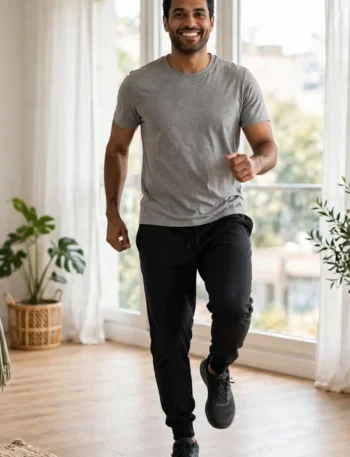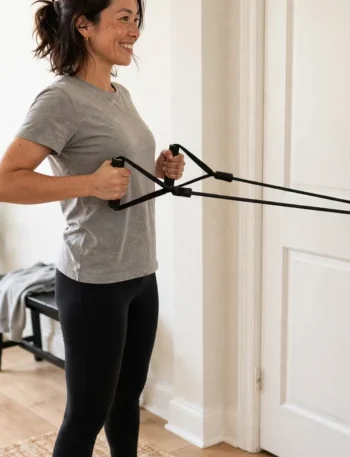
Prints just the plan, like a recipe card.
Last updated: November 23, 2026.
Want to get your heart rate up but your knees say no to jumping? You are not alone. A lot of beginners skip cardio workouts because the videos all seem to involve jumping jacks and burpees, and neither feels friendly to sore knees, a healing ankle, or downstairs neighbors.
This low-impact cardio workout keeps at least one foot on the floor at all times. It takes about 25 minutes, needs no equipment, and uses simple moves in short rounds so you can work at a pace where you can still speak in short sentences. Every move has an easier option, including holding a chair, and a harder option for the days you feel strong.
This workout sits in our Exercise and Workouts collection, which also includes walking plans, chair workouts, and gentle strength routines. It fits naturally with our 7-Day Low-Impact Lifestyle Meal Plan, and you can browse everything in Diet Plans.
Key takeaways
- Low impact means one foot stays on the floor. No jumping, ever, in this workout.
- Work in 40-second rounds with 20 seconds of rest, and repeat the circuit twice to start.
- Use the talk test: you should be able to speak in short sentences while you work.
- A chair beside you turns almost any move into a supported, safer version.
Who this workout is for, and who should check with a doctor first
This workout is for beginners who want cardio exercise that is kind to knees, hips, and ankles. It suits people who are returning to exercise after a break and anyone who prefers to keep things quiet and grounded.
Check with your doctor before starting if you have been inactive for a long time, if you have a heart condition, balance problems, joint problems, or a history of chest pain, or if you are pregnant or recovering from a recent surgery or injury. If you have diabetes or take medication that affects your blood sugar or heart rate, ask your doctor how to pace sessions like this.
If you have a history of disordered eating, talk with a doctor or a registered dietitian before following any diet plan. For eating disorder support in the US, visit the National Alliance for Eating Disorders at allianceforeatingdisorders.com.
What you need
- No equipment. A sturdy chair nearby for balance support is helpful.
- About 6 feet of clear floor space.
- Supportive shoes, or bare feet on a mat if that is comfortable for you.
- A bottle of water and a clock or timer you can see.
Warm-up (5 minutes)
- March in place slowly for 1 minute, arms swinging gently.
- Do 30 seconds of easy side steps, tapping one foot out and back.
- Roll your shoulders in slow circles for 30 seconds.
- Do 10 gentle standing knee lifts, alternating sides, at an easy pace.
- Finish with 1 minute of marching a little faster, and 10 easy heel taps in front of you.
The workout: low-impact cardio circuit
Do each move for 40 seconds, then rest or march slowly for 20 seconds. After the last move, rest 1 to 2 minutes and repeat the circuit. Start with 2 rounds. Keep your movements smooth, land softly on every step, and breathe steadily.
| Exercise | Time | Rounds |
|---|---|---|
| Step touch with reach | 40 seconds | 2 to 3 |
| Standing knee lift | 40 seconds | 2 to 3 |
| Heel tap and press | 40 seconds | 2 to 3 |
| Mini squat to calf raise | 40 seconds | 2 to 3 |
| Low-impact skater step | 40 seconds | 2 to 3 |
| March with arm pulls | 40 seconds | 2 to 3 |
Step touch with reach
Step your right foot out to the side and bring your left foot in to tap beside it, while reaching both arms up and across. Then step to the left and reach the other way. Keep a soft bend in your knees and a steady rhythm. One foot always stays on the floor.
Easier: Skip the arm reach and keep the steps small, holding a chair if you like.
Harder: Reach a little lower toward the floor on each step, or quicken the pace slightly.
Standing knee lift
Stand tall and lift one knee toward hip height while pulling your elbows down toward it, then switch sides in a slow marching rhythm. Brace your core lightly and keep your standing leg soft.
Easier: Lift the knee only partway, and hold a chair for balance.
Harder: Add a small reach overhead with the opposite arm as each knee lifts.
Heel tap and press
Tap one heel on the floor in front of you while pressing both arms forward, then switch sides. Keep your weight mostly on the standing leg and your steps light and quick but controlled.
Easier: Slow down and drop the arm press, or tap your toe instead of your heel.
Harder: Add a gentle double tap on each side before switching.
Mini squat to calf raise
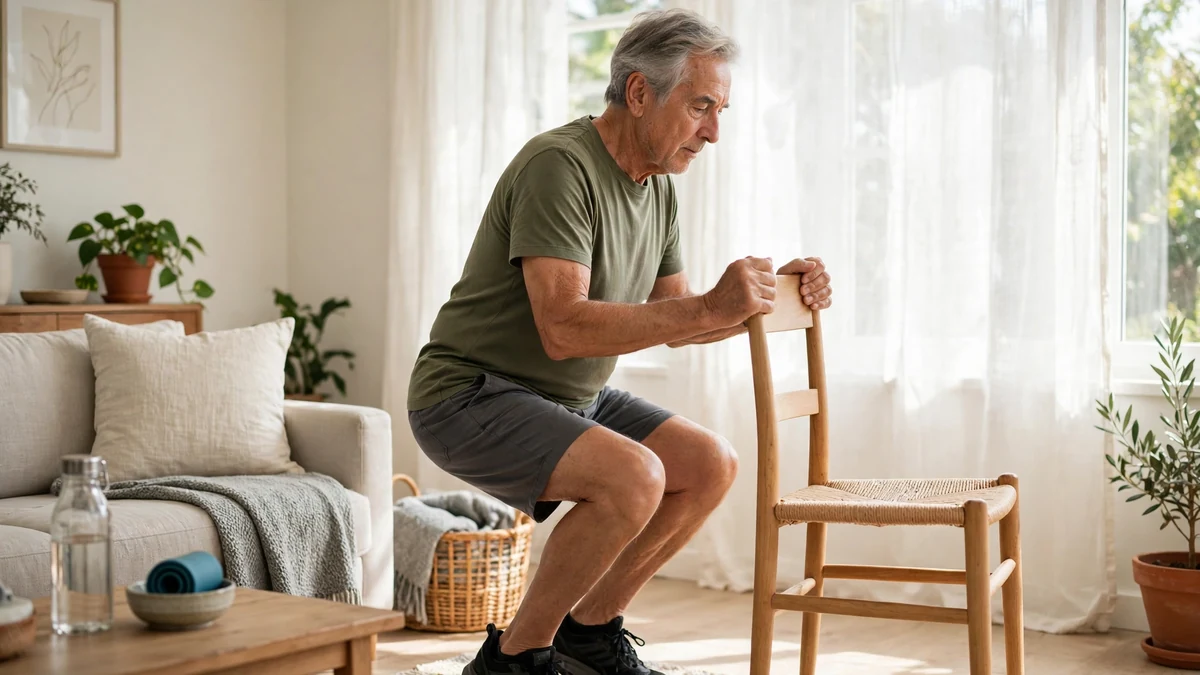
Stand with feet hip-width apart. Sit your hips back into a small squat, about a quarter of the way down, then stand and rise onto the balls of your feet. Lower and repeat at a steady pace. Use a chair back for balance if needed.
Easier: Make the squat smaller and skip the calf raise.
Harder: Sit a little deeper into the squat while keeping your heels down and knees comfortable.
Low-impact skater step
Step your right foot wide to the side and sweep your left foot behind it in a shallow curtsy, reaching your arms across your body. Push back and repeat on the other side. This is a step, not a jump: one foot stays grounded the whole time.
Easier: Make the steps narrower and keep your hands on your hips or a chair.
Harder: Bend a little deeper into the standing leg on each step.
March with arm pulls
March in place with purpose, lifting your knees to a comfortable height. As each knee lifts, pull both elbows down from overhead toward your ribs, as if pulling a rope down. Keep your steps soft and your breathing steady.
Easier: March without the arm pulls and at a slower pace.
Harder: Lift the knees a little higher and quicken the march slightly.
Cool-down and stretching
- March slowly for 1 to 2 minutes until your breathing eases.
- Standing quad stretch holding a chair, 20 to 30 seconds per side.
- Calf stretch against a wall, 20 to 30 seconds per side.
- Chest and shoulder stretch in a doorway, 20 to 30 seconds.
- Side stretch: reach one arm overhead and lean gently to the opposite side. Hold 15 to 20 seconds per side, then finish with slow breaths.
How to progress
Weeks 1 and 2: 2 rounds, and take the easier options whenever you need them. Weeks 3 and 4: aim for 3 rounds, or stretch each work interval to 45 seconds. After that, you can do this workout 3 or 4 days a week, with walking or strength on other days. The Physical Activity Guidelines for Americans recommend at least 150 minutes of moderate-intensity aerobic activity each week, and sessions like this one, plus regular walking, build toward that gradually.
Safety notes
Stop and rest if you feel pain, dizziness, nausea, or chest pain, and seek medical help right away for chest pain. Talk with your doctor before starting if you have been inactive or have any health condition. Good form matters more than speed, so slow down whenever your steps get sloppy or loud. Never exercise through sharp joint pain; low impact should feel gentle on your knees and ankles. Keep water nearby and take extra rest breaks whenever you need them.
Common mistakes
- Going too fast at the start and fading halfway through. Start easier than you think.
- Locking your knees during steps and squats. Keep them soft.
- Skipping rest intervals because the moves look simple.
- Wearing slippery socks on a hard floor. Use shoes or a mat.
- Holding your breath. Keep breathing in a steady rhythm.
Pair it with a diet plan
This workout matches the pace of the 7-Day Low-Impact Lifestyle Meal Plan, a full week of steady, simple meals. If you want to check the calorie level that fits you, the Calorie Calculator gives a quick estimate.
Frequently asked questions
Can low-impact cardio still count as real exercise?
Yes. Intensity is about how hard you are working, not whether you jump. If your breathing is faster, your heart is working harder, and you can speak only in short sentences, you are at a moderate intensity, and that counts.
How many days a week should I do this?
Start with 2 or 3 days a week and add walking on other days. As your fitness builds, you can do this workout up to 4 days a week, keeping at least one easier day between harder sessions.
What if I cannot finish a full round?
Rest whenever you need to, even in the middle of a move, and rejoin when you are ready. Marching slowly during rest intervals still keeps you moving. Finishing part of the workout regularly beats skipping it entirely.
Is this workout okay for sore knees?
It was designed to be gentle on knees, with no jumping and lots of support options. Still, knee problems vary, so check with your doctor or a physical therapist, and stop any move that causes sharp pain.
Do I need to wear shoes?
Supportive shoes are the safer default, especially on hard floors. If you prefer bare feet, use a mat and make sure your footing is secure.
Sources and further reading
- Physical Activity Guidelines for Americans, US Department of Health and Human Services: health.gov
- CDC, physical activity basics for adults: cdc.gov
- American Heart Association, recommendations for physical activity in adults: heart.org
This article is for general educational purposes only and is not medical, nutrition, or fitness advice. Talk with your doctor or a registered dietitian before changing your diet or starting an exercise program.