Prints just the plan, like a recipe card.
Last updated: November 23, 2026.
A stationary bike is the workout that waits for you: no weather, no traffic, no leaving the house. But many beginners climb on, pedal hard for six miserable minutes, and decide cycling is not for them. The problem is almost never the bike. It is the setup and the pacing, and both are fixable in one session.
This beginner stationary bike workout takes about 25 minutes and is built in three parts: an easy spin, a steady middle with short gentle surges, and an easy finish. Before any of that, you will set your seat height correctly, because the wrong seat is the number one cause of sore knees on an indoor bike.
This workout sits in our Exercise and Workouts collection, alongside outdoor cycling and walking plans. It pairs nicely with our 7-Day Winter Comfort Food Meal Plan, since indoor training season and comfort food season tend to arrive together, and the full library is in Diet Plans.
Key takeaways
- Set the seat so your knee keeps a slight bend at the bottom of the pedal stroke.
- Start every ride with 5 easy minutes. Cold legs and instant effort do not mix.
- Use short, gentle surges of 1 minute rather than one long hard push.
- Finish easier than you started, and stretch your calves, quads, and hips afterward.
Who this workout is for, and who should check with a doctor first
This workout is for beginners with access to a stationary bike at home or at a gym, including people who prefer indoor exercise because of weather, darkness, or balance concerns outdoors. The bike supports your weight, which makes it a low-impact option.
Check with your doctor before starting if you have been inactive for a long time, if you have a heart condition, knee or hip problems, balance issues, or a history of chest pain, or if you are pregnant or recovering from a recent surgery or injury, including a joint replacement. Ask specifically about seat height and range of motion if you have had knee or hip surgery.
If you have a history of disordered eating, talk with a doctor or a registered dietitian before following any diet plan. For eating disorder support in the US, visit the National Alliance for Eating Disorders at allianceforeatingdisorders.com.
What you need
- A stationary bike, upright or recumbent, with adjustable resistance.
- Supportive shoes that fit the pedals securely.
- A bottle of water within reach, and a small towel.
- A timer or the bike’s display, and a fan if your room runs warm.
Warm-up (5 minutes)
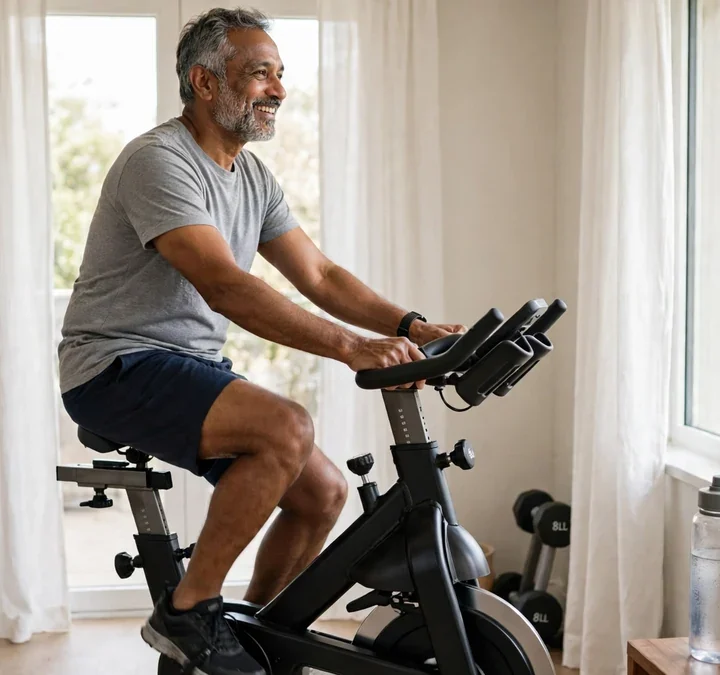
First, the setup. Sit on the bike and put your heel on one pedal at its lowest point. Your leg should be nearly straight. If your knee bends a lot, raise the seat; if you cannot reach, lower it. When you pedal with the ball of your foot, your knee should keep a slight, comfortable bend.
- Pedal at the lowest resistance for 2 minutes, legs turning easily.
- Continue at an easy pace for 2 more minutes, sitting tall with relaxed shoulders.
- Add a touch of resistance for the final minute, still able to talk in full sentences.
The workout: steady ride with gentle surges
The main ride lasts about 15 minutes. The middle block alternates 2 steady minutes with 1 slightly harder minute. Slightly harder means your breathing deepens and talking takes more effort, not a heavy, aching push in your legs. You can repeat the pattern more times as you get fitter, using the progression below.
| Part | Time | Effort |
|---|---|---|
| Easy spin (warm-up pace) | 5 minutes | Easy |
| Steady pedal | 2 minutes | Moderate |
| Gentle surge | 1 minute | A little harder |
| Repeat steady + surge | 4 more rounds | Moderate |
| Easy spin down | 5 minutes | Easy |
Steady pedal
Set the resistance so your legs turn over smoothly, roughly one revolution per second, at an effort where you can speak in short sentences. Sit tall, keep your knees tracking straight ahead, and let your hands rest lightly on the bars.
Easier: Drop the resistance a level and keep the same leg speed.
Harder: Add one level of resistance while keeping your pedaling smooth.
Gentle surge
For 1 minute, either add a small amount of resistance or pedal a little faster, so your breathing deepens and talking gets harder. This is a surge, not a sprint: you should be able to settle right back into the steady pace when the minute ends.
Easier: Make the surge 30 seconds, or skip it and stay steady.
Harder: Stand only if your bike and your balance are designed for it; otherwise, add resistance while seated. Seated is the default for beginners.
Easy spin down
Drop the resistance to your warm-up level and pedal easily for 5 minutes. Let your breathing and heart rate drift down gradually. End the ride feeling worked but not wiped out.
Easier: Extend the easy spin and shorten the middle block next time.
Harder: None needed. The cool-down stays easy on purpose.
Cool-down and stretching
- The easy spin down covers most of the cool-down. Step off carefully once your legs feel steady.
- Standing quad stretch holding the bike, 20 to 30 seconds per side.
- Calf stretch against a wall, 20 to 30 seconds per side.
- Figure-four stretch seated on a chair, ankle over the opposite knee, gentle lean. Hold 20 to 30 seconds per side for your hips.
- Chest stretch and 4 to 5 slow breaths to finish.
How to progress
Weeks 1 and 2: ride 2 or 3 times a week with 3 steady-plus-surge rounds in the middle. Weeks 3 and 4: build to the full 5 rounds. After that, add 2 to 3 minutes to the steady blocks, or add a sixth round. Keep one change at a time and keep at least one rest day between rides at first. This workout counts toward the Physical Activity Guidelines for Americans recommendation of at least 150 minutes of moderate-intensity aerobic activity a week, and you can combine it with walking to reach that total.
Safety notes
Stop and rest if you feel pain, dizziness, nausea, or chest pain, and seek medical help right away for chest pain. Talk with your doctor before starting if you have been inactive or have any health condition. Good form matters more than resistance: if your knees ache, check the seat height first and lower the resistance second. Never pedal through sharp joint pain. Keep the area around the bike clear, and be careful stepping off if your legs feel wobbly. Drink water during the ride, since indoor cycling makes most people sweat more than they expect.
Common mistakes
- Setting the seat too low and blaming the bike for sore knees.
- Cranking the resistance up and grinding slowly instead of spinning smoothly.
- Skipping the easy start and finish, which makes the whole ride feel harder.
- Hunching over the bars with locked elbows. Sit tall and keep a light grip.
- Watching the clock instead of your effort. Use the talk test to pace yourself.
Pair it with a diet plan
Indoor riding season pairs well with the 7-Day Winter Comfort Food Meal Plan, a week of warm, steady meals with the portions worked out. Check your own numbers first with the Calorie Calculator.
Frequently asked questions
Upright or recumbent bike: which is better for beginners?
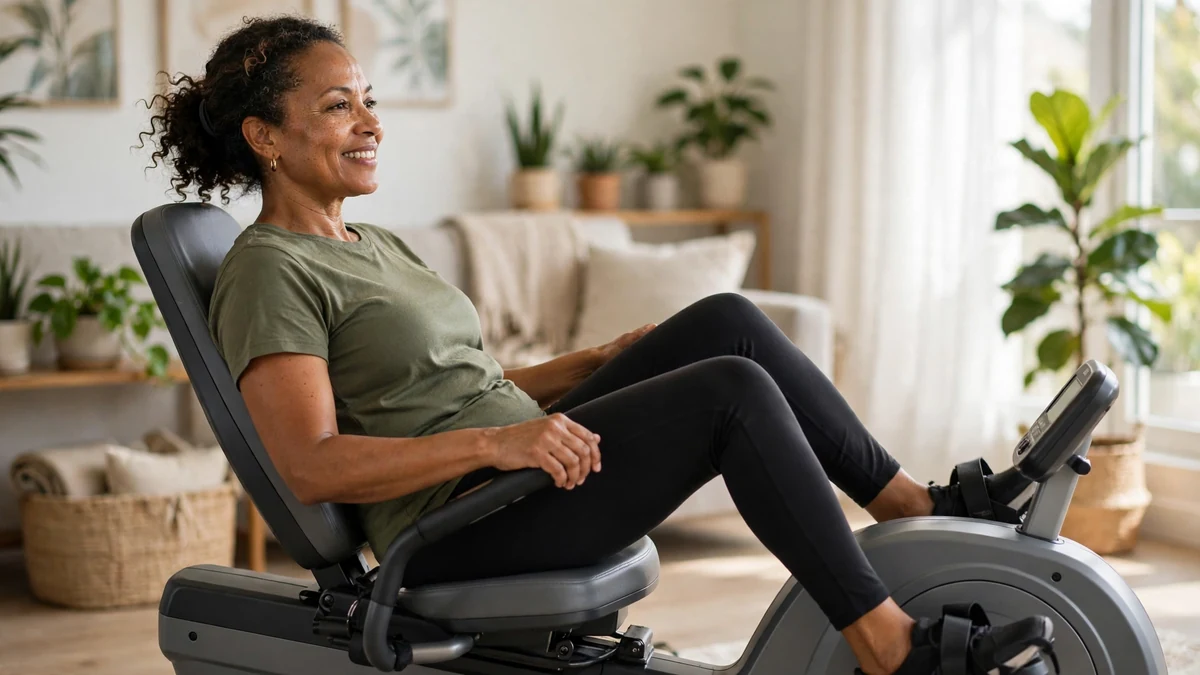
Both work. A recumbent bike has a chair-like seat with back support and is often kinder for people with back discomfort or balance concerns. An upright feels more like a regular bicycle. Choose the one you will actually ride.
How fast should my legs be turning?
Aim for a smooth rhythm of roughly one pedal revolution per second at a resistance that lets you keep that rhythm without rocking side to side. If you are bouncing in the seat, add a little resistance; if you are grinding, take some off.
Why do my knees ache after riding?
Seat height is the first thing to check, followed by resistance that is too high. Raise the seat a little, spin an easier gear, and keep rides shorter while you adjust. Sharp or persistent pain deserves a conversation with your doctor.
Can I watch TV or read while I ride?
Yes, and many beginners find it helps the time pass. Keep your posture tall and check your effort every few minutes so the pace does not quietly fade to nothing, or creep up without you noticing.
How many days a week should I ride?
Two or three days a week is a strong start. Add walking on other days if you like, and build toward a weekly total that fits the federal activity guidelines over time.
Sources and further reading
- Physical Activity Guidelines for Americans, US Department of Health and Human Services: health.gov
- CDC, physical activity basics for adults: cdc.gov
- American Heart Association, recommendations for physical activity in adults: heart.org
This article is for general educational purposes only and is not medical, nutrition, or fitness advice. Talk with your doctor or a registered dietitian before changing your diet or starting an exercise program.