Prints just the plan, like a recipe card.
Last updated: November 23, 2026.
Living upstairs changes how you think about exercise. Every jump sounds like a dropped bowling ball to the people below, and thin floors turn a normal workout into an apology tour. If that has been your excuse, it is a reasonable one, and this workout removes it.
This apartment-friendly cardio routine is quiet from start to finish: no jumping, no stomping, no dropped weights. It takes about 20 to 25 minutes on a rug or mat, in roughly the space of a large bath towel, and every move is done with soft, controlled steps. You will still breathe harder and feel warm; you just will not announce it to the whole building.
This workout sits in our Exercise and Workouts collection, alongside other small-space routines. Readers in apartments often pair it with our 7-Day Meal Plan for Apartment Cooks With No Oven, and the full library is in Diet Plans.
Key takeaways
- Quiet cardio is real cardio. Soft steps and controlled movement keep the noise down and the effort up.
- One foot stays on the floor in every move, which protects both your joints and your floor.
- A rug or mat under your feet absorbs sound and keeps steps silent.
- Work in 40-second rounds with slow marching rests, 2 rounds to start.
Who this workout is for, and who should check with a doctor first
This workout is for anyone in an apartment, condo, or shared house who wants cardio without disturbing anyone. It is also a kind choice for beginners with sensitive knees or ankles, since nothing leaves the floor.
Check with your doctor before starting if you have been inactive for a long time, if you have a heart condition, balance problems, joint problems, or a history of chest pain, or if you are pregnant or recovering from a recent surgery or injury. If balance is a concern, do the whole workout next to a sturdy chair or counter.
If you have a history of disordered eating, talk with a doctor or a registered dietitian before following any diet plan. For eating disorder support in the US, visit the National Alliance for Eating Disorders at allianceforeatingdisorders.com.
What you need
- A rug, carpet, or exercise mat to soften your steps.
- A sturdy chair or counter within reach for balance.
- Supportive shoes with soft soles, or socks with grip on a mat.
- A timer, comfortable clothes, and a bottle of water.
Warm-up (5 minutes)
- Walk in place very slowly for 1 minute, rolling your feet heel to toe so each step is silent.
- Do 30 seconds of gentle side steps, keeping your feet low.
- Roll your shoulders slowly for 30 seconds, then circle your arms gently.
- Do 10 slow standing knee lifts at an easy height, holding the chair if you like.
- Finish with 1 minute of easy marching and 8 quiet heel digs in front of you.
The workout: quiet cardio circuit
Do each move for 40 seconds, then march slowly in place for 20 seconds. Rest 1 to 2 minutes after the last move, then repeat. Start with 2 rounds. The test of good form here is simple: if someone in the next room can hear your feet, slow down and soften your steps.
| Exercise | Time | Rounds |
|---|---|---|
| Silent step-back | 40 seconds | 2 to 3 |
| Standing bicycle, slow | 40 seconds | 2 to 3 |
| Gentle shadow boxing | 40 seconds | 2 to 3 |
| Heel dig with reach | 40 seconds | 2 to 3 |
| Standing oblique crunch | 40 seconds | 2 to 3 |
| Quiet calf raise and march | 40 seconds | 2 to 3 |
Silent step-back
Stand tall with soft knees. Step one foot back and tap the ball of your foot on the floor behind you, then return and switch sides. Keep almost all your weight on the front leg, and place each foot down gently rather than pushing off. Move in a smooth, quiet rhythm.
Easier: Make the step back smaller and hold a chair for balance.
Harder: Bend the front knee a little deeper as you tap back, like a shallow reverse lunge.
Standing bicycle, slow
Stand tall with your fingertips behind your head, elbows wide. Lift one knee and rotate the opposite elbow gently toward it, then switch sides slowly. This is a balance and core move done at walking pace, not a race.
Easier: Keep your hands on your hips and just lift the knees.
Harder: Pause for 1 second with each knee lifted before switching.
Gentle shadow boxing
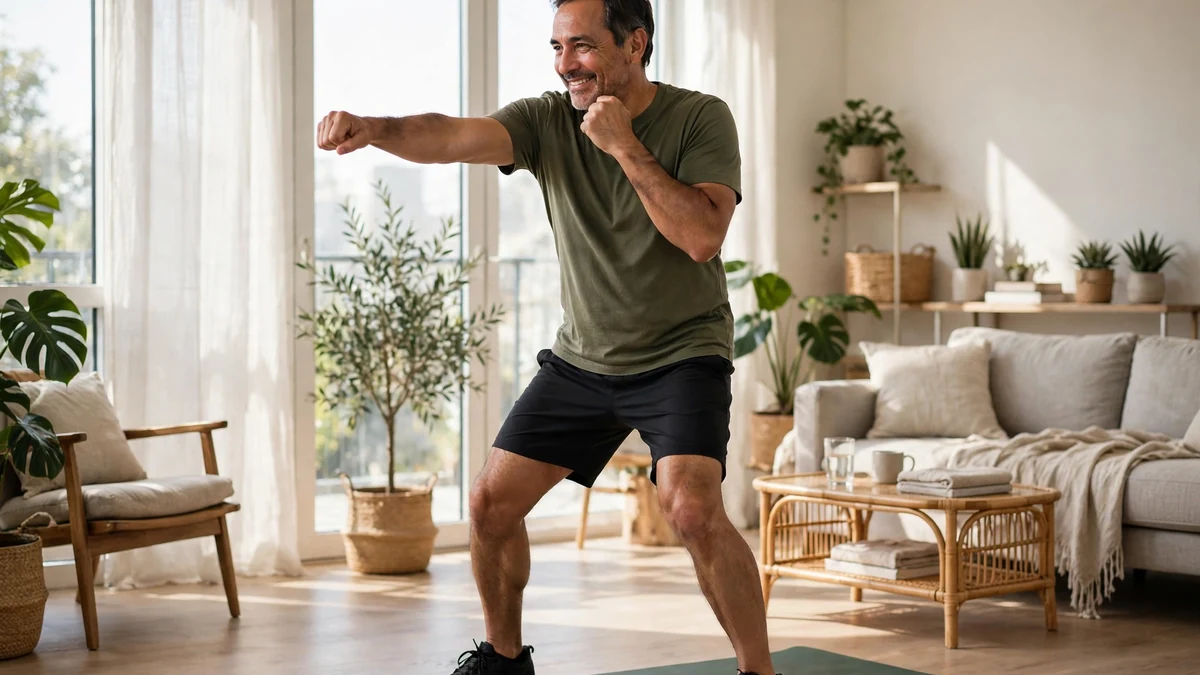
Stand with feet a little wider than hip-width, knees soft. Punch forward slowly, alternating arms, turning your torso slightly with each punch. Keep the punches controlled and your steps planted; shift your weight side to side instead of bouncing.
Easier: Punch at half speed with smaller movements.
Harder: Add a small knee bend as you punch, rising and lowering in a slow rhythm.
Heel dig with reach
Dig one heel into the floor in front of you while reaching both arms forward, then switch sides. Keep the taps light and the rhythm steady. Your standing leg does quiet, steady work while the other foot barely makes a sound.
Easier: Drop the arm reach and slow the pace.
Harder: Reach a little farther and add a gentle double dig on each side.
Standing oblique crunch
Stand with feet hip-width apart and one arm reaching overhead. Lift the knee on that side up toward your elbow while bringing the elbow down, crunching gently through your side. Return and do all reps on one side for 20 seconds, then switch for 20 seconds.
Easier: Lift the knee only partway and hold the chair with the free hand.
Harder: Slow the crunch down and pause at the squeeze for 1 second.
Quiet calf raise and march
Rise slowly onto the balls of your feet, pause, and lower without a sound. Do 4 calf raises, then march in place softly for 4 steps. Repeat the pattern until the timer ends. Hold a chair if your balance needs it.
Easier: Do the calf raises holding the chair with both hands.
Harder: Slow the lowering to a count of 3 on each raise.
Cool-down and stretching
- Walk in place slowly for 1 to 2 minutes.
- Calf stretch against a wall, 20 to 30 seconds per side.
- Standing quad stretch holding the chair, 20 to 30 seconds per side.
- Side stretch, reaching one arm overhead and leaning gently, 15 to 20 seconds per side.
- Chest stretch in a doorway or with hands clasped behind your back, 20 to 30 seconds, then slow breaths to finish.
How to progress
Weeks 1 and 2: 2 rounds at a pace where your steps stay silent. Weeks 3 and 4: add a third round, or lengthen each interval to 45 seconds of work. After a month, you can do this session 3 or 4 times a week. Sessions like this help you build toward the Physical Activity Guidelines for Americans recommendation of at least 150 minutes of moderate-intensity aerobic activity each week, alongside walking and everyday movement.
Safety notes
Stop and rest if you feel pain, dizziness, nausea, or chest pain, and seek medical help right away for chest pain. Talk with your doctor before starting if you have been inactive or have any health condition. Good form matters more than speed; quiet, controlled steps are both safer and harder than sloppy fast ones. Never exercise through sharp joint pain. Make sure your rug or mat cannot slide, and clear the small space around you before you start.
Common mistakes
- Letting steps get loud as you tire. Noise is your form check: slow down.
- Working out in slippery socks on bare wood. Use a mat or shoes.
- Skipping the chair support when your balance is shaky.
- Rushing the standing bicycle until it becomes twisting with momentum.
- Holding your breath during the boxing rounds. Breathe out with each punch.
Pair it with a diet plan
The 7-Day Meal Plan for Apartment Cooks With No Oven was designed for small kitchens and pairs neatly with a small-space workout habit. To check your own calorie target, use the Calorie Calculator.
Frequently asked questions
Will my downstairs neighbors really not hear this?
That is the design. One foot stays down, steps are placed rather than dropped, and a rug absorbs what little sound remains. If a move gets noisy as you tire, slow down or rest; quiet is the goal.
Can quiet cardio still raise my heart rate?
Yes. Big arm movements, deeper knee bends, and steady pacing all raise your effort without impact. Use the talk test: short sentences should feel possible but effortful.
How small a space do I need?
About the size of a yoga mat is enough. Every move happens in place or with one step to the side or back.
What if I live on the ground floor?
The workout still works well. The no-jumping design is gentle on joints for everyone, and you can use the harder options freely since noise is not a concern.
How often should I do this workout?
Start with 2 or 3 days a week. Add a fourth day when the routine feels comfortable, and mix in walking or strength sessions on other days if you like.
Sources and further reading
- Physical Activity Guidelines for Americans, US Department of Health and Human Services: health.gov
- CDC, physical activity basics for adults: cdc.gov
- American Heart Association, recommendations for physical activity in adults: heart.org
This article is for general educational purposes only and is not medical, nutrition, or fitness advice. Talk with your doctor or a registered dietitian before changing your diet or starting an exercise program.