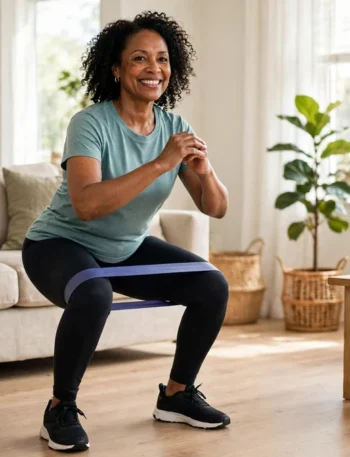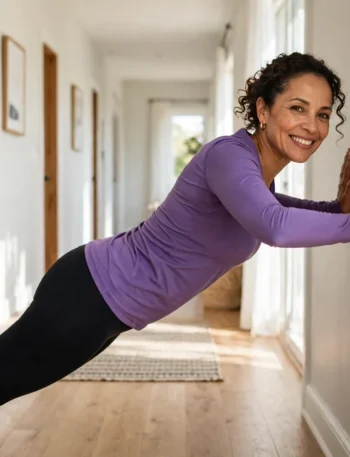
Prints just the plan, like a recipe card.
Last updated: November 23, 2026.
You know strength training is supposed to matter, but the gym feels like too much, and you own no equipment at all. A reasonable question follows: can a beginner actually build strength with nothing but body weight and a chair?
Yes. This workout uses six simple moves (chair squats, wall push-ups, glute bridges, bird dogs, calf raises, and standing leg raises) to work your legs, chest, arms, back, and core in about 25 to 30 minutes. You need a sturdy chair, a wall, and a small patch of floor. Every move comes with an easier and a harder option, so the same workout can grow with you for months.
This workout sits in our Exercise and Workouts collection, with our other beginner routines. It pairs well with the eating pattern in our 7-Day Meal Plan for Strength Training Beginners, and you can browse the full library in our Diet Plans section.
Key takeaways
- Six basic moves cover the whole body: legs, pushing muscles, hips, back, and core.
- Two rounds of the circuit, with rest between moves, is plenty for a beginner.
- Slow, controlled reps with good form beat fast, sloppy ones every time.
- Use the easier options without hesitation; they build the same skills.
- Two or three sessions a week, on non-consecutive days, is a solid schedule.
Who this workout is for, and who should check with a doctor first
This workout is for adults who are new to strength training and want a safe, equipment-free starting point at home. It suits people who can get down to the floor and back up, with a chair’s help if needed.
Check with your doctor before starting if you have been inactive for a long time, if you have a heart condition, joint problems (especially knees, hips, shoulders, or back), balance concerns, if you are pregnant, if you have had recent surgery or an injury, or if you have ever had chest pain during activity. When in doubt, ask first.
If you have a history of disordered eating, talk with a doctor or a registered dietitian before following any diet plan. For eating disorder support in the US, visit the National Alliance for Eating Disorders at allianceforeatingdisorders.com.
What you need
- A sturdy chair without wheels, placed against a wall so it cannot slide
- A clear wall space for push-ups
- A mat, carpet, or towel for floor moves
- Comfortable clothing and supportive shoes, or bare feet on a non-slip floor
- A water bottle and a small towel
Warm-up (5 minutes)
- March in place for 1 minute, swinging your arms gently.
- Roll your shoulders forward and backward, 10 times each way.
- Do 10 slow standing knee lifts, alternating sides.
- Do 8 sit-to-stands from your chair, at an easy pace, using your hands if you like.
- Do 10 gentle arm circles in each direction, then shake out your arms and legs.
The workout
Move through the six exercises in order, resting 30 to 60 seconds between them. After the last one, rest 1 to 2 minutes and repeat the circuit once more. Breathe out on the effort and in on the return for every rep.
| Exercise | Reps or time | Rounds |
|---|---|---|
| Chair squat | 8 to 12 reps | 2 |
| Wall push-up | 8 to 12 reps | 2 |
| Glute bridge | 10 to 15 reps | 2 |
| Bird dog | 6 to 8 reps per side | 2 |
| Standing calf raise | 12 to 15 reps | 2 |
| Standing side leg raise | 8 to 10 reps per side | 2 |
Chair squat
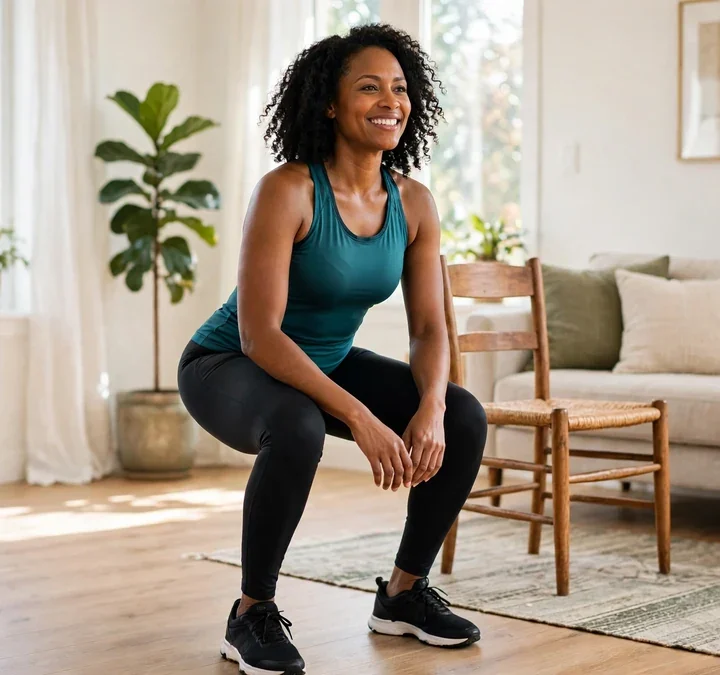
Stand in front of your chair with feet about hip-width apart, toes pointing slightly out. Push your hips back and bend your knees to sit down lightly on the chair, keeping your chest lifted and your weight in your heels and mid-foot. As soon as you touch the chair, press through your feet to stand tall. Keep your knees tracking in line with your toes.
Easier: Use a higher chair or a chair with a firm cushion on it, and use your hands on your thighs to help you stand.
Harder: Hover just above the chair without fully sitting, or slow the lowering down to a count of three.
Wall push-up
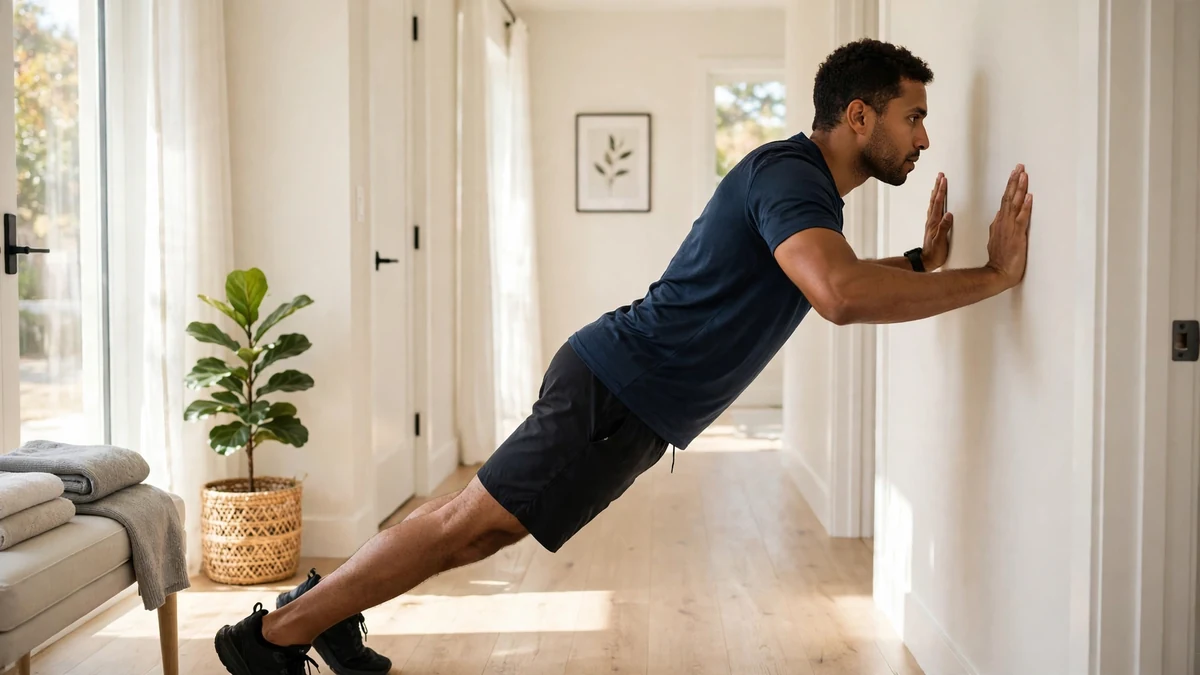
Stand facing a wall, about an arm’s length away, and place your palms flat on the wall at shoulder height, slightly wider than your shoulders. Keeping your body in one straight line from head to heels, bend your elbows to bring your chest toward the wall, then press back to the start. Keep your elbows pointing down and back, not flared wide.
Easier: Stand closer to the wall so less of your weight leans into the move.
Harder: Step your feet farther from the wall, or move to a sturdy countertop for a lower angle.
Glute bridge
Lie on your back with knees bent and feet flat on the floor, hip-width apart, arms resting by your sides. Press through your heels and lift your hips until your body forms a straight line from shoulders to knees, squeezing your glutes at the top. Pause for a second, then lower slowly.
Easier: Lift your hips only partway, to a height that feels comfortable.
Harder: Hold the top position for 3 to 5 seconds each rep, or march your feet in place slowly while keeping your hips level.
Bird dog
Start on hands and knees, hands under shoulders and knees under hips, back flat. Slide one arm forward and the opposite leg back until both are in line with your body, keeping your hips level and your core braced as if balancing a cup of water on your back. Pause, return slowly, and switch sides.
Easier: Move only the arm, or only the leg, one at a time.
Harder: Hold each extended position for 3 to 5 seconds before switching.
Standing calf raise
Stand tall behind your chair with fingertips resting on it for balance. Press through the balls of your feet to lift your heels as high as comfortable, pause at the top, and lower slowly. Keep the movement smooth, with no bouncing at the bottom.
Easier: Lift your heels only partway, and keep both feet firmly in the movement.
Harder: Slow the lowering to a count of three, or try a few reps on one foot while holding the chair.
Standing side leg raise
Stand tall beside your chair, holding it lightly. Keeping your standing leg soft and your body upright, lift the outside leg out to the side with toes pointing forward, to about 12 to 18 inches if comfortable. Lower slowly. Do all reps on one side, then switch. Your hips should stay level and your torso should not lean away.
Easier: Lift the leg only a few inches, and keep a firmer hold on the chair.
Harder: Pause for 2 seconds at the top of each rep, or add a second set on each side.
Cool-down and stretching
Walk slowly around the room for 1 to 2 minutes, then hold each stretch for about 20 to 30 seconds per side:
- Standing quadriceps stretch: Holding the chair, bend one knee and bring your heel toward your hip.
- Calf stretch: Step one foot back, heel down, and lean gently toward a wall.
- Chest opener: Clasp your hands behind your back and gently lift them while opening your chest.
- Seated figure-four stretch: Sit tall, cross one ankle over the opposite knee, and lean forward slightly until you feel a stretch in the hip.
How to progress
Stay with two rounds until every exercise feels controlled and you finish with a little energy left. Then progress in small steps: first add 2 reps to each exercise, then add a third round, then start choosing the harder options for one exercise at a time. The Physical Activity Guidelines for Americans recommend that adults get at least 150 minutes of moderate-intensity aerobic activity each week, plus muscle-strengthening activities on 2 or more days a week. This workout, twice a week alongside regular walking, covers the strengthening side of that guidance.
Safety notes
Stop and rest if you feel pain, dizziness, nausea, or chest pain, and seek medical help right away for chest pain or trouble breathing. Talk with your doctor before starting if you have been inactive or have a health condition. Choose good form over speed or extra reps, and never try to push through sharp joint pain. Mild muscle effort and next-day soreness are normal when you start; sharp, stabbing, or one-sided pain is not. Make sure your chair cannot slide, and clear the floor before floor moves.
Common mistakes
- Rushing reps and letting momentum do the work.
- Holding your breath through the hard part of a move.
- Letting knees cave inward during squats.
- Skipping the warm-up because the workout looks simple.
- Doing the workout every day instead of leaving rest days between sessions.
- Choosing the hardest option first and losing form by the second round.
Pair it with a diet plan
Strength training and adequate protein go together. Our 7-Day Meal Plan for Strength Training Beginners lays out a week of meals built for people starting exactly this kind of routine. To estimate your daily calorie needs, try the free Calorie Calculator.
Frequently asked questions
How often should I do this workout?
Two or three times a week, with at least one rest day between sessions. Your muscles rebuild on the rest days, so more is not automatically better.
Will bodyweight exercises really make me stronger?
Yes, especially as a beginner. Your muscles respond to effort, not to where the resistance comes from, and the harder options in this workout can keep challenging you for a long time.
Is it normal to be sore the next day?
Mild, even soreness in the muscles you worked is common for the first week or two and usually fades as your body adapts. Sharp pain, joint pain, or soreness that changes how you move is a sign to rest and, if it persists, to check with a doctor.
What if I cannot get down to the floor for bridges and bird dogs?
Use a firm bed for the bridge if the floor is not manageable, or swap bird dogs for standing knee lifts with a reach. A sturdy chair can also help you lower and raise yourself with control. If floor work is not safe for you, ask a physical therapist for seated alternatives.
When should I add weights?
When two or three rounds with the harder options feel controlled and leave you with energy to spare, you are ready to try a beginner dumbbell routine. There is no rush; many people progress on bodyweight alone for months.
Sources and further reading
- Physical Activity Guidelines for Americans, US Department of Health and Human Services: health.gov
- Centers for Disease Control and Prevention, physical activity basics for adults: cdc.gov
- American Heart Association, recommendations for physical activity in adults: heart.org
- MedlinePlus, exercise and physical fitness: medlineplus.gov
This article is for general educational purposes only and is not medical, nutrition, or fitness advice. Talk with your doctor or a registered dietitian before changing your diet or starting an exercise program.