Prints just the plan, like a recipe card.
Last updated: November 23, 2026.
You have seen them at the park: walkers pumping small hand weights as they stride along. It is natural to wonder whether carrying light weights would make your own walks do a little more, and whether it is actually a good idea for a beginner.
Done carefully, it can be. This guide shows you how to add very light hand weights to a normal walk: how to choose a starting weight, how to hold and carry them without straining your shoulders, and how to build a 25 to 35 minute weighted walk in stages. The weights stay light on purpose. The walking, not the weight, is the workout.
This workout sits in our Exercise and Workouts collection, with our other beginner walking routines. It pairs well with the eating pattern in our 7-Day Meal Plan for Walkers, and you can browse the full library in our Diet Plans section.
Key takeaways
- Start very light: about 1 to 3 pounds per hand is a common starting range for walking.
- Let your arms swing naturally and low; never pump weights up to shoulder height.
- Walk the first and last parts of every walk without weights.
- Skip the weights on any day your shoulders, elbows, or wrists feel sore.
- If carrying weights changes your stride or posture, the weights are too heavy.
Who this workout is for, and who should check with a doctor first
This guide is for adults who already walk comfortably for at least 20 to 30 minutes and want to add a small upper-body element. It is not a starting point for brand-new walkers; build your plain walking habit first, then come back to this.
Check with your doctor before adding hand weights if you have shoulder, elbow, wrist, or neck problems, if you have a heart condition or blood pressure concerns, if you have been inactive for a long time, if you are pregnant, if you have had recent surgery or an injury, or if you have ever had chest pain during activity. Weights add strain in places plain walking does not, so ask first when in doubt.
If you have a history of disordered eating, talk with a doctor or a registered dietitian before following any diet plan. For eating disorder support in the US, visit the National Alliance for Eating Disorders at allianceforeatingdisorders.com.
What you need
- A pair of light hand weights, about 1 to 3 pounds each, with a grip you can hold without squeezing hard
- Supportive walking shoes
- A water bottle (carry it before or after the weighted section, not during)
- A safe, flat route you know well
- Optional: a small bag or a spot at your turnaround point where you can set the weights down
If the weights have straps, use them loosely as a backup, not as a way to let the weights dangle from your wrists.
Warm-up (5 minutes)
Warm up without the weights:
- Walk at an easy pace for 2 minutes, arms swinging freely.
- Roll your shoulders forward and backward, 10 times each way.
- Open and close your hands 15 times, then circle each wrist 10 times in each direction.
- Do 10 gentle arm swings across your body, alternating sides.
- Walk 1 more easy minute, then pick up the weights.
The weighted walk
The weights join only the middle of the walk. Your warm-up, cool-down, and any hills stay unweighted.
| Part | Weights? | Minutes |
|---|---|---|
| Easy start | No | 5 |
| Weighted steady walk | Yes | 10 to 20 |
| Optional weighted intervals | Yes | 5 |
| Easy finish | No | 5 |
Easy start without weights (5 minutes)
Carry the weights only if you must bring them from home; otherwise pick them up after this section. Walk easily, let your shoulders drop away from your ears, and settle into your normal stride. Your arms should swing from the shoulder, relaxed.
Easier: Extend the easy start to 8 to 10 minutes and shorten the weighted section.
Harder: There is no harder version of warming up. Keep it easy.
Weighted steady walk (10 to 20 minutes)
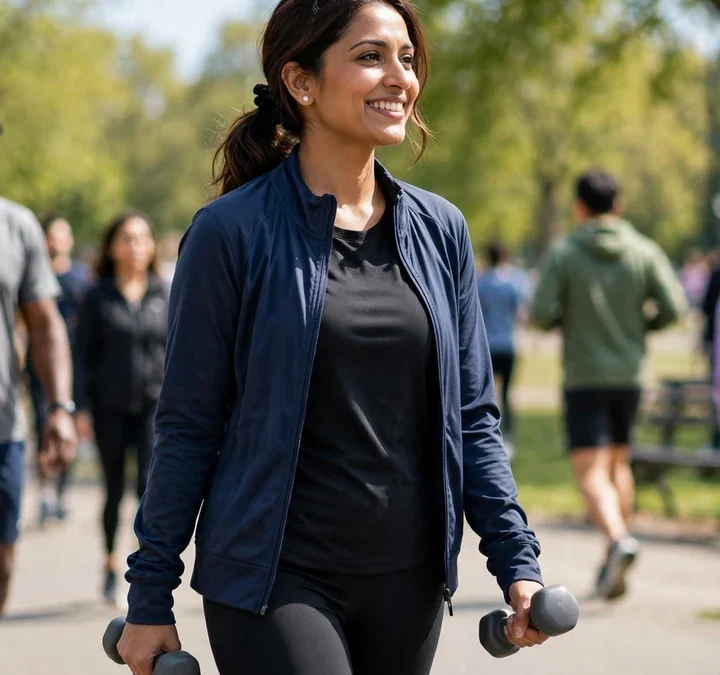
Hold one weight in each hand with a relaxed grip, as if holding a can you do not want to crush. Walk at your normal moderate pace and let your arms swing naturally at your sides, bending your elbows slightly as they come forward. Keep the swing low: your hands should stay below chest height and close to your body. Stand tall, look ahead, and check in every few minutes: shoulders down, jaw loose, grip relaxed.
Easier: Carry the weights for 5 minutes, set them down or carry them in one hand alternately for a stretch, and shorten the section.
Harder: Extend the weighted section toward 20 minutes over several weeks. Do not reach for heavier weights to make it harder.
Optional weighted intervals (5 minutes)
Once the steady section feels easy for two weeks, you may add five 1-minute slightly brisker walks during the weighted section, with 1 minute of normal pace between them. Keep your arm swing the same low, natural pattern even as your legs speed up. The moment your shoulders creep up or your grip tightens, the interval is over.
Easier: Skip the intervals entirely. They are optional seasoning, not the meal.
Harder: Add a second set of intervals later in the walk, after a few easy minutes.
Easy finish without weights (5 minutes)
Set the weights down or carry them loosely in one hand, and walk easily for the last 5 minutes. Shake out your hands and arms every minute or so. Your shoulders and forearms should feel worked but comfortable, never achy.
Easier: Finish with 3 easy minutes and go straight to the stretches below.
Harder: Extend the whole walk by 5 minutes, keeping the added time unweighted.
Cool-down and stretching
Hold each stretch for about 20 to 30 seconds per side:
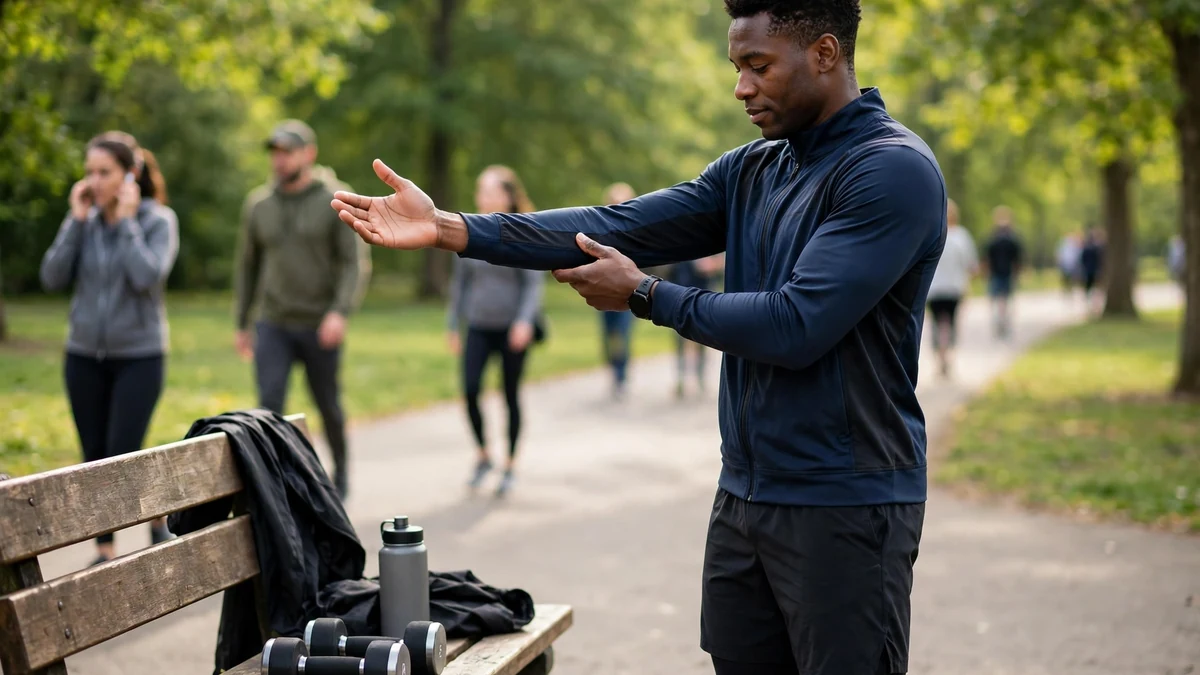
- Forearm stretch: Extend one arm, palm up, and gently press your fingers down with the other hand; then repeat palm down.
- Shoulder stretch: Draw one arm across your chest with the other hand and hold.
- Chest opener: Clasp your hands behind your back and gently lift them while opening your chest.
- Calf stretch: Step one foot back, heel down, and lean gently toward a wall.
- Hand shake-out: Shake both hands loosely for 15 seconds to finish.
How to progress
Progress by adding minutes with the weights, not by adding pounds. Add about 5 minutes to the weighted section each week until you reach 20 minutes. Only consider a slightly heavier pair (for example, moving from 1 pound to 2 or 3 pounds per hand) after several comfortable weeks, and drop back down if your form changes. The Physical Activity Guidelines for Americans recommend that adults get at least 150 minutes of moderate-intensity aerobic activity each week, plus muscle-strengthening activities on 2 or more days a week. Weighted walking supports the aerobic side; a simple bodyweight strength session twice a week covers the rest.
Safety notes
Stop and rest if you feel pain, dizziness, nausea, or chest pain, and seek medical help right away for chest pain or trouble breathing. Talk with your doctor before starting if you have been inactive or have a health condition. Choose good form over speed, and never try to push through sharp joint pain; weights make this rule more important, not less. If your shoulders, elbows, or wrists ache during or after a walk, the weights are too heavy or the session is too long. Never swing weights in big arcs, and keep a relaxed grip to avoid straining your forearms.
Common mistakes
- Starting with weights that are too heavy because they feel light in the store.
- Pumping the weights up to shoulder height like a marching band.
- Gripping tightly for the whole walk and ending with sore forearms.
- Carrying weights for the entire walk, including hills and the cool-down.
- Adding weight before plain walking feels easy and automatic.
Pair it with a diet plan
Regular walkers do well with a simple, steady eating pattern. Our 7-Day Meal Plan for Walkers was written for people building exactly this habit. To estimate your daily calorie needs, try the free Calorie Calculator.
Frequently asked questions
How heavy should my hand weights be?
Start with about 1 to 3 pounds per hand. If you cannot keep a relaxed grip and a natural arm swing, they are too heavy, no matter what the number says.
Can I use wrist weights instead?
Wrist weights keep your hands free, which some walkers prefer, and the same rules apply: keep them light, and stop if your shoulders or elbows complain. Hand weights are easier to set down mid-walk, which is one reason this guide uses them.
Should I carry weights on hills?
No. Walk hills unweighted. Hills already add work for your legs and heart, and adding arm strain on top of that is a common way to end up sore.
What if my shoulders get sore?
Take several days of plain walking, then try again with lighter weights or a shorter weighted section. Soreness that keeps returning is a sign to talk with your doctor or a physical therapist.
Do weighted walks replace strength training?
No. Light hand weights add a little arm and shoulder work, but they do not replace proper muscle-strengthening exercise. Keep a simple bodyweight or dumbbell routine on 2 days a week as your strength base.
Sources and further reading
- Physical Activity Guidelines for Americans, US Department of Health and Human Services: health.gov
- Centers for Disease Control and Prevention, physical activity basics for adults: cdc.gov
- American Heart Association, recommendations for physical activity in adults: heart.org
- MedlinePlus, exercise and physical fitness: medlineplus.gov
This article is for general educational purposes only and is not medical, nutrition, or fitness advice. Talk with your doctor or a registered dietitian before changing your diet or starting an exercise program.