Prints just the plan, like a recipe card.
Last updated: November 23, 2026.
The first cold snap arrives, the sidewalks look frosty, and your walking routine quietly disappears until spring. Sound familiar? Winter does not have to end a walking habit, but cold weather does ask for a little more planning than a summer stroll.
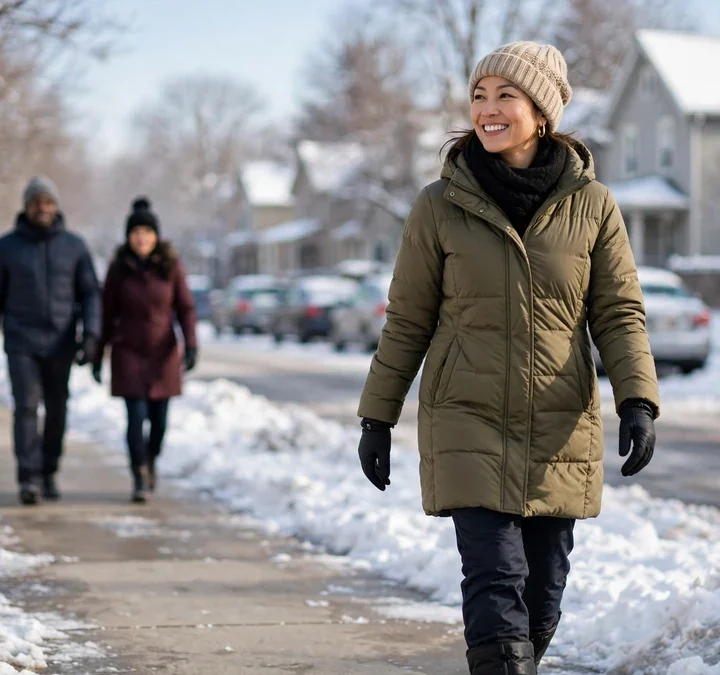
This guide shows beginners how to walk safely and comfortably in cold weather: how to dress in layers, how to warm up indoors, how to choose a route, and how to structure a 20 to 35 minute winter walk. You need no special equipment beyond warm clothing and shoes with decent grip, plus the good sense to move the walk indoors on genuinely icy days.
This workout sits in our Exercise and Workouts collection, with our other beginner-friendly routines. Cold evenings pair naturally with the hearty meals in our 7-Day Winter Comfort Food Meal Plan, and you can browse the full library in our Diet Plans section.
Key takeaways
- Dress in layers you can adjust: a warm base, an insulating middle, and a wind-blocking outer layer.
- Warm up indoors for 5 minutes so your first steps outside are never your coldest.
- Pick cleared, well-lit routes and shorten your stride on slick patches.
- Some days belong indoors. A hallway, mall, or treadmill walk still counts.
- Cover your head, hands, and ears, since comfort keeps walks consistent.
Who this workout is for, and who should check with a doctor first
This guide is for adults who already walk, or want to start walking, through the colder months. It suits beginners who can walk for at least 10 to 15 minutes at an easy pace and who want practical clothing and route advice rather than a hard workout.
Check with your doctor before walking in the cold if you have a heart condition, asthma or another breathing condition, circulation problems, joint problems, or balance concerns, if you have been inactive for a long time, if you are pregnant, if you have had recent surgery or an injury, or if you have ever had chest pain during activity. Cold air and extra effort can be a harder combination than either one alone, so ask first when in doubt.
If you have a history of disordered eating, talk with a doctor or a registered dietitian before following any diet plan. For eating disorder support in the US, visit the National Alliance for Eating Disorders at allianceforeatingdisorders.com.
What you need
- A moisture-wicking base layer (synthetic or wool rather than cotton, which stays cold when damp)
- An insulating middle layer, such as a fleece or light insulated jacket
- A wind-resistant outer layer
- A warm hat, gloves or mittens, and a scarf or neck gaiter
- Shoes or boots with tread and grip; slip-on traction cleats can help on packed snow
- A water bottle, since cold air hides thirst
- A phone, and a reflective item or light if you walk near dusk
Dress for how you will feel 10 minutes in, not at the door. Slightly cool at the start usually means comfortable once you are moving.
Warm-up (5 minutes)
Warm up inside, before you put on your outer layer, so you do not overheat:
- March in place for 1 minute, swinging your arms.
- Do 10 slow standing knee lifts per side.
- Roll your shoulders forward and backward, 10 times each way.
- Circle each ankle 10 times in each direction, holding a chair for balance.
- Finish with 1 minute of easy walking around the room, then dress and head out.

The winter walk
Build the walk in three parts. On very cold or windy days, shorten the middle part rather than skipping the walk entirely.
| Part | What to do | Minutes |
|---|---|---|
| Easy start | Easy pace out the door | 5 |
| Steady middle | Moderate pace, optional brisker intervals | 10 to 25 |
| Easy finish | Gradually slower pace home | 5 |
Easy start (5 minutes)
Begin at an easy pace for the first 5 minutes, even if you feel eager. Cold muscles and stiff joints need a gentler ramp-up than in summer. Walk into the wind on the way out if you can, so the wind is at your back on the way home when you are tired and cooling down.
Easier: Stay close to home on a short loop, so you can cut the walk short without a long walk back.
Harder: Add a second loop of your route instead of turning for home.
Steady middle (10 to 25 minutes)
Settle into a moderate pace where you can talk in short sentences. Keep your stride a little shorter than usual and land flat-footed on any patch that looks slick. If the route is clear and dry, add two or three 1-minute brisker stretches, returning to your steady pace between them. Keep your hands warm by keeping them moving or tucked into mittens.
Easier: Walk the whole middle at an easy pace and stop at 10 minutes.
Harder: Extend the middle to 25 minutes, or choose a route with one gentle hill.
Easy finish (5 minutes)
Slow down gradually over the last 5 minutes rather than stopping suddenly at your door. Once inside, change out of any damp layers before you stretch, since wet clothing chills you quickly at rest.
Easier: Finish with 3 easy minutes and go straight to warm, dry clothes.
Harder: Add 5 more steady minutes before you begin the finish.
Cool-down and stretching
Stretch indoors, holding each stretch for about 20 to 30 seconds per side:
- Calf stretch: Step one foot back, heel down, and lean gently toward a wall.
- Quadriceps stretch: Standing tall and holding a chair, bend one knee and bring your heel toward your hip.
- Hip flexor stretch: In a short staggered stance, tuck your hips slightly and shift forward.
- Shoulder stretch: Draw one arm across your chest with the other hand and hold.
How to progress
Add about 5 minutes to your total walk each week, as the weather allows, until you can walk 30 to 45 minutes comfortably. The Physical Activity Guidelines for Americans recommend that adults get at least 150 minutes of moderate-intensity aerobic activity each week, plus muscle-strengthening activities on 2 or more days a week. Four or five winter walks a week, plus a couple of short indoor strength sessions, is a realistic way to approach that target. On weeks with ice or dangerous wind, swap outdoor walks for indoor ones and count the week as a success anyway.
Safety notes
Stop and rest if you feel pain, dizziness, nausea, or chest pain, and seek medical help right away for chest pain or trouble breathing. Talk with your doctor before starting if you have been inactive or have a health condition. Never try to push through sharp joint pain. Watch for warning signs of getting too cold, such as numb or pale fingers and toes, intense shivering, or clumsiness: go inside, warm up gradually, and seek medical care if feeling does not return. Stay off icy surfaces entirely; no walk is worth a fall. Tell someone your route, carry your phone, and be visible to drivers in low winter light.
Common mistakes
- Wearing cotton layers that stay cold and damp once you sweat.
- Dressing for the temperature at the door and overheating 10 minutes in.
- Taking long summer strides on slick sidewalks.
- Skipping water because the cold hides thirst.
- Toughing it out on ice instead of moving the walk indoors.
- Forgetting head and hand coverage, then cutting the walk short from discomfort.
Pair it with a diet plan
Winter walking pairs well with warm, filling meals. Our 7-Day Winter Comfort Food Meal Plan keeps the comfort-food feel of the season in sensible portions. To estimate your daily calorie needs, try the free Calorie Calculator.
Frequently asked questions
How cold is too cold to walk outside?
There is no single number that fits everyone, because wind and ice matter as much as temperature. A practical rule: if surfaces are icy, the wind makes exposed skin sting within minutes, or you cannot stay warm with the layers you own, walk indoors that day.
Do I need special winter walking shoes?
Not necessarily. Shoes or boots with real tread and a firm grip handle most cleared sidewalks. Slip-on traction cleats add security on packed snow, but nothing makes glare ice safe, so skip icy routes entirely.
Why do I feel less thirsty in the cold?
Cold air blunts the feeling of thirst, and you still lose fluid through breathing and sweat under layers. Drink before you go and again when you get back, even if you do not feel thirsty.
Is walking in cold air bad for my lungs?
Most healthy adults can walk comfortably in cold weather, and a scarf or gaiter over the mouth warms the air you breathe. If you have asthma or another breathing condition, ask your doctor what precautions make sense for you.
What is a good indoor backup plan?
Mall walking, hallway laps, a treadmill, or marching in place during a show all work. Keep the same warm-up and cool-down so the habit feels identical, only the location changes.
Sources and further reading
- Physical Activity Guidelines for Americans, US Department of Health and Human Services: health.gov
- Centers for Disease Control and Prevention, physical activity basics for adults: cdc.gov
- American Heart Association, recommendations for physical activity in adults: heart.org
- MedlinePlus, exercise and physical fitness: medlineplus.gov
This article is for general educational purposes only and is not medical, nutrition, or fitness advice. Talk with your doctor or a registered dietitian before changing your diet or starting an exercise program.