Prints just the plan, like a recipe card.
Last updated: November 23, 2026.
A reader asked us recently: “I know I should stretch, but I never know which stretches to do or how long to hold them, so I just skip it.” That is a very common place to be stuck. This routine answers it with one simple, head-to-toe sequence you can learn once and repeat.
This full-body stretching routine for beginners covers your neck, shoulders, arms, back, hips, legs, and ankles in about 20 minutes. It suits beginners, regular exercisers who skip stretching, and anyone tight from sitting. You need a mat or carpeted floor, a chair, and a wall, and several stretches have standing or seated options.
This routine sits in our Exercise and Workouts collection, alongside walking plans, mobility routines, and beginner strength workouts. If you are building healthier habits overall, it pairs well with our 7-day meal plan for total beginners, and there are more plans to explore in the Diet Plans library.
Key takeaways
- Warm up for a few minutes before stretching. Never stretch cold muscles.
- Hold each stretch for about 20 to 30 seconds per side, breathing slowly.
- A stretch should feel like a gentle pull, never pain. Ease off if it hurts.
- The routine takes about 20 minutes and can be shortened by picking your tightest areas.
Who this workout is for, and who should check with a doctor first
This routine is for adults who want a simple, complete stretching session: beginners, walkers and strength trainees who skip stretching, and desk workers who feel stiff by the end of the day. Options are given so you can stretch standing, seated, or on the floor.
Check with your doctor first if you have been inactive for a long time, or if you have a heart condition, joint problems, a recent injury or surgery, a history of chest pain, or if you are pregnant. After a joint replacement, ask your doctor or physical therapist which ranges of motion are safe for you.
If you have a history of disordered eating, talk with a doctor or a registered dietitian before following any diet plan. For eating disorder support in the US, visit the National Alliance for Eating Disorders at allianceforeatingdisorders.com.
What you need
- A mat, rug, or carpeted floor
- A sturdy chair for balance and seated options
- A wall for standing stretches
- A small towel or strap if reaching your foot is difficult
- Comfortable clothes that let you move freely
Warm-up (3 minutes)
Stretching works best on warm muscles. Spend a few minutes moving first, especially if you have been sitting.
- March in place (1 minute). Walk gently on the spot, building to a comfortable pace with natural arm swings.
- Step touches (1 minute). Step out to each side and back, gradually taking slightly bigger steps.
- Arm swings and shoulder rolls (1 minute). Swing your arms gently forward and back, then roll your shoulders in slow circles.
The full-body stretching routine
Move through the stretches in order, head to toe. Hold each for 20 to 30 seconds, on both sides where the stretch is one-sided. Breathe slowly, and let the stretch ease slightly deeper on each out-breath without forcing it.
| Stretch | Hold | Rounds |
|---|---|---|
| Neck stretch | 20 seconds each side | 1 |
| Chest opener at a wall | 25 seconds each side | 1 |
| Standing back stretch | 30 seconds | 1 |
| Standing quad stretch | 25 seconds each side | 1 |
| Standing hamstring stretch | 25 seconds each side | 1 |
| Calf stretch at a wall | 25 seconds each side | 1 |
| Figure-four glute stretch | 30 seconds each side | 1 |
| Child’s pose or standing rest position | 45 seconds | 1 |
Neck stretch
- Sit or stand tall with your shoulders relaxed.
- Tilt your right ear toward your right shoulder until you feel a gentle stretch along the left side of your neck.
- Hold, breathing slowly, then switch sides.
Easier: Tilt only partway, and keep both shoulders pressed gently down.
Harder: Rest the hand of the stretching side lightly on your head for a small amount of extra weight. Do not pull.
Chest opener at a wall
- Stand side-on to a wall and place your nearest palm flat on it at shoulder height, arm straight.
- Turn your body slowly away from the wall until you feel a stretch across your chest and the front of your shoulder.
- Hold, then switch sides.
Easier: Bend the elbow slightly and turn only a small amount.
Harder: Place your forearm flat against the wall instead of just your palm.
Standing back stretch
- Stand facing the back of a chair and hold it with both hands, then walk your feet back until your arms are straight and your back is roughly flat.
- Let your chest sink gently toward the floor and your head drop between your arms.
- Keep your knees slightly bent and breathe into the stretch.
Easier: Keep your back higher by standing closer to the chair.
Harder: Straighten your legs a little more and press your chest down gently.
Standing quad stretch
- Hold the chair or a wall with one hand for balance.
- Bend the opposite knee and bring your heel toward your glute, catching your ankle or pant leg if you can.
- Keep your knees close together and stand tall, then switch sides.
Easier: Loop a towel around your ankle so you do not have to reach as far.
Harder: Gently press your hip forward a small amount while you hold.
Standing hamstring stretch
- Place one heel on the floor a step ahead of you, toes pointing up, leg straight.
- Hinge forward from your hips with a flat back until you feel a stretch down the back of that thigh.
- Support yourself with a hand on your other thigh or the chair, then switch sides.
Easier: Keep a bigger bend in the front knee and hinge only slightly.
Harder: Rest the heel on a low step and hinge a little farther.
Calf stretch at a wall
- Place both hands on a wall and step one foot back about two feet.
- Press the back heel into the floor and lean gently toward the wall until you feel a stretch in the back calf.
- Hold, then switch sides.
Easier: Take a shorter step back.
Harder: Step back a little farther, keeping the heel firmly down.
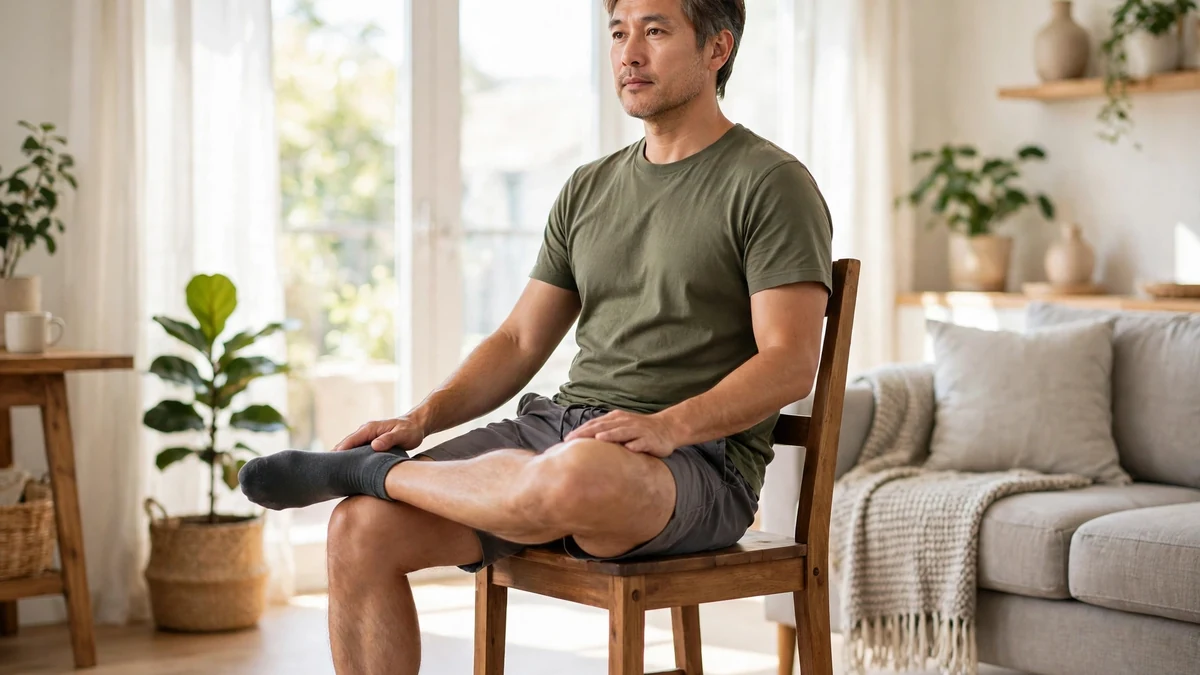
Figure-four glute stretch
- Lie on your back with knees bent, or sit tall in a chair.
- Cross one ankle over the opposite knee.
- Gently draw both legs toward you on the floor, or lean forward slightly from your hips in the chair, until you feel a stretch in the outer hip and glute of the crossed leg.
- Hold, then switch sides.
Easier: In the chair version, keep the crossed foot resting lower, near the ankle of the other leg.
Harder: On the floor, straighten the bottom leg a little while you hold.
Child’s pose or standing rest position
- On the floor: kneel, sit your hips back toward your heels, and stretch your arms forward on the mat, resting your forehead down.
- Standing alternative: use the standing back stretch position, holding the chair, and let your back relax.
- Breathe slowly and let your shoulders drop.
Easier: Place a cushion between your calves and thighs, or use the standing version only.
Harder: Walk your hands to one side, hold, then the other, for a gentle side stretch.
Cool-down and finishing (2 minutes)
- Standing full-body reach (30 seconds). Reach both arms overhead, stretch tall, then let them float down.
- Easy walking in place (1 minute). Walk slowly on the spot and shake out your arms and legs gently.
- Slow breathing (30 seconds). Breathe in for four counts and out for four counts, three or four times. Notice which areas feel looser than when you started.
How to progress
Two or three sessions a week is plenty to start, and the routine also works well right after a walk or workout. Progress gradually:
- Weeks 1 to 2: Hold each stretch for about 20 seconds and stick to the easier options where needed.
- Weeks 3 to 4: Build holds up to 30 seconds, and repeat the full routine twice if you have time.
- After that: Add a second daily mini-session of just your two or three tightest areas, such as after work or before bed.
Flexibility improves slowly and unevenly, and one side is often tighter than the other. That is normal. Judge progress over weeks, not days.
Safety notes
Stop and rest if you feel pain, dizziness, nausea, or chest pain, and seek medical help right away for chest pain. Talk with your doctor before starting if you have been inactive or have a health condition. A proper stretch feels like a gentle pull; sharp or joint pain means you have gone too far, so back off. Never exercise through sharp joint pain, and never bounce at the end of a stretch. Stand up slowly after floor stretches, using the chair until you feel steady.
Common mistakes
- Stretching cold. Always do the short warm-up first, especially after sitting.
- Holding your breath. Slow breathing helps the muscle relax into the stretch.
- Bouncing to reach farther. This can strain the muscle you are trying to loosen.
- Forcing a stretch to match the other side. Bodies are rarely symmetrical; work within each side’s comfort.
- Rushing through every stretch in five minutes. Fewer stretches held properly beat a hurried full list.
- Stretching a fresh injury. Leave injured areas alone and get advice from your doctor or a physical therapist.
Pair it with a diet plan
Stretching days pair nicely with a simple, no-fuss eating plan. Our 7-day meal plan for total beginners is a good place to start if you are building several habits at once. For an estimate of your daily calorie needs, try the free Calorie Calculator.
Frequently asked questions
How long should I hold each stretch?
About 20 to 30 seconds per side works for most people. If a stretch still feels very tight after 30 seconds, release it, rest a moment, and repeat once rather than forcing a longer hold.
Should stretching hurt a little?
No. You should feel a mild to moderate pulling sensation that eases as you breathe. Pain, tingling, numbness, or a sharp feeling in a joint means you should come out of the stretch right away.
Is it better to stretch before or after exercise?
Gentle movement comes first: warm up before activity, and do your deeper, held stretches afterward, when your muscles are warm. This routine is designed for after a workout or as a stand-alone session following its own warm-up.
How often should I do this routine?
Two or three times a week is a good start, and daily is fine if it feels good. Short daily sessions on tight areas, such as calves and hips, work well too.
What if I cannot get down on the floor?
Use the standing and chair options given for each stretch. You can complete the whole routine upright with a chair and a wall, and it will still cover every major area.
Sources and further reading
- Flexibility and stretching information, MedlinePlus: medlineplus.gov
- Physical Activity Guidelines for Americans, US Department of Health and Human Services: health.gov
- Physical activity basics for adults, Centers for Disease Control and Prevention: cdc.gov
This article is for general educational purposes only and is not medical, nutrition, or fitness advice. Talk with your doctor or a registered dietitian before changing your diet or starting an exercise program.