Prints just the plan, like a recipe card.
Last updated: November 23, 2026.
When your knees, hips, shoulders, or back are unreliable, exercise advice can feel like it was written for someone else. “Just go for a run” is not helpful, and neither is a workout full of jumping and deep bends. The useful question is different: what kinds of movement tend to be kind to joints, and how do you build them into a week without flaring things up?
This general guide to joint-friendly exercise covers the main types of movement that are usually gentler on joints: walking on soft, flat routes, stationary cycling, water exercise, and supported strength training. It includes a sample session of about 25 minutes using a chair and a wall, with easier and harder options for every exercise. It is general information only. It does not diagnose anything, and your doctor or physical therapist is the right person to advise on your specific joints.
This guide sits in our Exercise and Workouts collection, with low-impact workouts, chair routines, and walking plans. It was written to go with our 7-Day Joint-Friendly Eating Plan, and you can find the rest of the library in Diet Plans.
Key takeaways
- Low-impact movement keeps at least one foot on the ground and avoids jumping and jarring landings.
- Water exercise and stationary cycling are classic joint-friendly options because they support your body weight.
- Stronger muscles around a joint help support it, so gentle strength work matters.
- Warm up, move within a comfortable range, and judge a session by how you feel the next day.
- Sharp pain, swelling, or a joint that gives way are reasons to stop and check with your doctor.
Who this workout is for, and who should check with a doctor first
This guide is for adults with stiff, achy, or sensitive joints who want a sensible framework for moving more, and for beginners who simply prefer low-impact exercise. The sample session suits people who can stand and walk around their home and use a chair for support.
Check with your doctor or physical therapist before starting if you have been inactive for a long time, have a heart condition, have joint problems that are new, worsening, or undiagnosed, are pregnant, have had recent surgery or a joint replacement, or have a history of chest pain. Ask which movements and ranges suit your joints, especially after any procedure. This guide cannot tell you why a joint hurts, and it is not a rehabilitation program.
If you have a history of disordered eating, talk with a doctor or a registered dietitian before following any diet plan. For eating disorder support in the US, visit the National Alliance for Eating Disorders at allianceforeatingdisorders.com.
What you need
- A sturdy chair without wheels, against a wall
- Supportive shoes with cushioned, non-slip soles
- A mat or carpet for the floor exercise, or a bed with a firm surface as an alternative
- A glass of water
- Optional for other days: access to a stationary bike or a pool with a shallow end
Warm-up (5 minutes)
Joints that complain appreciate a gradual start. Keep the warm-up slow and well within your comfortable range.
- Easy marching in place (2 minutes). Hold the chair if you like, lift your feet a few inches, and swing your arms gently.
- Heel and toe taps (1 minute). Tap one heel forward and the toes back, alternating sides, to warm the ankles and knees.
- Shoulder rolls and arm swings (1 minute). Roll your shoulders in slow circles, then swing your arms gently forward and back.
- Small sit-to-stands (1 minute). Stand up and sit down 4 or 5 times at an easy pace, using your hands freely.
The joint-friendly sample session
Do this session 2 or 3 times a week. On other days, choose a joint-friendly aerobic option: a flat walk, 10 to 20 minutes on a stationary bike with low resistance, or walking and moving in a pool. Rest whenever you need to, and keep the effort at a level where you can talk in full sentences.
1. Sit-to-stand from a chair
Reps: 8 to 10.
- Sit near the front of the chair, feet flat and hip width apart.
- Lean your chest slightly forward and press through your feet to stand tall.
- Sit back down slowly, reaching your hips toward the chair.
- Keep your knees tracking over your toes and your movements smooth.
Easier: Raise the seat with a firm cushion and push off your thighs or the chair arms.
Harder: Cross your arms over your chest, or slow the lowering phase to a count of three.
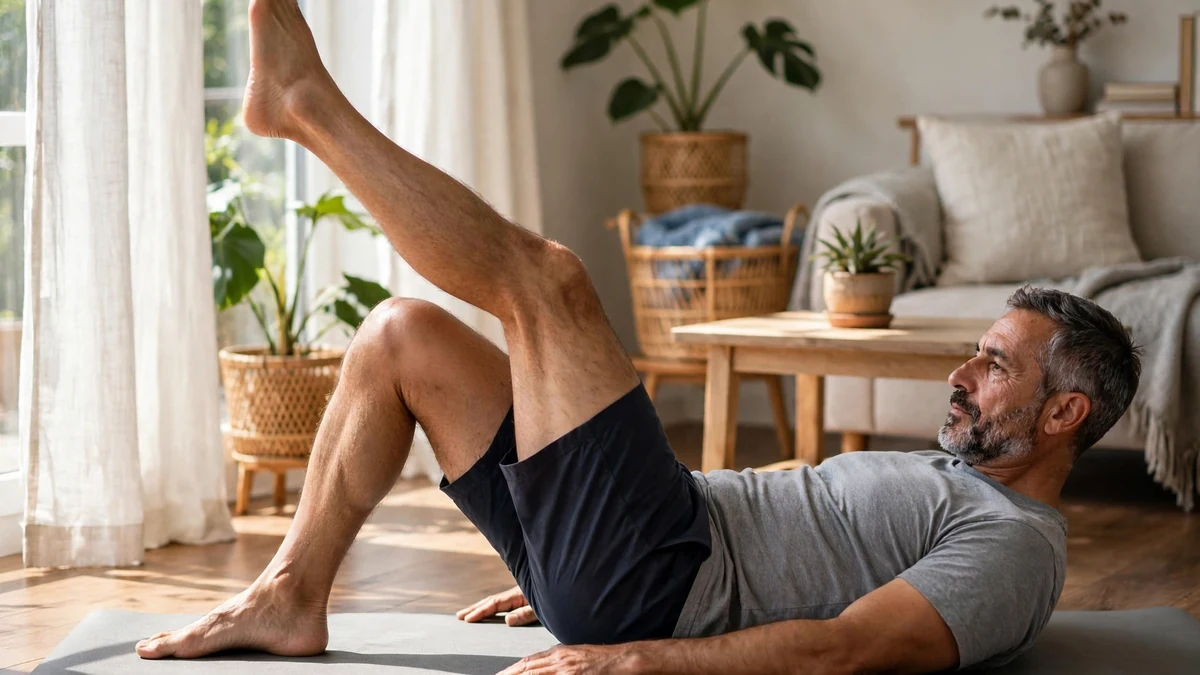
2. Straight leg raises
Reps: 8 per leg.
- Lie on your back with one knee bent and foot flat, the other leg straight.
- Tighten the front of the straight leg’s thigh and lift the leg about 12 inches.
- Pause briefly, then lower it slowly to the floor.
- Keep your lower back resting gently on the floor throughout.
Easier: Lift the leg only 6 inches, or keep a slight bend in the knee.
Harder: Hold the lifted leg for a count of three before lowering.
3. Wall push-ups
Reps: 10.
- Place your palms on a wall at shoulder height, shoulder width apart, and step back a short distance.
- Bend your elbows to bring your chest toward the wall, keeping your body in one line.
- Stop a few inches from the wall, then press back out.
- Keep your heels down and your neck relaxed.
Easier: Stand closer to the wall so the lean is smaller.
Harder: Step farther back, or use a sturdy countertop for a deeper angle.
4. Standing heel raises
Reps: 12.
- Stand behind the chair, holding the back with both hands.
- Rise onto the balls of your feet, lifting your heels high.
- Pause at the top, standing tall.
- Lower your heels slowly to the floor.
Easier: Rise only partway, or do the exercise seated.
Harder: Lower over a count of three, or shift slightly more weight to one leg at a time.
5. Glute bridges
Reps: 10.
- Lie on your back, knees bent, feet flat and hip width apart.
- Press through your heels and lift your hips until your body forms a gentle line from shoulders to knees.
- Squeeze your buttocks at the top for a breath.
- Lower slowly back down.
Easier: Lift your hips only a few inches.
Harder: Hold the top for a count of three, or march your feet slightly at the top, one at a time.
Cool-down and stretching
Cool down for about 5 minutes, and stretch gently while your muscles are warm.
- Slow walking (2 minutes). Walk around the room at an easy pace until your breathing settles.
- Calf stretch at the wall (30 seconds per side). Step one foot back, heel down, and lean gently into the wall.
- Seated hamstring stretch (30 seconds per side). Sit on the chair edge, straighten one leg with the heel down, and hinge forward gently with a flat back.
- Supported quad stretch (20 seconds per side). Holding the chair, bend one knee and ease your heel toward your buttock only as far as comfortable; skip the grab if it bothers your knee.
- Slow breathing (1 minute). Sit comfortably and breathe in for four counts and out for six.
How to progress
Progress in joint-friendly exercise is mostly about adding minutes and days, not intensity.
- Weeks 1 to 2: The sample session twice a week with easier options, plus 10-minute flat walks or bike sessions on 2 other days.
- Weeks 3 to 4: Two full rounds, and stretch aerobic sessions to 15 to 20 minutes.
- Week 5 and beyond: Build toward the general guidance in the Physical Activity Guidelines for Americans: at least 150 minutes of moderate-intensity aerobic activity each week, plus muscle-strengthening activities on 2 or more days a week, all at joint-friendly intensities.
Use the next-day test: if a joint is noticeably worse the day after a session, the session was too much for now. Cut it back by about a third and build again more slowly.
Safety notes
Stop and rest if you feel pain, dizziness, nausea, or chest pain during exercise, and seek medical help right away for chest pain. Never exercise through sharp joint pain, and pay attention to swelling: a joint that swells after activity is telling you to scale back and possibly check in with your doctor. Talk with your doctor before starting if you have been inactive for a long time or have any health condition, and ask your physical therapist to review your exercise choices after any injury or surgery. Good form matters more than range or reps, so move slowly, stay in the range that feels smooth, and keep support within reach for standing exercises. Warm up every time; cold, stiff joints are more likely to protest.
Common mistakes
- Choosing high-impact exercise because it looks more effective, then flaring up a joint for a week.
- Pushing into a painful range of motion to match a picture or video.
- Skipping strength work and only doing cardio, leaving joints without muscular support.
- Judging a workout only by how it feels during the session and ignoring the next day.
- Stopping all movement after one flare instead of scaling back to a gentler level.
Pair it with a diet plan
Joint-friendly movement pairs well with an eating pattern built on fish, vegetables, beans, berries, and olive oil. Our 7-Day Joint-Friendly Eating Plan follows exactly that pattern for a full week. For a general estimate of your daily calorie needs before choosing a plan, try the Calorie Calculator.
Frequently asked questions
What types of exercise are usually easiest on joints?
Walking on flat, even surfaces, stationary cycling, water exercise such as pool walking or aqua classes, and supported strength training are the classic low-impact choices. They let you move and build strength without jumping or jarring landings. Your doctor or physical therapist can help you pick among them based on which joints bother you.
Is walking okay if my knees ache?
Many people with achy knees walk comfortably on flat routes in supportive shoes, especially starting with short distances. If walking consistently makes a knee swell or the pain keeps building, get it checked rather than pushing through.
Should I exercise on a day when a joint is flaring?
Gentle movement within a comfortable range, like easy range-of-motion work or a short flat walk, is often better than total rest, but a hot, swollen, or very painful joint deserves rest and possibly medical advice. When in doubt, do less that day.
How will I know if I did too much?
The next day tells you. Mild muscle soreness is common and fine. A joint that is more swollen, stiffer, or more painful than baseline a day later means the session was too big; reduce the time or reps next time and rebuild gradually.
Sources and further reading
- Physical Activity Guidelines for Americans, US Department of Health and Human Services: health.gov
- CDC pages on physical activity and arthritis: cdc.gov
- MedlinePlus information on exercise and joint health: medlineplus.gov
- American Heart Association guidance on being active: heart.org
This article is for general educational purposes only and is not medical, nutrition, or fitness advice. Talk with your doctor or a registered dietitian before changing your diet or starting an exercise program.