Prints just the plan, like a recipe card.
Last updated: November 23, 2026.
Maybe you bought a resistance band because it was cheap and fits in a drawer, and now it mostly lives in that drawer. Or maybe squats with weights feel like too much right now, and you want a way to work your legs and glutes that is gentle on your knees. A resistance band leg workout is a good place to start, because the band adds challenge without loading your joints the way heavy weights can.
This workout uses one loop band or a long band with handles and takes about 25 to 30 minutes, including the warm-up and cool-down. It suits beginners who can get down to the floor and back up, and it works well in a living room or bedroom. Every move includes an easier and a harder option, so you can match it to your day.
This workout sits in our Exercise and Workouts collection, alongside walking plans, chair workouts, and other beginner routines. Many readers pair it with our 7-Day Low-Impact Lifestyle Meal Plan, and you can browse the full library in Diet Plans.
Key takeaways
- One resistance band is all you need for a full leg and glute session at home.
- Keep the band above your knees for most moves, and move slowly so the band does the work.
- Use a chair or wall for balance whenever you need it. Support is part of good form.
- Start with the lightest band you have, and do 2 rounds before you think about adding a third.
Who this workout is for, and who should check with a doctor first
This workout is for adults who want to strengthen their legs, hips, and glutes at home with low-impact moves. It suits people who find floor work comfortable and who want an option that is quieter and gentler than jumping or heavy weights.
Check with your doctor before starting if you have been inactive for a long time, if you have a heart condition, joint problems, or a history of chest pain, or if you are pregnant or recovering from a recent surgery or injury. If you have knee or hip pain, ask your doctor or a physical therapist which of these moves are right for you.
If you have a history of disordered eating, talk with a doctor or a registered dietitian before following any diet plan. For eating disorder support in the US, visit the National Alliance for Eating Disorders at allianceforeatingdisorders.com.
What you need
- One loop resistance band (light or medium). A long flat band or a band with handles also works for most moves.
- A sturdy chair or a wall for balance.
- A mat or carpeted floor for the floor moves.
- Comfortable clothes and supportive shoes, or bare feet on a mat.
- A bottle of water.
Warm-up (5 minutes)
Do each move slowly. The goal is to wake up your legs and hips, not to tire them out.
- March in place for 1 minute, swinging your arms gently.
- Stand tall and do 10 slow sit-to-stands from your chair, using your hands on the seat only if you need them.
- Hold the chair and swing one leg forward and back 10 times, then switch legs.
- Do 10 gentle standing knee lifts, alternating sides, holding the chair for balance.
- Finish with 30 seconds of easy side steps, left and right.
The workout: band leg and glute circuit
Move through the five exercises in order, rest about 1 minute, then repeat the circuit. Start with 2 rounds. Keep the band flat and above your knees unless a move says otherwise, and never let it roll up into a tight rope.
| Exercise | Reps | Rounds |
|---|---|---|
| Band squat | 10 to 12 | 2 to 3 |
| Glute bridge with band | 12 to 15 | 2 to 3 |
| Standing kickback | 10 per leg | 2 to 3 |
| Lateral band walk | 8 steps each way | 2 to 3 |
| Clamshell | 10 per side | 2 to 3 |
Band squat
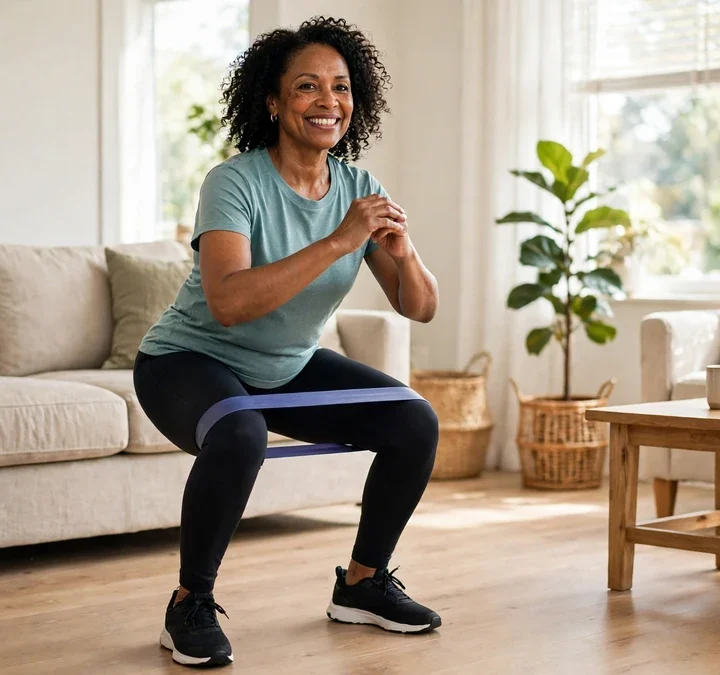
Step into the loop band and slide it just above your knees. Stand with your feet about hip-width apart, toes pointing slightly out. Sit your hips back and down as if sitting into a chair, keeping your chest lifted and your knees pressing gently out into the band. Go only as low as feels comfortable, then press through your heels to stand. Do 10 to 12 reps.
Easier: Squat to a chair, tapping the seat lightly each rep, or use no band.
Harder: Slow the lowering down to a count of 3, or hold the bottom position for 2 seconds.
Glute bridge with band
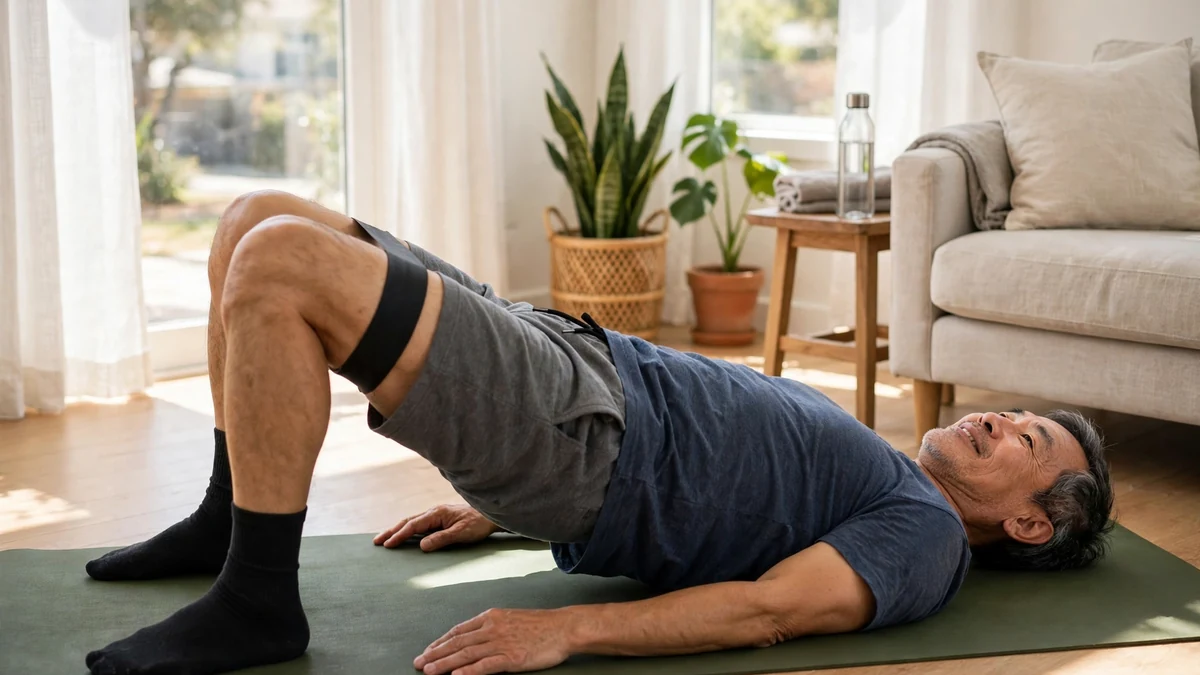
Lie on your back with the band above your knees, knees bent, feet flat on the floor about hip-width apart. Press your knees gently out into the band, squeeze your glutes, and lift your hips until your body forms a line from shoulders to knees. Lower slowly. Do 12 to 15 reps.
Easier: Skip the band and keep your feet a little closer together.
Harder: Hold the top position for 3 seconds, or lift one foot slightly at the top for a few reps per side.
Standing kickback
Stand facing a chair or wall, holding it for balance, with the band above your ankles. Keeping your standing leg slightly bent, sweep the other leg straight back a short distance, squeezing your glute. Keep your hips facing forward and your back flat. Return slowly. Do 10 reps per leg.
Easier: Remove the band and do the same slow leg sweep.
Harder: Pause for 2 seconds at the back of each rep, or add a small pulse.
Lateral band walk
With the band above your knees, bend your knees slightly and sit your hips back a little. Step sideways 8 steps, keeping tension on the band the whole time and your feet pointing forward. Then step back the other way. Keep your steps small and controlled.
Easier: Move the band up a little higher on your thighs, or take smaller steps.
Harder: Sit a little lower into the squat position as you step, or use a stronger band.
Clamshell
Lie on your side with the band above your knees, knees bent, feet together, and your head resting on your arm. Keeping your feet touching, open your top knee like a clamshell, only as far as you can without rolling your hips back. Lower slowly. Do 10 reps, then switch sides.
Easier: Do the move without the band.
Harder: Hold the open position for 2 seconds on each rep.
Cool-down and stretching
- Walk slowly around the room for 1 minute until your breathing settles.
- Standing quad stretch: hold a chair, bend one knee and bring your heel toward your glute. Hold 20 to 30 seconds per side.
- Figure-four stretch: sit in a chair, cross one ankle over the opposite knee, and lean forward gently until you feel a stretch in your hip. Hold 20 to 30 seconds per side.
- Calf stretch: hands on a wall, one foot back, heel down, lean in gently. Hold 20 to 30 seconds per side.
- Finish with 4 to 5 slow, deep breaths, standing tall.
How to progress
Do this workout 2 or 3 times a week, with at least one rest day between sessions. In week 1, do 2 rounds and learn the moves. In weeks 2 and 3, add a few reps to each exercise. When 2 rounds feel steady and your form stays clean, add a third round. After 4 to 6 weeks, you can move to a stronger band for one exercise at a time. Progress should feel gradual. Being a little tired at the end is fine; being sore for days means you did too much.
Safety notes
Stop and rest if you feel pain, dizziness, nausea, or chest pain, and seek medical help right away for chest pain. Talk with your doctor before starting if you have been inactive for a long time or have any health condition. Good form matters more than speed or reps, so slow down whenever a move feels sloppy. Never exercise through sharp joint pain; a mild muscle effort feeling is normal, a sharp or pinching feeling is not. Check your band before each session for cracks or tears, since a snapping band can startle or sting.
Common mistakes
- Letting the knees cave inward during squats and band walks. Press them gently out into the band.
- Rushing through reps so momentum, not muscle, does the work.
- Starting with the strongest band and struggling through poor form.
- Holding your breath. Breathe out on the effort, in on the return.
- Skipping the warm-up because the workout looks easy.
Pair it with a diet plan
Strength work goes better with steady meals behind it. The 7-Day Low-Impact Lifestyle Meal Plan matches this gentle approach, with simple portions already worked out. If you are not sure how much to eat, the Calorie Calculator gives you a starting estimate based on your size and activity level.
Frequently asked questions
How often should I do this workout?
Two or three times a week is a good rhythm for beginners, with rest days in between. The Physical Activity Guidelines for Americans recommend muscle-strengthening activities on 2 or more days a week, and this session counts toward that.
Which band strength should I buy?
Start with a light or medium loop band. If you can finish the reps with good form and feel you could do a few more, the band is about right. Many sets include several strengths, which makes progressing easier.
My knees bother me during squats. What should I do?
Squat to a chair, keep the movement smaller, and press your knees out gently. If you feel sharp pain, stop that move and talk with your doctor or a physical therapist about options for your knees.
Can I do this workout without a band?
Yes. Every move here works without the band while you learn it. Add the band when the basic movement feels comfortable and you want more challenge.
Should my muscles be sore the next day?
Mild tiredness is common when a workout is new. Strong soreness that lasts for days usually means the session was too much, so cut back on rounds or reps next time and build up again slowly.
Sources and further reading
- Physical Activity Guidelines for Americans, US Department of Health and Human Services: health.gov
- CDC, physical activity basics for adults: cdc.gov
- MedlinePlus, exercise and physical fitness background: medlineplus.gov
This article is for general educational purposes only and is not medical, nutrition, or fitness advice. Talk with your doctor or a registered dietitian before changing your diet or starting an exercise program.