Prints just the plan, like a recipe card.
Last updated: November 23, 2026.
Your legs are your largest, strongest muscles, and they respond quickly to training. If you have a pair of dumbbells and want a leg session that goes a step beyond bodyweight work, this beginner dumbbell leg workout is the natural next move.
The session uses five moves: a goblet squat, a dumbbell deadlift, a supported split squat, a weighted glute bridge, and calf raises. It suits healthy beginners who can already do bodyweight squats comfortably. It takes about 25 to 30 minutes, and you need dumbbells, a sturdy chair, and a low step or the floor for calf raises.
This workout sits in our Exercise and Workouts collection, alongside the bodyweight lower body routine you can use on no-equipment days. It pairs well with the 7-Day Meal Plan for Strength Training Beginners from our Diet Plans library.
Key takeaways
- Legs can usually handle more weight than arms, so expect your leg dumbbells to progress faster.
- The hip hinge (deadlift pattern) matters as much as the squat for balanced legs and glutes.
- Support is allowed: hold a chair for split squats until your balance is solid.
- Two leg sessions a week, with rest days between, is a proven beginner rhythm.
Who this workout is for, and who should check with a doctor first
This workout is for adults who have done some bodyweight leg training and want to add load gradually. It is also suitable if you are starting fresh but are generally active, as long as you begin with very light weights and the supported options.
Check with your doctor first if you have been inactive for a long time, have a heart condition, have knee, hip, ankle, or back problems, have had a joint replacement, are pregnant, have had recent surgery or an injury, or have a history of chest pain. Balance problems are another reason to get guidance first, since this session includes single-leg work.
If you have a history of disordered eating, talk with a doctor or a registered dietitian before following any diet plan. For eating disorder support in the US, visit the National Alliance for Eating Disorders at allianceforeatingdisorders.com.
What you need
- A pair of dumbbells. Many beginners start leg work around 5 to 10 pounds per hand, but lighter is fine if form needs practice.
- A sturdy chair without wheels, against a wall, for balance and split squat support.
- A mat or carpet for bridges.
- A wall or countertop for calf raise balance.
- Supportive shoes, water, and a towel.
Warm-up (5 minutes)
- March in place for 1 minute, lifting your knees gradually higher.
- Do 8 bodyweight squats to a chair.
- Do 8 unweighted hip hinges, hands sliding down your thighs.
- Do 8 glute bridges at an easy pace.
- Circle each ankle 8 times each way, holding the chair.
The workout: dumbbell leg session
Do the moves in order, resting 60 to 90 seconds between sets. Do 2 to 3 sets of each. Keep your movements slow and controlled, and finish each set with one or two clean reps still in reserve.
| Exercise | Reps | Sets |
|---|---|---|
| Goblet squat | 8 to 12 | 2 to 3 |
| Dumbbell deadlift | 8 to 12 | 2 to 3 |
| Supported split squat | 6 to 10 per side | 2 to 3 |
| Weighted glute bridge | 10 to 15 | 2 to 3 |
| Standing calf raise (holding dumbbells optional) | 10 to 15 | 2 |
Goblet squat
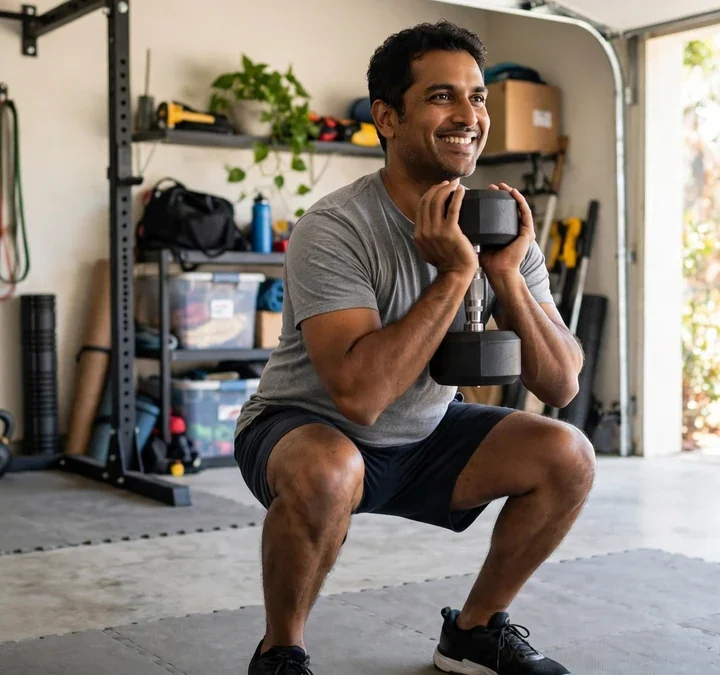
Hold one dumbbell vertically at your chest, both hands cupping the top end. Feet slightly wider than hip width, toes out a little. Sit your hips back and down, keeping your chest lifted and the weight close to your body. Drive through your whole foot to stand, knees tracking over your toes.
Easier: Squat to a chair behind you, or drop the weight and cross your arms.
Harder: Pause for two seconds at the bottom, or use a slightly heavier dumbbell.
Dumbbell deadlift
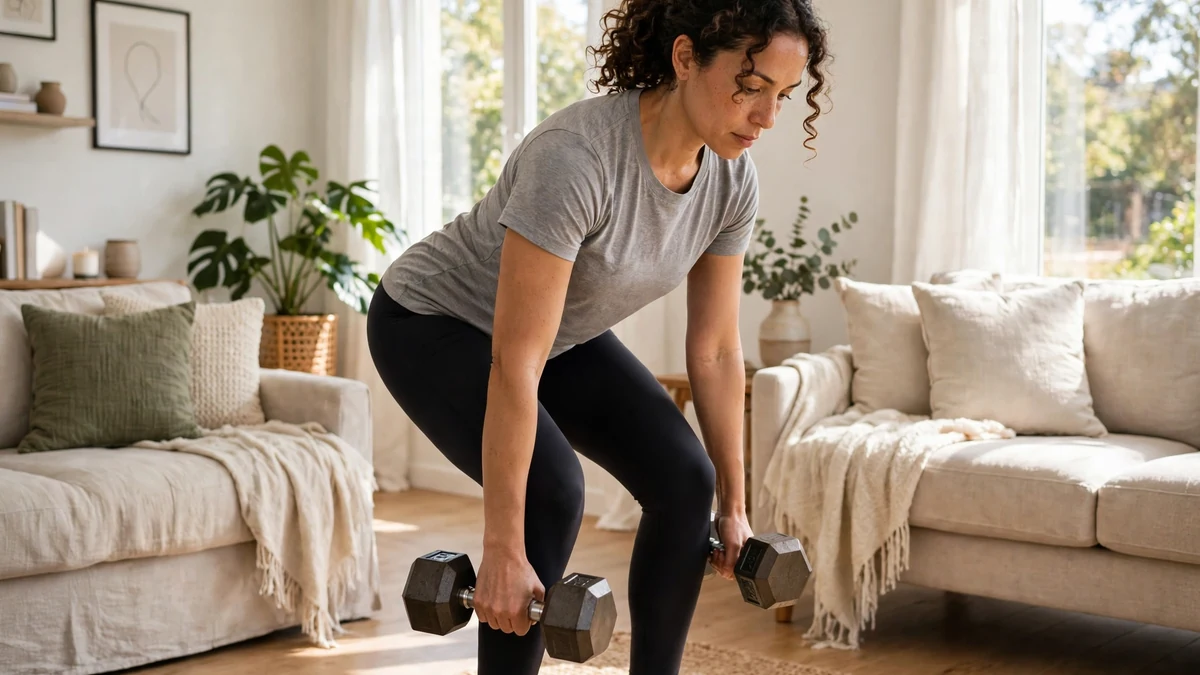
Stand with feet hip width apart, a dumbbell in each hand in front of your thighs. Soften your knees, push your hips back, and slide the weights down the fronts of your legs with a flat back and lifted chest. Stop when you feel a strong stretch in the backs of your thighs, usually around knee to mid-shin height. Push your hips forward to stand and squeeze your glutes.
Easier: Use no weights and practice the hinge pattern with hands on thighs.
Harder: Slow the lowering to three seconds, keeping the weights close to your legs.
Supported split squat
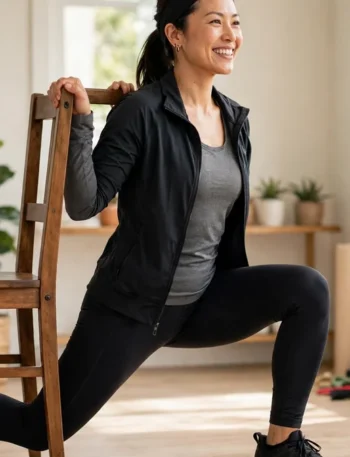
Stand beside a sturdy chair or countertop and hold it with one hand. Take a long step forward with the far leg so your feet are staggered, hip width apart side to side. Holding a light dumbbell in your free hand is optional. Lower straight down until both knees bend comfortably, front knee tracking over toes, then press through the front foot to rise. Finish all reps, then switch sides.
Easier: Skip the dumbbell, shorten your stance, and lower only partway.
Harder: Let go of the support once balance is steady, or pause at the bottom for two seconds.
Weighted glute bridge
Lie on your back, knees bent, feet flat and hip width apart. Rest a dumbbell across the front of your hips and hold it steady with both hands. Press through your heels to lift your hips into a straight line from shoulders to knees. Squeeze your glutes for one second at the top, then lower slowly.
Easier: Do the bridge with no weight, as in the bodyweight routine.
Harder: Hold the top for 3 seconds per rep, or use a slightly heavier dumbbell.
Standing calf raise
Stand tall behind a chair, holding the back for balance. Hold a light dumbbell in one hand if you want extra load. Press through the balls of your feet to lift your heels high, pause, then lower slowly until your heels touch the floor. Keep your knees straight but not locked and your body tall.
Easier: Do the raises with no weight and a smaller range.
Harder: Do them on a step edge for a deeper range, or one leg at a time with chair support.
Cool-down and stretching
- Walk slowly for 1 minute.
- Standing quad stretch holding the chair, 30 seconds per side.
- Calf stretch against a wall, 30 seconds per side.
- Figure-four stretch for hips and glutes, 30 seconds per side, lying down or seated.
- Seated hamstring stretch, 30 seconds per side.
- Finish with 5 slow breaths.
How to progress
Weeks 1 and 2: 2 sets of each move, twice a week, weights light enough that form never wavers. Weeks 3 and 4: add reps to reach the top of each range, then a third set. Next step: increase the dumbbell weight for the squat, deadlift, and bridge by the smallest available step, while keeping arm-level weights out of it; legs progress faster and that is normal. If heavier weights are not available, slow every lowering phase to three or four seconds. Log your weights and reps each session.
Safety notes
Stop and rest if you feel pain, dizziness, nausea, or chest pain, and seek medical help right away for chest pain. Talk with your doctor before starting if you have been inactive or have a health condition. Choose good form over speed and heavier weights. Never exercise through sharp joint pain; knee pain during split squats means shorten the stance, reduce depth, or swap the move for extra goblet squats. Keep your back flat during deadlifts, and set weights down with bent legs rather than a rounded back.
Common mistakes
- Turning the deadlift into a squat by bending the knees too much and dropping the hips.
- Letting the knees cave inward during squats and split squats.
- Using a weight so heavy the goblet squat pulls you forward onto your toes.
- Bouncing the bridge at the bottom instead of pausing and squeezing.
- Skipping support on split squats before balance is ready.
- Holding your breath through whole sets.
Pair it with a diet plan
Leg day pairs well with a plan that keeps protein steady across the week. The 7-Day Meal Plan for Strength Training Beginners is built for exactly this kind of training schedule. Use the Calorie Calculator to check your intake matches your activity.
Frequently asked questions
How heavy should dumbbells be for legs?
Legs are strong, so many beginners progress to 8 to 15 pounds per hand for deadlifts within a few months, but starting at 5 pounds or even with no weight is completely fine. The correct weight is the one that lets you finish a set with clean form and a rep or two in reserve.
What is the difference between the goblet squat and the deadlift?
The squat bends the knees a lot and keeps your torso fairly upright, training mainly the front of the thighs and glutes. The deadlift is a hip hinge with softer knees and a forward lean from the hips, training the backs of the thighs and glutes. Both patterns matter for balanced legs.
My knees feel wobbly during split squats. Is that normal?
Some wobble is normal while your balance and single-leg strength develop, which is why the supported version comes first. Keep a hand on the chair, shorten your stance, and reduce depth. If you feel actual joint pain rather than effort, stop and check with a doctor.
Can I do this workout twice in one week with the bodyweight leg workout too?
Two leg sessions a week total is a good target for beginners, so pick either this dumbbell session twice, or one dumbbell and one bodyweight session. A third hard leg day usually slows recovery rather than speeding progress.
Should I feel this in my lower back?
Your back muscles work to keep you flat and stable during deadlifts, so mild effort there is expected. Sharp pain, or soreness that centers on the spine rather than the muscles, means your hinge form needs work: reduce the weight, shorten the range, and focus on pushing the hips back with a flat back.
Sources and further reading
- Physical Activity Guidelines for Americans, US Department of Health and Human Services: health.gov
- CDC, physical activity basics for adults: cdc.gov
- MedlinePlus, exercise and physical fitness background: medlineplus.gov
This article is for general educational purposes only and is not medical, nutrition, or fitness advice. Talk with your doctor or a registered dietitian before changing your diet or starting an exercise program.