
Prints just the plan, like a recipe card.
Last updated: November 23, 2026.
Four weeks is enough to start feeling fitter, and then a common question shows up: what do I do next so I keep improving without wearing myself out? This 8-week plan is the answer. It takes the same friendly structure, walking plus simple strength work, and stretches the build-up over two months so the progress feels almost easy.
Across eight weeks you will grow from 15-minute walks and one strength circuit to 40-minute walks, short brisk intervals, and a fuller strength routine, reaching the general weekly activity pattern recommended for adults by the end. It suits beginners who finished a shorter plan, or patient starters who prefer a slower ramp. You need a sturdy chair, a wall, and comfortable shoes, and nothing else.
This plan sits in our Exercise and Workouts collection, next to the shorter plans and single-session workouts it builds on. On the food side, it pairs well with our 7-day meal plan for total beginners, and the Diet Plans library has more plans for the weeks ahead.
Key takeaways
- The weekly pattern stays the same for 8 weeks: 3 walks, 2 strength sessions, 2 easier days.
- Walking grows from 15 to 40 minutes, with short brisk intervals added from week 3.
- Strength grows from 4 exercises and 1 round to 6 exercises and 2 rounds.
- By week 8, most people following the plan reach about 150 minutes of weekly aerobic activity plus 2 strength days.
Who this workout is for, and who should check with a doctor first
This plan is for adults who want a gradual, two-month path to regular exercise: beginners who like a slow build, people who completed a 4-week plan, and anyone returning after a break who wants structure without intensity.
Check with your doctor before starting if you have been inactive for a long time, if you have a heart condition, joint problems, or a history of chest pain, or if you are pregnant or recovering from surgery or a recent injury. Repeating any week, or pausing and resuming, is always acceptable.
If you have a history of disordered eating, talk with a doctor or a registered dietitian before following any diet plan. For eating disorder support in the US, visit the National Alliance for Eating Disorders at allianceforeatingdisorders.com.
What you need
- A sturdy chair and a clear wall space
- Comfortable walking shoes and clothes for the weather
- A safe walking route, or room to walk in place at home
- A calendar or log to track your weeks
- Water, and a small towel if you like
Warm-up (5 minutes)
Use this warm-up before every session in the plan.
- Easy walking (2 minutes). Walk in place or around the room at a gentle pace.
- Arm circles and shoulder rolls (1 minute). Slow circles, then rolls in both directions.
- Side steps (1 minute). Step out and back in a steady rhythm, arms swinging gently.
- Easy knee lifts and ankle circles (1 minute). Lift each knee a few times, then circle each ankle, holding support if you like.
The workout: your 8-week schedule
Walking days are Monday, Wednesday, and Friday. Strength days are Tuesday and Saturday, using the circuit in the next section. Thursday and Sunday are rest or gentle days. Every walk includes the warm-up above and the cool-down below in its minutes.
| Week | Walking (Mon, Wed, Fri) | Strength (Tue, Sat) |
|---|---|---|
| Week 1 | 15 minutes, easy pace | 4 exercises, 1 round |
| Week 2 | 20 minutes, easy pace | 4 exercises, 1 round, add 2 reps each |
| Week 3 | 25 minutes, with 3 one-minute brisk intervals | 5 exercises, 1 round |
| Week 4 | 30 minutes, with 4 one-minute brisk intervals | 5 exercises, 2 rounds |
| Week 5 | 30 minutes, with 5 one-minute brisk intervals | 6 exercises, 2 rounds |
| Week 6 | 35 minutes, mostly comfortable pace | 6 exercises, 2 rounds, one harder option |
| Week 7 | 35 minutes, with 6 one-minute brisk intervals | 6 exercises, 2 rounds, two harder options |
| Week 8 | 40 minutes, comfortable with a strong finish | 6 exercises, 2 rounds, your best form |
A brisk interval simply means walking faster for 1 minute, at a pace where talking takes effort, then returning to your comfortable pace for at least 2 minutes before the next one. Spread the intervals through the middle of the walk.
Sit-to-stand from a chair
- Sit near the front of the chair, feet flat and hip width apart.
- Lean slightly forward from your hips and press through your heels to stand.
- Sit down slowly and repeat. Start with 8 reps.
Easier: Use your hands to help push up, or use a taller chair.
Harder: Cross your arms over your chest and take three seconds to sit down.
Wall push-ups
- Place palms flat on a wall at shoulder height, feet an arm’s length back.
- Bend your elbows to bring your chest toward the wall, body straight.
- Press back to the start. Start with 8 reps.
Easier: Stand closer to the wall.
Harder: Step farther back, or move to a sturdy countertop.
Glute bridge
- Lie on your back, knees bent, feet flat, arms by your sides.
- Press through your heels and lift your hips to a straight line from shoulders to knees.
- Squeeze your glutes, then lower slowly. Start with 10 reps.
Easier: Lift partway, or use the seated glute squeeze alternative: sit tall, press feet down, squeeze for five seconds, release.
Harder: Hold the top for three seconds per rep.
Standing calf raises
- Stand behind the chair, fingertips on the back for balance.
- Rise onto the balls of your feet, pause, and lower slowly. Start with 10 reps.
Easier: Use a smaller lift, or do them seated.
Harder: Take three seconds up and three seconds down.
Standing side leg lifts (added in week 3)
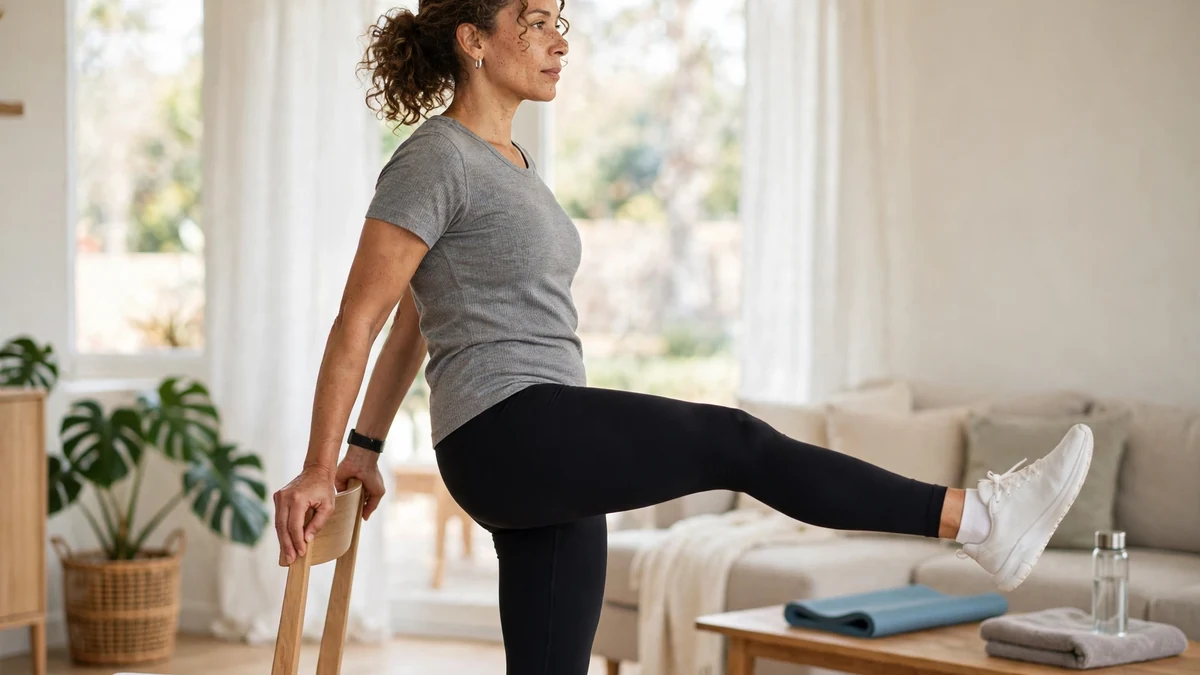
- Stand behind the chair, holding the back, torso upright.
- Move one leg out to the side, toes pointing forward, then lower slowly. Do 8 reps per side.
Easier: Move the leg only a few inches.
Harder: Pause for two seconds at the top of each lift.
Standing knee lifts (added in week 5)
- Stand beside the chair, holding it lightly.
- Lift one knee toward hip height, lower, and alternate sides for 8 lifts per side.
Easier: Lift each knee only a few inches.
Harder: Pause with the knee up for two seconds before switching.
Cool-down and stretching (5 minutes)
- Slow walking (1 minute). Ease your pace down until your breathing settles.
- Calf stretch (30 seconds each side). Step one foot back, heel down, lean gently into a wall.
- Standing quad stretch (30 seconds each side). Hold the chair and bring one heel toward your glute.
- Chest opener (30 seconds). Clasp your hands behind your back and gently open your chest.
- Standing side bend (30 seconds each side). Reach one arm overhead and lean gently away from it.
- Slow breathing (30 seconds). A few slow breaths, then log your session.
How to progress after week 8
By the end of week 8 you will be close to the general pattern described in the Physical Activity Guidelines for Americans: at least 150 minutes of moderate-intensity aerobic activity each week, plus muscle-strengthening activities on 2 or more days a week. To keep going:
- Maintain first. Repeat week 8 for two or three weeks until it feels like your normal routine.
- Then vary. Swap one walk for cycling, swimming, or a low-impact cardio session, keeping the same weekly rhythm.
- Keep strength honest. When two rounds feel easy, use harder options or add a new exercise rather than adding a third round every time.
Safety notes
Stop and rest if you feel pain, dizziness, nausea, or chest pain, and seek medical help right away for chest pain or trouble breathing. Talk with your doctor before starting if you have been inactive or have a health condition. Good form comes before speed, especially as rounds and intervals increase. Never exercise through sharp joint pain; choose the easier option or skip that exercise. Build in extra rest whenever life or your body asks for it. Missing a few days and resuming is far better than pushing through exhaustion.
Common mistakes
- Treating the brisk intervals as sprints. They should feel strong but controlled, and you should be able to return to an easy pace right after.
- Adding time and intensity in the same week. The table changes one thing at a time on purpose.
- Skipping strength days because walking feels like enough. The two halves of the plan do different jobs.
- Comparing your week 2 to someone else’s week 8. Your only comparison is your own last week.
- Letting a bad week end the plan. Drop back one week and continue.
Pair it with a diet plan
Two months of steady exercise goes well with a simple eating plan you can rotate without getting bored. Our 7-day meal plan for total beginners is a friendly starting point. For an estimate of your daily calorie needs at your new activity level, try the free Calorie Calculator.
Frequently asked questions
How is this different from a 4-week plan?
The structure is the same, but the build-up is slower and goes further: more walking time, brisk intervals, and two extra strength exercises. It suits people who want to reach the general weekly guidelines gradually rather than quickly.
What if a week feels too hard?
Repeat it. The schedule is a guide, and your body sets the real pace. Staying on a week until it feels comfortable is exactly how the plan is meant to be used, even if that makes it a 10-week plan for you.
Do the brisk intervals have to be walking?
They are written as faster walking, which keeps the plan low impact. If you exercise on a stationary bike or in a pool some days, you can make the intervals faster cycling or swimming instead, using the same one-minute pattern.
Can I do the strength circuit on walking days instead?
You can, if your schedule demands it, but keep at least one day between strength sessions so the same muscles can recover. The written pattern, strength on Tuesday and Saturday, gives you that spacing automatically.
What should I do when the 8 weeks are over?
Repeat week 8 until it feels routine, then vary one session a week: a new route, a different activity, or a longer weekend walk. Long-term consistency with small changes beats starting a brand-new intense plan.
Sources and further reading
- Physical Activity Guidelines for Americans, US Department of Health and Human Services: health.gov
- Physical activity basics for adults, Centers for Disease Control and Prevention: cdc.gov
- Getting active, American Heart Association: heart.org
This article is for general educational purposes only and is not medical, nutrition, or fitness advice. Talk with your doctor or a registered dietitian before changing your diet or starting an exercise program.