Prints just the plan, like a recipe card.
Last updated: November 23, 2026.
Arms and shoulders do a lot of quiet work in daily life: carrying bags, pushing doors, lifting things onto shelves. If those tasks have started to feel harder, a short dumbbell session aimed at your arms and shoulders is a practical place to start.
This workout uses four dumbbell moves to train your biceps, triceps, and shoulders in about 20 minutes. It suits healthy beginners who already have a pair of light dumbbells. You need a sturdy chair for seated options and back support, and weights you can control. A light pair, about 2 to 5 pounds, is a common starting point for these smaller muscles.
This workout sits in our Exercise and Workouts collection, where you will find full-body dumbbell and bodyweight routines for other days. It pairs well with the 7-Day Meal Plan for Strength Training Beginners from our Diet Plans library.
Key takeaways
- Overhead press, lateral raise, bicep curl, and overhead triceps extension cover shoulders and arms completely.
- Small muscles tire fast, so light weights and clean form beat heavy weights and swinging.
- Seated versions give you back support and stop you from using your whole body to cheat the weight up.
- Once or twice a week is enough for an arm and shoulder session like this.
Who this workout is for, and who should check with a doctor first
This workout is for adults who are new to dumbbell training and want a focused, short session for the arms and shoulders. It fits well on a day between full-body workouts or alongside a walk.
Check with your doctor first if you have been inactive for a long time, have a heart condition, have shoulder, elbow, wrist, or neck problems, have had a rotator cuff injury, are pregnant, have had recent surgery, or have a history of chest pain. Shoulders are the most complex joints in the body, and overhead movements deserve extra caution if yours have ever been injured.
If you have a history of disordered eating, talk with a doctor or a registered dietitian before following any diet plan. For eating disorder support in the US, visit the National Alliance for Eating Disorders at allianceforeatingdisorders.com.
What you need
- One pair of light dumbbells you can press overhead with control.
- A sturdy chair with back support for seated options.
- A mat or carpet if you want to finish with floor stretches.
- Comfortable clothing, water, and a small towel.
- A mirror, if available, to check that your shoulders stay down and level.
Warm-up (5 minutes)
- March in place for 1 minute with arm swings.
- Do 10 arm circles forward and 10 backward, growing the circles gradually.
- Do 10 shoulder rolls each direction.
- Do 8 wall push-ups.
- Pick up your lightest dumbbells and do 5 slow curls and 5 slow presses at half effort.
The workout: dumbbell arms and shoulders
Do the four moves in order, resting 60 seconds between sets. Do 2 to 3 sets of each. These are small muscles; the last two reps of a set should feel challenging while your form stays clean, and no rep should involve swinging or arching.
| Exercise | Reps | Sets |
|---|---|---|
| Overhead press | 8 to 12 | 2 to 3 |
| Lateral raise | 8 to 12 | 2 to 3 |
| Bicep curl | 10 to 15 | 2 to 3 |
| Overhead triceps extension | 8 to 12 | 2 to 3 |
Overhead press
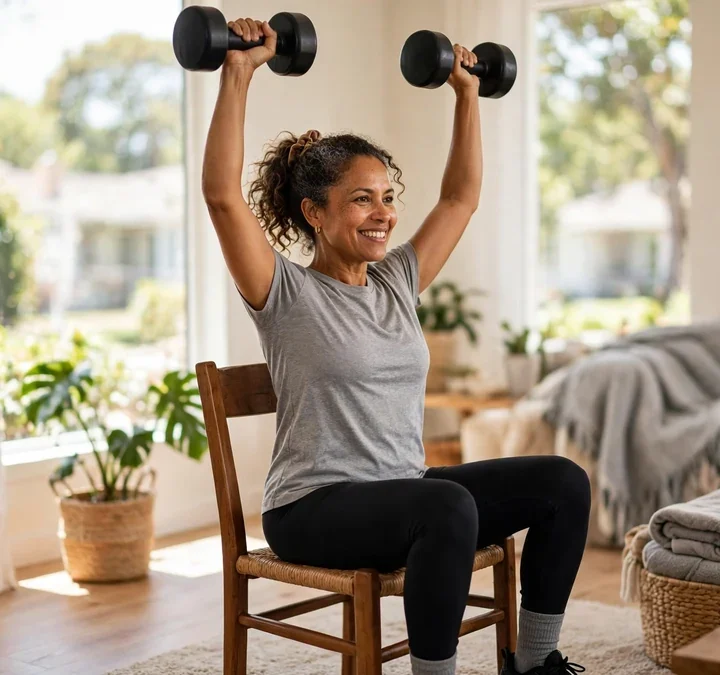
Sit tall in a sturdy chair with back support, or stand with feet hip width apart. Hold a dumbbell in each hand at shoulder height, palms facing forward. Tighten your stomach, then press the weights up until your arms are straight but not locked, keeping your ribs down. Lower slowly to shoulder height.
Easier: Press one arm at a time while the other rests, or use lighter dumbbells.
Harder: Press from standing and add a two-second pause with the weights at shoulder height between reps.
Lateral raise
Stand or sit tall with a light dumbbell in each hand by your sides, palms facing your thighs, elbows slightly bent. Keeping that soft bend, lift your arms out to the sides until they reach about shoulder height, as if pouring from two pitchers at the top. Lower slowly. If you have to shrug or swing, the weights are too heavy.
Easier: Lift to only halfway up, or raise one arm at a time.
Harder: Pause for two seconds at shoulder height on each rep.
Bicep curl
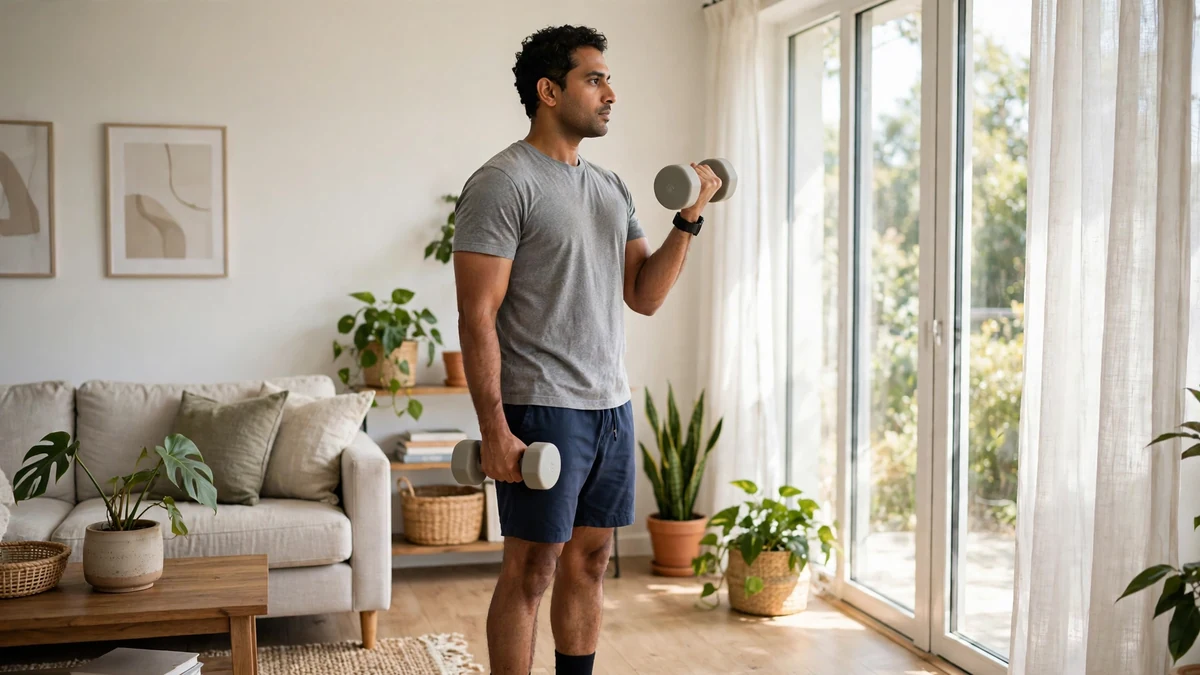
Stand or sit tall with a dumbbell in each hand, arms hanging, palms facing forward. Keep your elbows pinned close to your ribs. Bend your elbows to curl the weights toward your shoulders, then lower slowly for a count of three until your arms are straight again. Your upper arms should barely move.
Easier: Curl one arm at a time, or use lighter dumbbells.
Harder: Slow the lowering phase to four seconds, which makes light weights feel serious.
Overhead triceps extension
Sit tall with back support. Hold one dumbbell with both hands around one end and lift it overhead, arms straight. Keeping your elbows close to your head and pointing forward, bend your elbows to lower the weight behind your head, then straighten your arms to press it back up. Move slowly and keep your upper arms still.
Easier: Use your lightest dumbbell and a smaller range, lowering only partway.
Harder: Do the extension one arm at a time with a lighter dumbbell, supporting the working elbow with your free hand.
Cool-down and stretching
- Shake out your arms and hands for 30 seconds.
- Cross-body shoulder stretch, 30 seconds per side.
- Overhead triceps stretch: reach one hand down your back and press gently at the elbow with the other hand, 30 seconds per side.
- Doorway chest stretch, 30 seconds per side.
- Wrist circles and gentle forearm stretches, 30 seconds.
- Finish with 5 slow breaths, shoulders down and back.
How to progress
Weeks 1 and 2: 2 sets per move, once or twice a week. Weeks 3 and 4: reach the top of the rep ranges, then add a third set. After that, increase weight only on the moves where form is perfect, and only by the smallest step available. Shoulders respond well to patience: an extra two seconds of pause per rep is often a smarter progression than a heavier dumbbell. Keep notes on weight and reps so progress is visible.
Safety notes
Stop and rest if you feel pain, dizziness, nausea, or chest pain, and seek medical help right away for chest pain. Talk with your doctor before starting if you have been inactive or have a health condition. Choose good form over speed and heavier weights. Never exercise through sharp joint pain; shoulder pinching during presses or raises means stop, lighten the weight, and reduce the range. Keep dumbbells in a firm grip, especially when one is overhead during the triceps extension.
Common mistakes
- Swinging the body to curl or press weights that are too heavy.
- Arching the lower back during overhead presses.
- Lifting lateral raises above shoulder height with a shrug.
- Letting the elbows drift forward or flare during curls and extensions.
- Rushing the lowering phase of every rep.
- Training arms hard the day before a full-body session that also uses them.
Pair it with a diet plan
Short, focused workouts still deserve steady fuel. The 7-Day Meal Plan for Strength Training Beginners provides a balanced week with regular protein. Check your overall intake using the Calorie Calculator if you are unsure where you stand.
Frequently asked questions
How heavy should my dumbbells be for arm work?
Lighter than for leg work, because the muscles are smaller. A light pair, about 2 to 5 pounds, is a common starting point. The right weight lets you finish a set with clean form and one or two reps in reserve, without swinging or shrugging.
Why do my shoulders click during raises?
Occasional painless clicks are common, but clicking with pain is a stop signal. Try a smaller range, lighter weights, and keeping your thumbs pointing slightly up during lateral raises. If pain continues, talk with a doctor or physical therapist before continuing overhead work.
Can I do this workout sitting down?
Yes. Every move here works seated in a sturdy chair with back support, and seated pressing is actually easier on your lower back. Seated training is a perfectly good way to build arm and shoulder strength.
How often should I train arms and shoulders?
Once or twice a week is enough, especially since your shoulders and arms also work during rows, presses, and full-body sessions. Muscles need rest days to adapt, and small muscles fatigue faster than large ones.
Will curls alone give me stronger arms?
Curls train the front of the upper arm, but the backs of the arms (triceps) make up a large share of arm size and pushing strength. That is why this session includes the overhead extension and the press, so the whole arm gets trained.
Sources and further reading
- Physical Activity Guidelines for Americans, US Department of Health and Human Services: health.gov
- CDC, physical activity basics for adults: cdc.gov
- MedlinePlus, exercise and physical fitness background: medlineplus.gov
This article is for general educational purposes only and is not medical, nutrition, or fitness advice. Talk with your doctor or a registered dietitian before changing your diet or starting an exercise program.