Prints just the plan, like a recipe card.
Last updated: November 23, 2026.
Turning 40 often comes with a quiet surprise: the workout that felt easy at 32 now leaves you sore for three days, and the knees, back, or shoulders have started sending opinions. It is tempting to decide your active years are behind you. They are not. What changes after 40 is mostly the recipe, not the goal: more warm-up, more strength work, and more respect for recovery.
This beginner guide to exercise over 40 lays out a balanced week of walking and simple strength training you can do at home with no equipment or a light pair of dumbbells. The sample strength session takes about 30 minutes, and the walking days are flexible. Every exercise has step-by-step cues plus an easier and a harder option, so the plan can meet you where you are and grow with you.
This guide sits in our Exercise and Workouts collection, with walking plans, chair workouts, and low-impact routines. It pairs naturally with our 7-Day Meal Plan for Women Over 40, and the full range of plans lives in Diet Plans.
Key takeaways
- A good week after 40 mixes brisk walking most days with strength training twice a week.
- Warm up longer than you used to; joints and muscles appreciate the extra minutes.
- Strength work protects the muscles and bones that daily life depends on.
- Recovery is part of the program: sleep, rest days, and gentle movement on off days.
- Start easier than you think you need to, and add difficulty in small steps.
Who this workout is for, and who should check with a doctor first
This guide is for adults in their forties who are new to exercise, returning after a long break, or looking for a saner structure than the all-or-nothing routines of their twenties. The movements are low-impact and joint-friendly, and the schedule is realistic for people with jobs and families.
Check with your doctor before starting if you have been inactive for a long time, have a heart condition, have joint problems, are pregnant, have had recent surgery or an injury, or have a history of chest pain. Blood pressure, blood sugar, and joint issues are all common in this decade and worth a conversation before you begin. This guide is general information, not a personal medical recommendation.
If you have a history of disordered eating, talk with a doctor or a registered dietitian before following any diet plan. For eating disorder support in the US, visit the National Alliance for Eating Disorders at allianceforeatingdisorders.com.
What you need
- Supportive walking shoes
- A sturdy chair for balance and sit-to-stands
- Comfortable clothing and a water bottle
- Optional: a light pair of dumbbells, about 2 to 5 pounds, or two water bottles
- Optional: a mat or carpeted floor space
Warm-up (5 minutes)
Do not skip this, especially first thing in the morning. Move gently and build warmth gradually.
- Easy walking in place or around the room (2 minutes). Start slow and let your pace creep up slightly.
- Shoulder rolls and arm circles (1 minute). Roll the shoulders, then make small arm circles that grow a little bigger.
- Hip circles and knee lifts (1 minute). Hands on hips, circle your hips slowly both ways, then lift each knee a few inches at a time.
- Ankle circles and calf pumps (1 minute). Circle each ankle, then rise onto your toes and lower down a few times.
The sample strength workout
Do this session twice a week on non-consecutive days, for example Tuesday and Saturday. On three to five other days, walk at a pace that makes you breathe a little harder for 20 to 40 minutes. Rest or stretch gently on the remaining days.
1. Sit-to-stand from a chair
Reps: 10.
- Sit near the front of a sturdy chair, feet flat and hip width apart.
- Lean your chest slightly forward and press through your feet to stand fully upright.
- Pause, then sit back down slowly, reaching your hips back.
- Keep your knees in line with your toes throughout.
Easier: Raise the seat with a cushion and push off your thighs.
Harder: Hold a light dumbbell at your chest with both hands, or slow the lowering to a count of three.
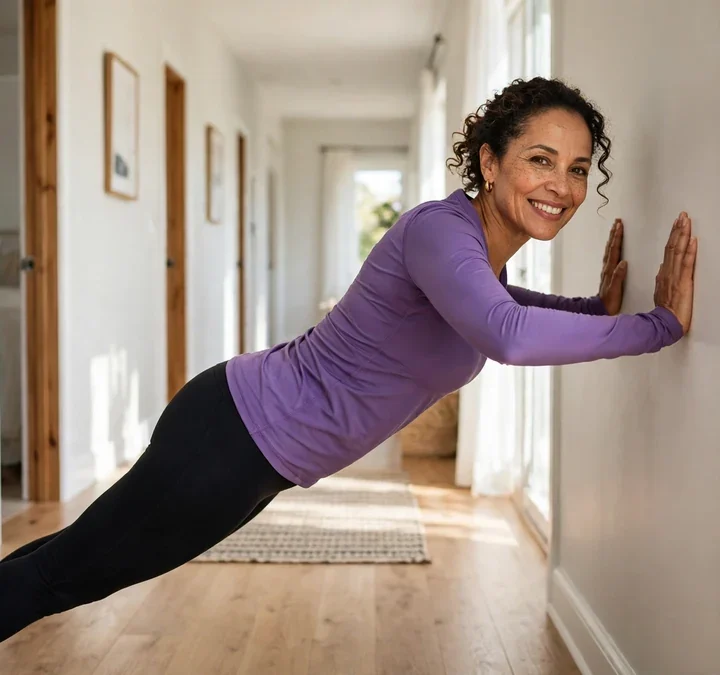
2. Wall push-ups
Reps: 10.
- Stand about an arm’s length from a wall and place your palms flat at shoulder height, shoulder width apart.
- Keeping your body in one straight line, bend your elbows to bring your chest toward the wall.
- Stop before your forehead gets close, then press back to the start.
- Keep your heels down and your stomach gently braced.
Easier: Stand closer to the wall so the angle is gentler.
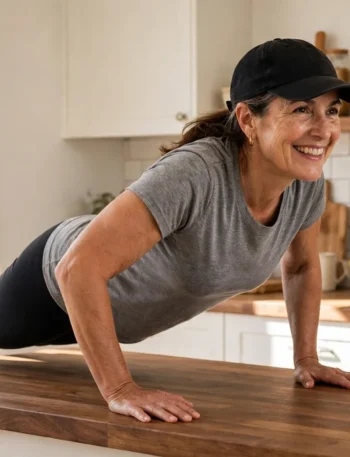
Harder: Step your feet farther back, or move to a countertop and then the floor as you get stronger over the weeks.
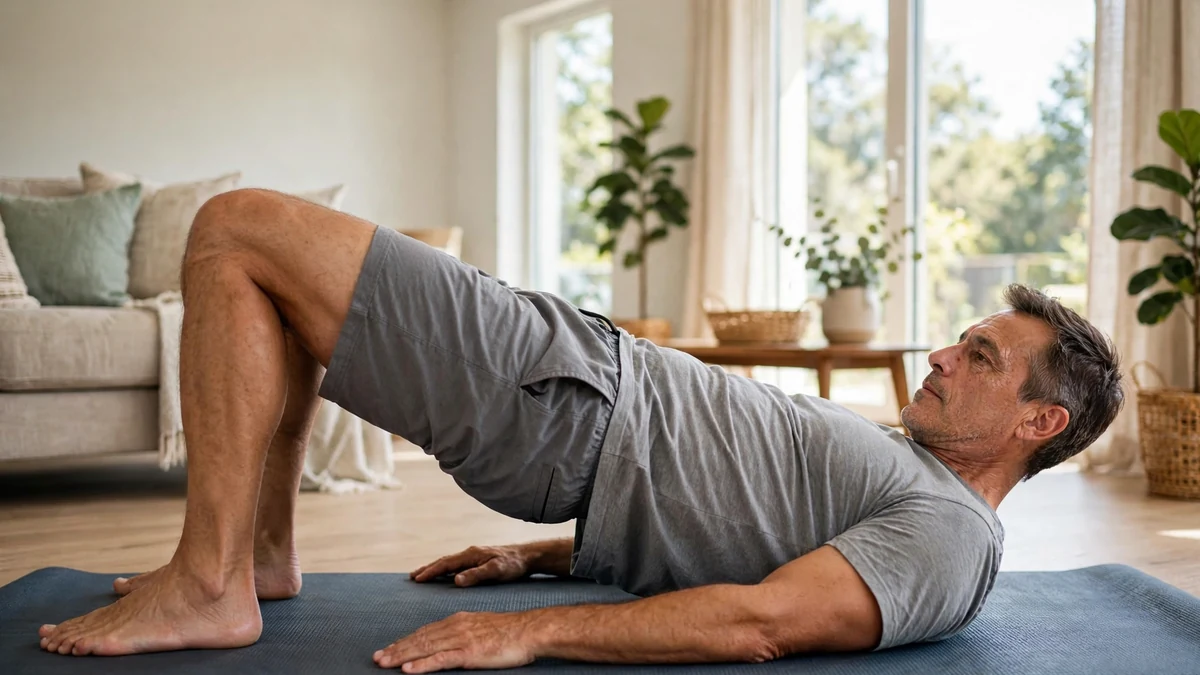
3. Glute bridges
Reps: 12.
- Lie on your back, knees bent, feet flat and hip width apart.
- Press through your heels and lift your hips until your shoulders, hips, and knees form a gentle line.
- Squeeze your buttocks for a breath at the top.
- Lower slowly, one vertebra at a time if you can.
Easier: Lift your hips only partway and keep your arms pressed into the floor for help.
Harder: Hold the top for a count of three, or place a light dumbbell across your hips and hold it steady.
4. Bird dog
Reps: 6 per side.
- Start on hands and knees, hands under shoulders and knees under hips, back flat.
- Slide your right hand forward and your left foot back until both are lifted and in line with your body.
- Pause for a breath without letting your hips sway, then return to the start.
- Repeat on the other side, alternating.
Easier: Lift only the arm or only the leg, keeping the other knee and hand firmly down.
Harder: Hold each reach for a count of three.
5. Standing calf raises
Reps: 12.
- Stand tall behind a chair, holding it lightly for balance.
- Rise up onto the balls of your feet as high as comfortable.
- Pause at the top, then lower your heels slowly to the floor.
- Keep the movement smooth, without bouncing at the bottom.
Easier: Do a smaller rise, or sit and press your toes into the floor to lift your heels.
Harder: Slow the lowering to a count of three, or hold light dumbbells.
6. Marching in place with tall posture
Time: 1 minute.
- Stand tall with your feet hip width apart and shoulders relaxed.
- March in place, lifting each knee toward hip height as far as is comfortable.
- Swing your arms naturally, opposite arm to opposite leg.
- Keep your chest lifted and your steps quiet.
Easier: March lower and slower, holding a chair with one hand.
Harder: Pick up the pace slightly, or hold the knee up for a breath at the top of each step.
Cool-down and stretching
Cool down for about 5 minutes after every session, walking first, then stretching.
- Slow walking (2 minutes). Walk at an easy pace until your breathing settles.
- Standing quad stretch (30 seconds per side). Hold a chair, bend one knee, and bring your heel toward your buttock as far as comfortable.
- Chest stretch at a wall (30 seconds per side). Place your forearm on a wall and turn gently away until your chest stretches.
- Calf stretch (30 seconds per side). Step one foot back against a wall lean, heel down, until the back leg stretches.
- Deep breathing (1 minute). Stand or sit tall, breathing in for four counts and out for six.
How to progress
Think in four-week blocks. Finish each session feeling like you could have done a little more.
| Weeks | Walking | Strength |
|---|---|---|
| 1 to 2 | 20 minutes, 3 days a week | 1 to 2 rounds, easier options |
| 3 to 4 | 25 to 30 minutes, 4 days a week | 2 rounds, standard versions |
| 5 to 6 | 30 to 40 minutes, 4 to 5 days a week | 2 rounds, try one harder option |
| 7 to 8 | 40 minutes, 5 days a week | 2 to 3 rounds or light dumbbells |
The Physical Activity Guidelines for Americans recommend that adults get at least 150 minutes of moderate-intensity aerobic activity each week, plus muscle-strengthening activities on 2 or more days a week. The schedule above builds toward exactly that, at a pace your joints can adapt to.
Safety notes
Stop and rest if you feel pain, dizziness, nausea, or chest pain during exercise, and seek medical help right away for chest pain. Never exercise through sharp joint pain; switch to the easier option or choose a different move. Talk with your doctor before starting if you have been inactive for a long time or have any health condition. Expect a day of mild muscle soreness when a session is new, but treat joint aches that build week after week as a sign to scale back and get advice. Good form beats more reps: move slowly and breathe steadily.
Common mistakes
- Copying a twenty-something’s routine, complete with jumping and daily high intensity.
- Skipping strength work and only walking, which leaves muscle unchallenged.
- Skipping the warm-up because it feels unproductive.
- Adding time, weight, and harder options all in the same week.
- Ignoring sleep and rest days, then wondering why energy keeps dropping.
Pair it with a diet plan
Training twice a week goes further when meals support it with enough protein and produce. The 7-Day Meal Plan for Women Over 40 is built for this stage of life, and there is a matching over-40 plan for men in the same collection. To estimate your daily calorie needs, use the Calorie Calculator.
Frequently asked questions
Is it too late to build strength in my forties?
No. Adults can build muscle and strength in their forties and well beyond with regular, progressive training. You may progress a little more gradually than you did at 25, and warm-ups and recovery matter more, but the basic approach in this guide works.
How many days a week should I exercise?
A practical target is walking on most days and strength training on 2 non-consecutive days, which lines up with the Physical Activity Guidelines for Americans: at least 150 minutes of moderate-intensity aerobic activity each week, plus muscle-strengthening activities on 2 or more days a week. Start below that and build up over several weeks.
Why am I so sore after workouts now?
Recovery slows somewhat with age, and muscles that have not been challenged in a while complain loudly at first. Mild soreness for a day or two is common when starting. Keep sessions a little easier than you think necessary for the first two weeks, warm up well, and space strength days apart.
What if my knees or back bother me during these exercises?
Use the easier options, shrink the range of motion, and swap any exercise that consistently bothers a joint for one that does not. Ongoing pain deserves a check with your doctor or a physical therapist rather than guesswork.
Sources and further reading
- Physical Activity Guidelines for Americans, US Department of Health and Human Services: health.gov
- CDC pages on physical activity for adults: cdc.gov
- American Heart Association guidance on fitness and activity: heart.org
- MedlinePlus information on exercise and physical fitness: medlineplus.gov
This article is for general educational purposes only and is not medical, nutrition, or fitness advice. Talk with your doctor or a registered dietitian before changing your diet or starting an exercise program.