Prints just the plan, like a recipe card.
Last updated: November 23, 2026.
Sit at a desk for most of the day and your hips will tell you about it: stiff when you stand up, tight when you climb stairs, and an achy lower back by evening. Sitting shortens the muscles at the front of the hip and switches off the ones at the back, and a few minutes of gentle mobility work can help.
This hip mobility routine for beginners takes about 15 minutes and works the hips through every direction they are meant to move: forward, back, out to the side, and rotating. It suits desk workers, beginners, and older adults. Most moves are standing with a chair for balance, and the rest are seated, so you never need the floor unless you want to.
This routine sits in our Exercise and Workouts collection, with stretching routines, walking plans, and desk-friendly sessions. It pairs well with our 7-day meal plan for desk workers, and you can find more eating plans in the Diet Plans library.
Key takeaways
- The routine takes about 15 minutes and needs only a chair and a little floor space.
- It covers hip flexion, extension, side movement, and rotation, the full range your hips use every day.
- Every move has a supported version, so balance is never a barrier.
- Short, regular sessions work better for stiff hips than one long session now and then.
Who this workout is for, and who should check with a doctor first
This routine is for adults whose hips feel stiff from sitting, driving, or general inactivity, and for beginners who want to move more freely when walking or getting up from a chair.
Check with your doctor first if you have been inactive for a long time, or if you have a heart condition, a history of chest pain, significant hip, knee, or back problems, or if you are pregnant or recovering from surgery or injury. After a hip replacement, ask your doctor or physical therapist which movements are safe for you, and follow their guidance over anything here.
If you have a history of disordered eating, talk with a doctor or a registered dietitian before following any diet plan. For eating disorder support in the US, visit the National Alliance for Eating Disorders at allianceforeatingdisorders.com.
What you need
- A sturdy chair that does not slide
- A wall or countertop within reach for balance
- A small clear floor space
- Comfortable clothes and shoes that grip, or bare feet on a non-slip floor
- Optional: a cushion for the seated stretches
Warm-up (3 minutes)
Mobility work goes better once blood is flowing. Keep these moves small and easy.
- March in place (1 minute). Walk gently on the spot, swinging your arms, and gradually lift your knees a little higher.
- Gentle leg swings (1 minute). Holding the chair, swing one leg forward and back like a slow pendulum for 30 seconds, then the other leg.
- Small hip circles (1 minute). With a hand on the chair, circle your hips slowly in both directions, keeping the circles small.

The hip mobility routine
The main routine takes about 9 minutes. Move slowly and stay in a pain-free range throughout. Your hips should feel like they are loosening and working, never pinching or catching. If a move pinches at the front of the hip, make it smaller or skip it.
| Exercise | Time or reps | Rounds |
|---|---|---|
| Standing hip circles (single leg) | 6 each direction, each leg | 1 |
| Standing knee lifts | 8 each side | 1 |
| Glute bridge | 10 reps | 1 |
| Standing hip abduction (leg out to the side) | 8 each side | 1 |
| Standing hip flexor stretch | 25 seconds each side | 1 |
| Seated figure-four stretch | 30 seconds each side | 1 |
| Supported bodyweight hip hinge | 8 reps | 1 |
Standing hip circles (single leg)
- Stand beside the chair and hold it with one hand.
- Lift the far knee slightly and draw a slow circle with it, as if tracing a circle on the floor with your toes.
- Complete the circles in one direction, then reverse, and switch legs.
Easier: Keep your toe resting lightly on the floor as you trace the circle.
Harder: Lift the knee higher and make the circles a little bigger, keeping your pelvis still.
Standing knee lifts
- Hold the chair lightly and stand tall.
- Lift one knee toward hip height, keeping your chest up and your standing leg steady.
- Lower slowly and repeat on the other side, alternating.
Easier: Lift the knee only a few inches and keep a firm hold on the chair.
Harder: Pause for two seconds at the top of each lift.
Glute bridge
- Lie on your back with knees bent and feet flat on the floor, or use the seated alternative below if the floor is not an option.
- Press through your heels and lift your hips until your shoulders, hips, and knees form a straight line.
- Squeeze your glutes for a second, then lower slowly.
Easier: Lift your hips only partway. Seated alternative: sit tall, press both feet into the floor, and squeeze your glutes for five seconds. Repeat 10 times.
Harder: Hold the top of the bridge for three seconds on each rep.
Standing hip abduction (leg out to the side)
- Stand behind the chair, holding the back with both hands.
- Move one leg out to the side, keeping it straight, toes pointing forward, and your torso upright.
- Lower slowly and repeat, then switch sides.
Easier: Move the leg only a few inches out.
Harder: Pause at the top and add a second small pulse before lowering.
Standing hip flexor stretch
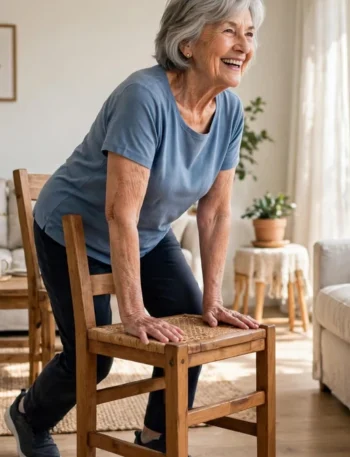
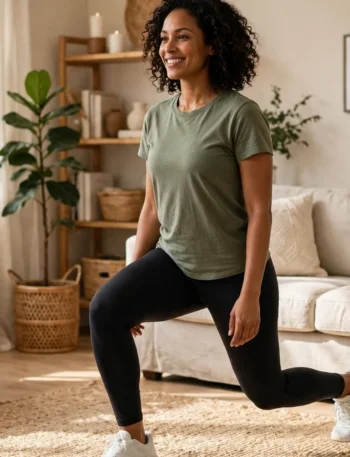
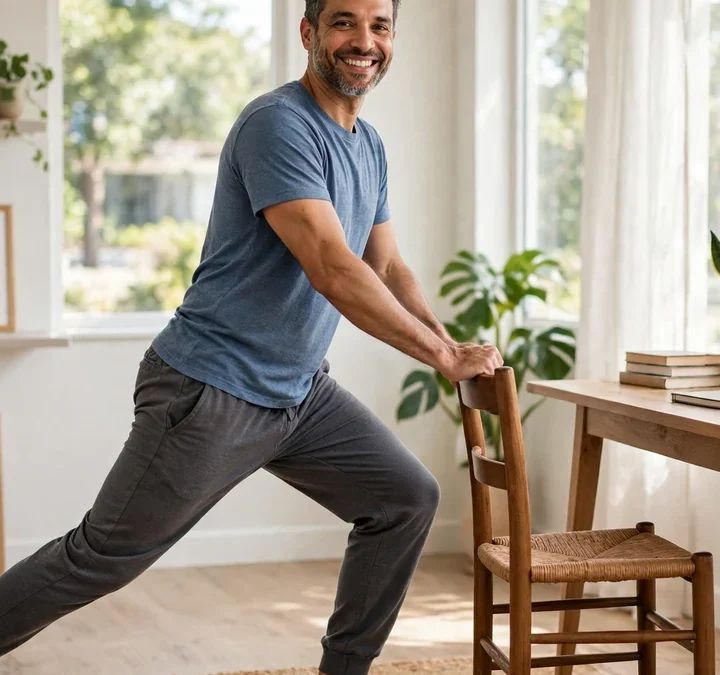
- Stand beside the chair for support and step one foot back about two feet, like a short lunge position.
- Bend both knees slightly, tuck your tailbone a little, and shift your weight forward until you feel a stretch at the front of the back hip.
- Hold, then switch sides.
Easier: Take a shorter step back and keep a hand on the chair the whole time.
Harder: Raise the arm on the same side as the back leg overhead and lean very slightly away.
Seated figure-four stretch
- Sit tall near the front of the chair with both feet flat.
- Cross one ankle over the opposite knee.
- Sit up straight and lean forward gently from your hips until you feel a stretch in the outer hip of the crossed leg.
- Hold, then switch sides.
Easier: Rest the crossed foot on the opposite shin instead of the knee.
Harder: Lean a little farther forward, keeping your back straight.
Supported bodyweight hip hinge
- Stand facing the chair back, about a foot away, holding it lightly, feet hip width apart.
- Push your hips backward as if closing a door behind you, keeping your back flat and knees slightly bent.
- When you feel the backs of your thighs engage, squeeze your glutes to stand back up.
Easier: Make the hinge smaller and keep a firm hold on the chair.
Harder: Let go of the chair once the pattern feels steady, keeping your hands hovering just above it.
Cool-down and stretching (3 minutes)
- Easy march in place (1 minute). Slow right down and let your breathing settle.
- Repeat the seated figure-four stretch (30 seconds each side). Most people find the second hold more comfortable than the first.
- Standing quad stretch (30 seconds each side). Hold the chair, bend one knee, and bring your heel toward your glute.
- Slow breathing (30 seconds). Breathe in for four counts and out for four counts, and notice how standing and walking feel now.
How to progress
Hip mobility responds well to short, frequent practice. A practical pattern is a 2-minute version on workdays and the full routine two or three times a week.
- Weeks 1 to 2: Do the full routine twice a week, using easier options freely, plus the warm-up moves on other days.
- Weeks 3 to 4: Add a third full session, and build toward the standard holds and reps.
- After that: Use the harder options on two or three moves, or repeat the main routine twice for a longer session.
Mobile hips also make walking and strength sessions easier, which helps you build toward the general weekly activity targets for adults.
Safety notes
Stop and rest if you feel pain, dizziness, nausea, or chest pain, and seek medical help right away for chest pain. Talk with your doctor before starting if you have been inactive or have a health condition. Mobility work should never involve forcing a joint; a pinch at the front of the hip is a signal to make the movement smaller or stop. Never exercise through sharp joint pain. Slow circles and lifts do more for your hips than fast, sloppy ones. Stand up slowly after the floor exercise and hold the chair until you feel steady.
Common mistakes
- Forcing range. Pushing into a pinch teaches your body to guard, not to loosen.
- Holding your breath during the stretches. Slow breathing helps the muscles let go.
- Leaning the whole torso during side leg lifts. Keep upright and let the hip do the work.
- Doing the routine once a month and expecting change. Little and often wins.
- Skipping the warm-up. A few minutes of marching makes every move easier and safer.
- Ignoring one-sided stiffness. Spend an extra few seconds on the tighter side, within comfort.
Pair it with a diet plan
If your hips are stiff from desk work, your meals probably happen at that desk too. Our 7-day meal plan for desk workers keeps weekday eating simple and planned. You can also estimate your daily calorie needs with the free Calorie Calculator.
Frequently asked questions
How often should I do hip mobility work?
A few minutes most days beats a long session once a week. Try the full routine two or three times a week, with the warm-up moves or a stretch or two on other days.
Why do my hips feel tighter on one side?
Most people favor one side when sitting, standing, and climbing stairs, so one hip often ends up stiffer. It is common and usually nothing to worry about. Give the tighter side a little extra time, and mention persistent one-sided pain to your doctor.
Can hip mobility work help my lower back feel better?
Stiff hips can make the lower back work harder during everyday movement, so loosening them often makes daily activities feel easier. This routine is general mobility work, not a treatment for back pain. For ongoing back pain, see your doctor or a physical therapist.
What if a stretch pinches at the front of my hip?
Come out of it and make the movement smaller, or change the angle slightly. A pinch is different from a stretch feeling, and pushing through it is not helpful. If it keeps happening, ask a physical therapist to check your form.
Do I need to get on the floor for this routine?
No. Only the glute bridge is written for the floor, and a seated alternative is given. Everything else is standing or seated, with support within reach.
Sources and further reading
- Flexibility and stretching information, MedlinePlus: medlineplus.gov
- Physical Activity Guidelines for Americans, US Department of Health and Human Services: health.gov
- Physical activity basics for adults, Centers for Disease Control and Prevention: cdc.gov
This article is for general educational purposes only and is not medical, nutrition, or fitness advice. Talk with your doctor or a registered dietitian before changing your diet or starting an exercise program.