Prints just the plan, like a recipe card.
Last updated: November 23, 2026.
Resistance bands are famous for leg workouts, but what about your arms, chest, back, and shoulders? If dumbbells are not an option right now, or you travel and need something that fits in a carry-on, a band can train your whole upper body in about 25 minutes, with no weights at all.
This workout uses one long resistance band with handles, or a flat therapy band. You will anchor it to a sturdy door for two moves, so check that your door closes firmly and the anchor point is solid. Every exercise has an easier option (less tension) and a harder one (more tension or a pause), which makes the band easy to adjust as you get stronger.
This workout sits in our Exercise and Workouts collection, along with its leg and glute companion workout. It pairs well with our 7-Day Meal Plan for Strength Training Beginners, and the rest of the library is in Diet Plans.
Key takeaways
- A single band can train chest, back, shoulders, and arms at home.
- Step closer to or farther from the anchor to change the difficulty.
- Slow returns matter with bands, because the tension is there the whole way back.
- Check your band for tears before every session, and never anchor it to anything that can move.
Who this workout is for, and who should check with a doctor first
This workout is for beginners who want upper body strength training without weights, including people who travel often or have limited storage. It is low impact and done standing or seated, which suits small spaces.
Check with your doctor before starting if you have been inactive for a long time, if you have a heart condition, shoulder or elbow problems, or a history of chest pain, or if you are pregnant or recovering from a recent surgery or injury. If you have a latex sensitivity, look for bands made from other materials, and ask your doctor about any shoulder movement that causes pain.
If you have a history of disordered eating, talk with a doctor or a registered dietitian before following any diet plan. For eating disorder support in the US, visit the National Alliance for Eating Disorders at allianceforeatingdisorders.com.
What you need
- One long resistance band with handles, or a flat therapy band (light to medium tension).
- A sturdy door that closes firmly, for anchored moves. A door anchor strap helps but is not required if your band instructions allow a closed-door anchor.
- A sturdy chair for one seated move.
- Comfortable clothes and a bottle of water.
Warm-up (5 minutes)
- March in place for 1 minute, swinging your arms.
- Roll your shoulders in slow circles, 8 forward and 8 backward.
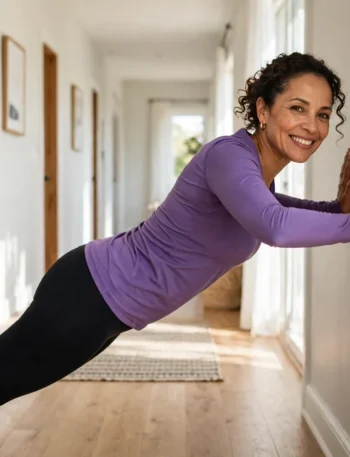
- Do 10 wall push-ups: hands on a wall, bend and straighten your elbows slowly.
- Hold the band lightly in both hands and do 10 gentle chest-opening pulls, only to a comfortable stretch.
- Finish with 8 slow arm circles each direction, small then larger.
The workout: band upper body circuit
Do the six exercises in order, then rest 1 to 2 minutes and repeat. Start with 2 rounds. To make any band move easier, step closer to the anchor or hold the band with more slack. To make it harder, step farther away or choke up on the band for more tension.
| Exercise | Reps | Rounds |
|---|---|---|
| Band chest press | 10 to 12 | 2 to 3 |
| Band row | 10 to 12 | 2 to 3 |
| Band overhead press | 8 to 10 | 2 to 3 |
| Band bicep curl | 10 to 12 | 2 to 3 |
| Band triceps pressdown | 10 to 12 | 2 to 3 |
| Band pull-apart | 10 to 12 | 2 to 3 |
Band chest press
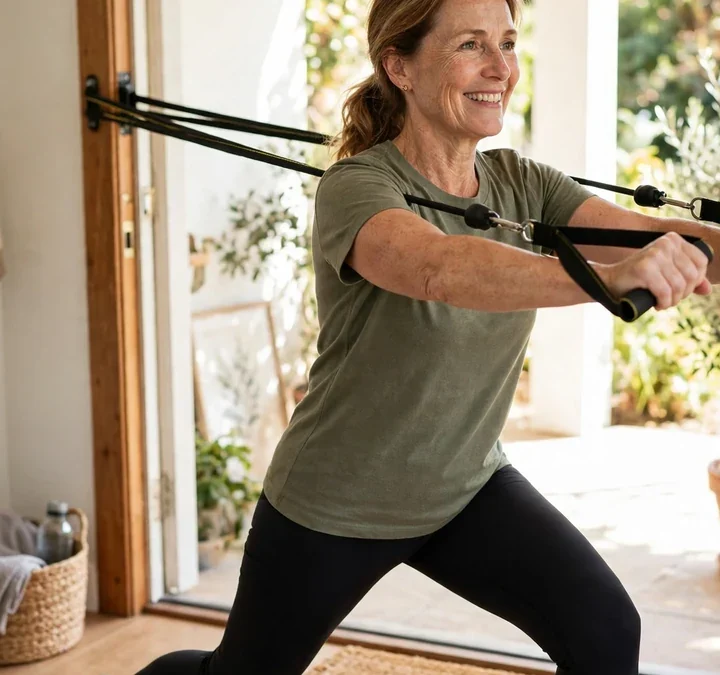
Anchor the band at chest height behind you in a closed door, or wrap it around your back under your shoulder blades. Hold a handle in each hand at chest level, step forward into a staggered stance, and press your hands forward until your arms are nearly straight. Return slowly. Do 10 to 12 reps.
Easier: Step closer to the door, or do wall push-ups instead.
Harder: Step farther forward for more tension, or pause 1 second with arms extended.
Band row
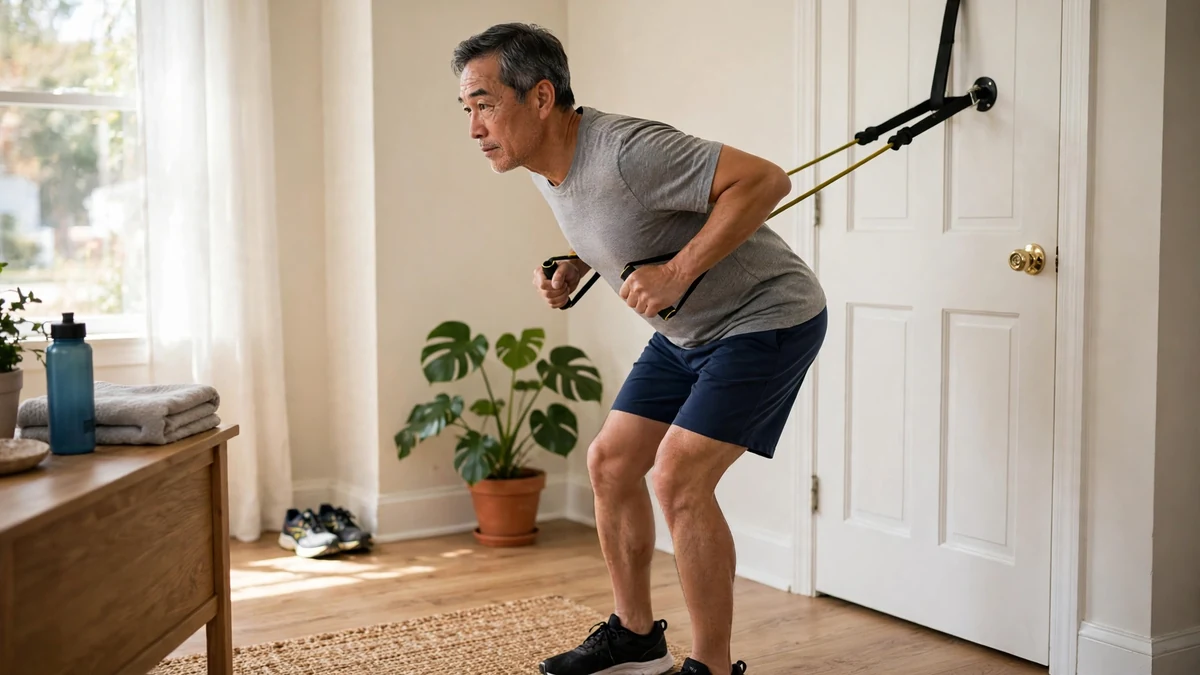
Anchor the band at waist height in front of you, or loop it around a sturdy post. Hold a handle in each hand, step back until the band is taut, hinge slightly forward with a flat back, and pull your elbows back toward your ribs, squeezing your shoulder blades. Return slowly. Do 10 to 12 reps.
Easier: Stand more upright and step closer to the anchor.
Harder: Step back for more tension, or row one arm at a time.
Band overhead press
Stand on the middle of the band with both feet, holding a handle in each hand at shoulder height. Press up until your arms are nearly straight overhead, keeping your ribs down and your core braced. Lower slowly. Do 8 to 10 reps. Skip the overhead position if it bothers your shoulders, and use the easier option.
Easier: Sit in a chair and press one arm at a time with less tension.
Harder: Stand with feet closer together on the band for more tension, or pause at the top.
Band bicep curl
Stand on the middle of the band, holding a handle in each hand, arms at your sides, palms forward. Keeping your elbows tucked at your ribs, curl your hands up toward your shoulders. Lower slowly to a count of 3. Do 10 to 12 reps.
Easier: Stand with one foot off the band, or curl one arm at a time.
Harder: Stand with feet wider on the band for more tension, or pause halfway down.
Band triceps pressdown
Anchor the band high in a closed door. Stand facing the door, holding the handles with elbows bent and tucked at your sides. Push your hands down until your arms are straight, keeping your elbows still. Return slowly. Do 10 to 12 reps.
Easier: Step closer to the door or use one arm at a time.
Harder: Step back for more tension, or slow the return to a count of 3.
Band pull-apart
Hold the band in front of your chest with both hands, arms straight, hands about shoulder-width apart on the band. Keeping your arms straight, pull your hands apart by squeezing your shoulder blades together, until the band lightly approaches your chest. Return slowly. Do 10 to 12 reps. This is a gentle posture move, so light tension is fine.
Easier: Hold the band wider for less tension.
Harder: Hold the band a little narrower, or pause 2 seconds at the open position.
Cool-down and stretching
- Shake your arms out gently and walk in place for 1 minute.
- Chest stretch in a doorway, 20 to 30 seconds per side.
- Shoulder stretch across the chest, 20 to 30 seconds per side.
- Triceps stretch: reach one hand down your back and guide the elbow gently with the other hand. Hold 20 to 30 seconds per side.
- Wrist and forearm stretch: extend one arm, gently press the fingers back, then down. Hold 15 to 20 seconds per side, and finish with slow breaths.
How to progress
Do this workout 2 or 3 times a week. In weeks 1 and 2, use 2 rounds and learn where to stand for the right tension. In weeks 3 and 4, add 2 reps per exercise. When the reps feel smooth, step farther from the anchor or use a stronger band for one move at a time. A third round is the next step after that. The Physical Activity Guidelines for Americans recommend muscle-strengthening activities on 2 or more days a week, and this session counts.
Safety notes
Stop and rest if you feel pain, dizziness, nausea, or chest pain, and seek medical help right away for chest pain. Talk with your doctor before starting if you have been inactive or have any health condition. Good form matters more than tension, so use the lightest setup that lets you move cleanly. Never exercise through sharp joint pain, especially in the shoulders and elbows. Anchor bands only to doors that latch firmly, stand to the side of the band’s path, and inspect the band for cracks before each use so it cannot snap toward your face.
Common mistakes
- Letting the band snap back instead of controlling the return.
- Standing so far away that your form breaks down under too much tension.
- Shrugging your shoulders up during presses and curls. Keep them down and back.
- Holding your breath on hard reps.
- Anchoring the band to furniture that can slide or tip.
Pair it with a diet plan
Upper body days feel better with a steady week of meals behind them. The 7-Day Meal Plan for Strength Training Beginners was built for people starting exactly this kind of routine. Use the Calorie Calculator to estimate your needs before you pick a calorie level.
Frequently asked questions
Can bands really build upper body strength?
Yes. Your muscles respond to tension and effort, and a band provides both. The key is choosing a tension that makes the last few reps feel challenging while your form stays clean.
What if I do not have a door anchor?
Most moves have an anchor-free version: wrap the band around your back for presses, stand on it for curls and presses, and hold it in both hands for pull-aparts. For rows, a sturdy stair rail or post works if it cannot move.
My shoulders click during the overhead press. Is that okay?
Clicking without pain is common, but pain is a stop sign. Try the seated one-arm version with less tension, or replace the press with extra pull-aparts, and mention it to your doctor if it keeps happening.
How do I know which band tension to use?
If you can finish the reps with good form and feel you could do 1 or 2 more, the tension is about right. If your form breaks down early, step closer or use a lighter band.
Can I combine this with the band leg workout?
Yes. Many readers do the upper body workout and the leg and glute workout on different days, which gives each muscle group rest while you train 3 or 4 days a week.
Sources and further reading
- Physical Activity Guidelines for Americans, US Department of Health and Human Services: health.gov
- American Heart Association, strength and resistance training basics: heart.org
- CDC, physical activity basics for adults: cdc.gov
This article is for general educational purposes only and is not medical, nutrition, or fitness advice. Talk with your doctor or a registered dietitian before changing your diet or starting an exercise program.